
Zero-Dust Cleanroom Case Formers for Pharma (Up to 40 CPM, Double-Head, 200-500 gsm) | ZRAY
Pharmaceutical packaging lines live under rules most corrugated plants never see. GMP guidelines and ISO 14644 cleanroom classifications limit airborne particles, and a case erector is, by default, a dust generator: it feeds corrugated blanks with cut edges, folds them, and in the process sheds fiber dust into the air you are trying to keep clean. The answer is not a bigger vacuum cleaner bolted to the side. It is a machine designed around dust control from the blank magazine to the discharge conveyor. This article covers how ZRAY achieves zero-dust cleanroom operation on high-speed pharma case forming, what to specify for ISO Class 7/8 environments, and the engineering details inspectors will actually check.
Where the Dust Comes From
Before you can remove dust, you need to know where it is produced. On a case former running 30-40 CPM, every cycle generates particles.
- Cut-edge fiber. Corrugated blanks arrive with exposed flute tips on every cut edge. Every fold, every vacuum pull, every contact with the forming platen releases a small burst of fiber.
- Crease dust. Score lines made on dirty dies carry crushed fiber and ink residue. When the blank folds, that residue separates and becomes airborne.
- Print residue. Flexo-printed liners shed ink dust, especially water-based inks on recycled board.
- Hopper friction. Blanks sliding against each other in the hopper abrade the liners, which is why the first 30 seconds of a run produce the worst dust spike.
- Vacuum exhaust. The most overlooked source: the vacuum pump exhausts air back into the room, carrying whatever it pulled off the blanks.
Board Grades for Pharma Cases
Pharma shippers are usually smaller, cleaner blanks than beverage or appliance cases, but they still follow standard corrugated specs. We routinely form these grades in cleanroom configurations.
| Flute | Caliper | Basis weight | Pharma use case |
|---|---|---|---|
| E flute | 1.5-1.8 mm | 200-350 gsm | secondary packaging cartons, narrow cases |
| B flute | 2.5-3.0 mm | 250-400 gsm | standard pharma shippers, single-wall default |
| C flute | 3.5-4.0 mm | 300-450 gsm | larger shippers needing stacking strength |
| EB flute | 4.5-5.5 mm | 300-500 gsm | premium double-wall look, reduced blank weight |
| BC flute | 6.0-7.0 mm | 400-500+ gsm | export shippers, cold-chain pharma transport |
For cleanroom duty we add two material requirements on top of the board spec: no wax or siliconized coatings on the liner (they foul vacuum cups and smoke at glue temperature), and low-dust die cutting from your blank supplier. A cleanly cut blank cuts your dedusting load in half before the machine starts.
How ZRAY Builds Zero-Dust Operation
A cleanroom case former is not a standard machine with a filter added. These are the design points that make the difference.
1. Enclosed forming chamber. The blank magazine, pickup, and forming area sit inside a sealed chamber with negative pressure. Dust generated during folding is drawn into the extraction duct instead of the room. The discharge conveyor is the only opening, and it is covered by an air curtain.
2. Two-stage dedusting. The first stage is a brush-and-suction station at the magazine outlet that sweeps both blank faces. The second stage is a high-flow extraction around the folding zone that captures the burst released at the moment of folding. Combined, the two stages remove the cut-edge and crease dust before it becomes airborne.
3. HEPA-filtered air handling. Extraction air passes through a pre-filter and a HEPA filter before any of it returns to the room. In an ISO Class 7 environment this keeps the machine’s own contribution below the class limit. The filter housing is sized for easy quarterly replacement, because a loaded filter silently raises particle counts.
4. Vacuum exhaust rerouted. The vacuum pump’s exhaust is ducted out of the cleanroom or through the same HEPA bank. This is the detail most suppliers miss, and it is the difference between a machine that looks clean and one that measures clean.
5. Food-grade stainless contact surfaces. The forming platen, guides, and discharge area are stainless steel with radiused edges. No painted panels flake, no cast corners collect fiber. Wipe-down is a 10-minute validated sanitation step, not a degreasing project.
6. Positive-pressure guarding where needed. In ISO Class 7, the operator side is kept clean by slightly positive air pressure relative to the machine interior, so dust stays inside the extraction path rather than drifting toward the operator. In Class 8 zones the negative-pressure chamber alone is usually sufficient.
Technical Specifications: ZRAY Pharma Cleanroom Case Former
| Parameter | Value |
|---|---|
| Rated speed | 20-40 CPM (double-head configuration) |
| Box length (L) | 180-500 mm |
| Box width (W) | 150-400 mm |
| Box height (H) | 100-450 mm |
| Board grade | E/B/C/EB/BC flute; 200-500 gsm |
| Cleanroom compatibility | ISO Class 7/8; GMP-packaging compliant design |
| Dedusting | Two-stage brush + extraction; HEPA-filtered air return |
| Air pressure | 0.5-0.7 MPa |
| Compressed air | approx. 400-550 L/min at 40 CPM |
| Electrical | 220/380 V, 50/60 Hz |
| Power consumption | approx. 2.5-3.5 kW running |
| Changeover time | 5-8 min per size (stored recipes) |
| Validation documentation | FAT protocol, IQ/OQ support documents |
PLC Alarms and Troubleshooting
AL-11 Dust Sensor / Filter Clog Warning
- Check the differential pressure across the HEPA bank. Above the datasheet limit, replace the filter, not later, because particle counts rise before the alarm threshold.
- Verify the extraction fan is at rated speed; a slipping belt drops airflow without stopping the machine.
- Check the pre-filter; if it loads in less than a month, the blank supplier’s cutting quality is the root cause.
- After filter replacement, reset the alarm and run a particle-count verification shift before revalidating.
AL-03 Vacuum Low
- Confirm pump running and manifold gauge at setpoint (-0.04 to -0.06 MPa).
- Check cups for wear; cleanroom blanks are printed and coated, which wears cups faster than plain kraft.
- Verify the blank recipe matches actual size; over- or undersized blanks shift the cup pattern off the liner.
- If the alarm recurs, inspect the vacuum solenoid and the extraction interlock; on cleanroom machines the vacuum and extraction are interlocked by design.
AL-05 Box Not Formed
- Inspect the blank for weak scores; cleanroom blanks with heavy printing lose crease definition.
- Lower the forming force in the recipe by 10-15% and re-run a single cycle.
- Check hopper brake tension; high brake pressure warps printed blanks on pickup.
- Verify the glue temperature is within the adhesive datasheet range if the machine uses hot-melt bottom sealing.
Maintenance Schedule for Cleanroom Duty
Cleanroom machines get validated, so maintenance must be predictable and documented. This schedule matches a 2-shift pharmaceutical line.
| Interval | Task |
|---|---|
| Daily | Perform validated wipe-down of contact surfaces; check extraction airflow indicator; record particle-count spot check; drain air system condensate |
| Weekly | Clean both dedusting brush stations; inspect HEPA pre-filter visually; verify vacuum gauge and cup condition; log PLC alarm history |
| Monthly | Replace HEPA pre-filter; check extraction fan belt tension and current draw; clean vacuum solenoid filters; verify glue head cleanliness if fitted |
| Quarterly | Replace HEPA filter and validate the housing seal; full leak test of pneumatic circuit; recalibrate pressure sensors; re-verify recipe setpoints |
| Semi-annual | Full dedusting system overhaul; replace all vacuum cups and seals; particle-count revalidation of the machine’s cleanroom contribution; mechanical alignment check |
Changeover and Sanitation Protocol
A cleanroom machine earns its classification during changeovers, not during steady running. The protocol we ship with every pharma case former covers the three moments when contamination risk is highest.
- Between batches. A 15-minute standard changeover routine: stop the line, wipe all contact surfaces with validated agent, run one empty cycle, and verify the extraction indicator before the new size starts. Recipe-based changeover means no tools and no exposed adjustment points to trap fiber.
- Between products. If the previous product was dusty recycled board and the next is a sterile-adjacent pharmaceutical shipper, the protocol adds a HEPA pre-filter replacement and a particle-count spot check before the first case of the new product runs. This is not optional in a GMP audit.
- After maintenance. Any work on the forming chamber or extraction duct triggers a re-clean and a one-hour particle-count verification run before the machine returns to validated production. The log records the filter change, the cleaning agent batch, and the measured particle counts.
Our FAT protocol covers all three scenarios with your blanks and your cleaning agents, so the machine arrives validated for the way you actually work, not for the way the datasheet imagines you work.
Which Machine for Your Pharma Line
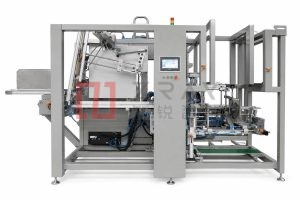
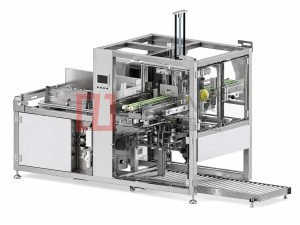
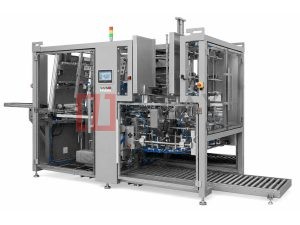
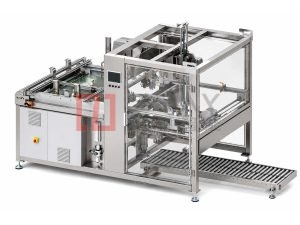
For high-volume pharma packaging lines running 20-40 CPM with double-head speed requirements, the Double-Head High-Speed Case Former is the machine that carries the cleanroom package without sacrificing throughput. For smaller production batches, single-head lines, or sterile-adjacent rooms where floor space is the constraint, the Single-Piece Case Erector can be built with the same enclosed chamber and HEPA air handling. Either way, we will run a FAT with your actual pharma blanks, on video, with particle-count data from the trial included in the acceptance record.
Get a Cleanroom Case Former Quote
Send your box dimensions, board grade, cleanroom class (ISO 7 or 8), line speed, and the glue or tape preference. We will confirm the correct model, the dedusting and HEPA package, a 45-day delivery schedule, and pricing with CE/EAC compliance.
- Email: [email protected]
- WhatsApp: +86 13681839278
- Inquiry form: https://www.cartonerecting.com/en/contact/
Our sales engineers reply within 24 working hours, usually with a technical datasheet attached.
Want To Know More About Our Upgraded Machines?
Send your carton specifications and output demand, our engineer will provide free technical scheme & quotation
Latest Products
Subscribe To Get Latest News & Technical Guides
Leave your business email to receive free industry articles and new product updates