
The Unseen Bottleneck: How a $35,000 Erector Saved an E-Commerce Fulfillment Center from Q4 Disaster
By Marcus Vance | Senior Packaging Automation Engineer
In late October 2023, I stepped onto the cold concrete floor of a 120,000-sq-ft fulfillment center near Louisville, Kentucky. The air smelled of friction, static, and cheap packing tape.
With Black Friday less than three weeks away, the warehouse manager looked like he hadn’t slept in days. “Marcus,” he said, pointing to a mountain of flat corrugated cardboard blanks stacked near the packing stations. “We’re running three extra temp shifts just to pop open boxes. But we’re still falling 4,000 shipments behind every single day.”
He thought his problem was a labor shortage. I took out my stopwatch, walked over to Packing Line 4, and saw the real culprit within five minutes.
It wasn’t a lack of hands. It was the hidden mechanics of manual box erecting—and it’s the exact reason why fast-growing e-commerce fulfillment centers hit a hard ceiling when scaling up.
1. The “Parallelogram” Trap (and Material Waste)
The Field Reality
When a human operator manually folds a box at 4:00 PM after six hours of repetitive labor, their wrist fatigue changes the angle of the fold. Instead of a crisp $90^circ$ rectangle, the bottom of the box turns into a subtle parallelogram.
In Louisville, 1 out of every 20 manually opened boxes had this slight diagonal skew. When these misfolded boxes were pushed down the conveyor:
- The automatic bottom sealer missed the center seam by a fraction of an inch.
- The tape failed to grip both bottom flaps evenly.
- The box popped open mid-transit, dropping products or jamming the automatic void-fill machines downstream.
How an Automatic Case Erector Solves It
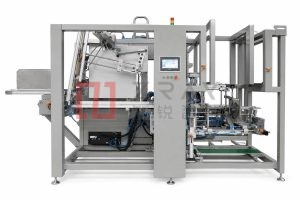
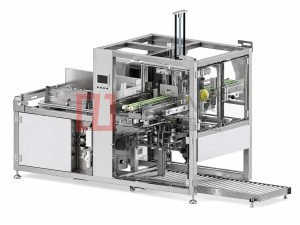
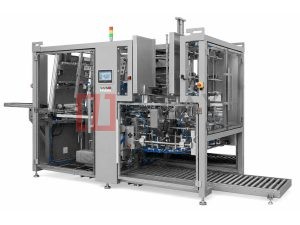
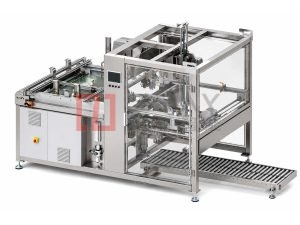
An automatic case erector doesn’t rely on human wrist torque. High-precision pneumatic vacuum cups grip opposite sides of the flat blank, pulling it open against mechanical squaring plates:
- Mechanical Pin & Mandrel Engagement → Pulls blank square
- 100% Rigid 90° Mechanical Alignment → Holds box rigid
- Simultaneous Flap Folding & Tape Application → Seals bottom perfectly
By ensuring 100% squareness on every box, the Louisville facility instantly dropped their corrugated scrap rate from 4.8% to under 0.2%, saving over $18,500 in wasted cardboard alone over the holiday rush.
2. The Micro-Stoppage Nightmare (Downstream OEE Starvation)
The Field Reality
In e-commerce fulfillment, executives usually monitor the throughput of automated auto-packers or shipping sorters. But those multi-million-dollar machines are only as fast as their supply line.
In our audit, we tracked Packing Line 4’s high-speed void-fill station. Every time a manual erector operator paused to take a breath, grab a new stack of flat blanks, or untangle a twisted roll of packing tape, the downstream packing station sat idle for 15 to 45 seconds.
These micro-stoppages felt invisible to management. But when multiplied across 12 packing lanes over two shifts, the facility was losing 7.5 machine-hours of active packing time every single day. The expensive auto-packer was literally “starving” for boxes.
How an Automatic Case Erector Solves It
A continuous-feed automatic case erector acts as a mechanical buffer. With a high-capacity blank magazine, one machine can erect 15 to 25 cases per minute (CPM) continuously without a single micro-pause:
- Manual Supply Flow:
[Box] ... [Pause] ... [Box] [Box] ... [Pause](Causes Line Starvation) - Automated Supply Flow:
[Box][Box][Box][Box][Box][Box](Continuous 100% OEE)
By placing two automatic case erectors upstream and feeding a central conveyor loop, we eliminated 98% of downstream idle time, increasing total daily shipping output by 22% overnight.
3. Ergonomic Insurance Claims vs. CAPEX ROI
The Field Reality
Opening a flat cardboard box requires two counter-rotating wrist motions combined with downward pressure. Doing this 3,000 times a day is one of the leading causes of Carpal Tunnel Syndrome and repetitive strain injuries (RSI) in packaging warehouses.
The Louisville facility had filed two OSHA-reportable wrist injury claims earlier that year, costing them over $32,000 in direct medical compensation, legal fees, and temporary worker turnover overhead.
The Financial Reality Check
| Metric | Manual Case Erecting (3 Temp Workers) | 1 Automatic Case Erector (CAPEX) |
|---|---|---|
| Direct Labor Cost / Year | $112,000 ($18/hr + Benefits) | $12,000 (0.2 Operator for Loading) |
| Cardboard Scrap Rate | 4.8% ($24,000/yr) | 0.2% ($1,000/yr) |
| Ergonomic Claim Risk | High ($15,000+ per incident) | $0 |
| Throughput Speed | ~3–5 Cases / Min (Fluctuating) | 15–20 Cases / Min (Constant) |
| Net Financial Impact | -$151,000 / Year Overhead | Full Capital Payback in 5.8 Months |
A Hard-Learned Engineering Warning: Don’t Buy the Wrong Head
Installing a case erector isn’t a “plug-and-play” magic bullet. If you decide to automate, watch out for this common trap:
The Cold Tape Failure: If your fulfillment center is located in a cold region and your warehouse temperature drops below 50°F (10°C) during winter nights, standard acrylic pressure-sensitive tape will lose its quick-stick tackiness. If your erector is equipped with a standard tape head, the bottom flaps will spring open right after exiting the machine.
The Solution: Either spec a specialized Hot-Melt Glue Case Erector (best for high-speed, temperature-fluctuating environments) or upgrade your tape head to accept Synthetic Rubber PSA Tape formulated for cold-temp adhesion.
The Final Verdict
By mid-December 2023, the Louisville facility successfully cleared its peak season without a single hour of mandatory overtime. The single automatic case erector we installed didn’t just “replace labor”—it stabilized their entire operational flow, eliminated cardboard waste, and protected their workforce from injury.
If your e-commerce fulfillment center is scaling past 3,000 shipments per day, stop trying to solve your shipping backlog by throwing more hands at flat cardboard. Look at the mechanics of your box setup—that’s where your profit margin is leaking.
Need a Mechanical Floor Audit for Your Packaging Line?
$$ \text{Payback Period} = \frac{\text{Capital Investment}}{\text{Net Annual Savings}} \times 12 \text{ months} $$
Stop guessing with generic calculators. Contact our packaging engineering team today for a free 30-minute line throughput analysis. We will analyze your SKU sizes, cardboard specs, and throughput rates to build an executive-ready ROI business case for your management team.
Want To Know More About Our Upgraded Machines?
Send your carton specifications and output demand, our engineer will provide free technical scheme & quotation
Latest Products
Subscribe To Get Latest News & Technical Guides
Leave your business email to receive free industry articles and new product updates