
Medical Device Master Case Erecting and Sealing: Cleanroom Compliance at ISO Class 7 and 8
A master case station in a medical device plant is not a packaging station. It is the last controlled step before a sterile barrier system becomes a shipping unit, and it sits inside a validation envelope that most general industrial erectors were never designed to enter.
The machine must erect and seal a case without generating particles, without introducing a lubricant or adhesive migration risk, without compromising the sterile barrier, and while producing a record that survives an audit three years later. Those requirements change the specification far more than the speed requirement does.
The Short Answer
Erecting and sealing inside ISO Class 7 or 8 is achievable with a standard case erector only if four things are specified from the start: cleanroom-rated materials and lubrication, direct vacuum extraction at the dust-generating points, a sealing method with documented migration data, and an equipment qualification package.
Board choice matters as much as the machine. A double-wall BC-flute case at 7.0 mm with a moisture content of 6 to 8 per cent sheds far less fibre than a single-wall kraft board, and the sealing method must be compatible with whichever surface treatment the sterile barrier supplier has qualified.
Speed is secondary. A cleanroom master case station typically runs 8 to 15 cases per minute, and the reason is not technology but the audit trail that wraps around every change.
What “Cleanroom Compliant” Actually Requires of the Machine
The first requirement is particle generation. Corrugated board shedding is unavoidable, so the engineering response is containment rather than elimination: local extraction at the magazine, at the blank pick point, and at the flap folding station, sized so that the air velocity at the capture point holds entrained fibre. A typical configuration draws 200 to 400 cubic metres per hour through HEPA-filtered extraction on each of the two or three capture points.
The second requirement is lubricant control. Standard machine lubrication used on a general industrial erector — particularly open-chain lubricants and general-purpose grease — is unacceptable in a controlled area because it migrates. Cleanroom machines use PFPE or NSF H1 food-grade lubricants, sealed-for-life bearings where possible, and a lubrication schedule that is documented rather than assumed. This is the single most common gap in a machine relocated from a general plant into a cleanroom: the mechanical logic is fine, but the lubrication is not.
The third is surface finish and cleanability. Flat surfaces, no horizontal ledges that collect dust, stainless or powder-coated frames, and an enclosure that can be wiped down. A machine with exposed black-oxide fasteners and open gear trains cannot be cleaned to a validated standard however often the operator wipes it.
The fourth is material documentation. Every polymer in the machine that could touch the case — suction cups, belt surfaces, guide strips — needs a USP Class VI or equivalent biocompatibility statement, because the case contacts a product that will contact a patient.
Sealing Method and the Migration Question
The sealing method is where medical device packaging most often departs from general industrial practice.
Hot-melt adhesive is the default for speed and strength. In a cleanroom context the specification question is not whether it bonds but whether it migrates. Adhesives used here should carry documented migration data against the applicable regulatory framework, and the application temperature should be held tightly because thermal degradation of adhesive produces both odour and volatiles — a genuine contamination pathway.
For EVA-based adhesives the practical window is 150 to 180 °C at the nozzle, with the tank held slightly lower. Exceeding 185 °C is where degradation products begin to appear, and this is exactly the condition that triggers the alarm below.
Tape sealing avoids the adhesive migration question entirely but introduces its own. The tape’s adhesive must be validated for contact with the outer surface of the sterile barrier in the intended configuration, and the tape carrier sheds less fibre if it is paper-based rather than a coated film that can fracture. Where the sterile barrier is a Tyvek or film pouch inside the case, tape on the case itself is generally the lower-risk choice.
Cold glue or water-based systems are sometimes used in temperature-sensitive applications but introduce moisture into a controlled environment, and the drying curve is slower than the case rate unless the station is lengthened.
The decision should be made with the sterile barrier supplier, not by the machine builder alone. It is a validation decision rather than an engineering preference.
Board Specification for Master Cases
| Parameter | Recommended range | Note |
|---|---|---|
| Construction | Double-wall BC or AB | Higher edge crush, less flexing in the folder |
| Thickness | 7.0 mm (BC) to 8.0 mm (AB) | Thin single wall flexes and mis-folds |
| Moisture content | 6 – 8 per cent | Below 6 per cent causes cracking, above 9 per cent weakens glue bond |
| Surface paper grammage | 150 g/m² minimum | Below this the liner tears at the score |
| Glue consumption | 1.4 – 2.0 g per case | Two lines, 6 – 10 mm from the score |
| Compression dwell | 2.5 – 4.0 s | Longer than a general-line station |
The moisture content figure deserves emphasis. Board that has been stored in a dry, conditioned warehouse can drop below 5 per cent, and at that point the liner cracks along the score line when the flaps fold. The machine is blamed, the board supplier is called, and the actual cause is a storage condition that changed when the air conditioning schedule changed. A moisture meter at goods-in is a validation instrument, not a convenience. Common board and blank questions are collected in our FAQ.
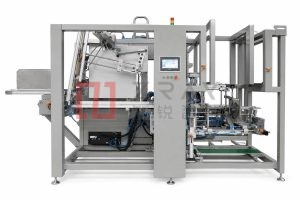
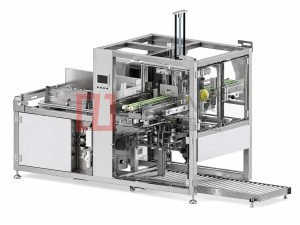
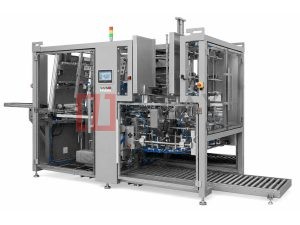
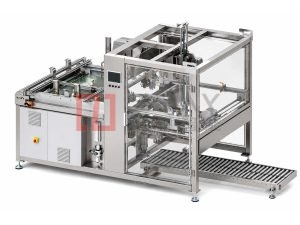
Machine configuration follows the volume profile rather than the cleanroom class. A plant running one master case size at high volume is best served by a dedicated Single-Piece Carton Erector configured for that format, because the format is fixed and the cycle can be optimised around it. A plant running two or three master case sizes across multiple product lines should look at the Double-Head High-Speed Case Former, which keeps the case rate high enough to absorb the changeover time inside a validated schedule. Where the master case is a heavy-duty construction with a separate body and lid, the Three-Piece Carton Erector covers the forming sequence that a standard RSC machine cannot.
Qualification: Where the Project Time Actually Goes
The machine qualification package follows the standard three-stage structure, and each stage has a specific purpose in an audit.
Installation Qualification (IQ) documents that the machine was delivered, installed and configured as specified — utilities, extraction flow rates, lubrication type, spare parts list, and calibration certificates for any instrumented parameter such as temperature controllers and pressure gauges.
Operational Qualification (OQ) demonstrates that the machine performs across its stated operating range, including the extremes. It is not enough to prove the machine runs at nominal speed on nominal board. OQ should include worst-case runs at minimum and maximum case size, at minimum and maximum board moisture, and at the low end of the glue temperature window. These are the conditions where a cleanroom erector fails an audit — not at nominal.
Performance Qualification (PQ) runs production-representative batches and confirms that the output meets the specification consistently, normally across three consecutive runs, with squareness, seal integrity and case count recorded.
Two details commonly missed. First, change control: the qualification is against a fixed configuration, so replacing a suction cup with a non-identical part is a change that may require re-qualification. Second, alarm response is part of the validation: operators must be trained on the alarms below, and the training must be documented.
Alarm Handling in a Controlled Area
| Alarm | Meaning | First three checks |
|---|---|---|
E-12 Vacuum Low |
Pick-up vacuum below setpoint | Cup condition, filter loading, extraction balance |
E-21 Glue Head Overtemp |
Nozzle or tank above 185 °C | Thermocouple, PID setpoint, glue circulation |
E-41 Flap Detect Missing |
Flap not detected in position | Sensor lens contamination, flap fold, board moisture |
E-46 Extraction Flow Low |
Extraction below validated minimum | Filter differential pressure, fan belt, duct blockage |
E-46 Extraction Flow Low is the alarm that a general industrial machine does not have and that a cleanroom installation cannot function without. When it appears, the corrective action is documented — filter change, flow verification, and a note in the batch record. Treating it as a nuisance alarm is exactly the pattern an audit is designed to find.
Similarly, E-41 Flap Detect Missing in a controlled area is often a sensor-lens contamination fault rather than a mechanical one, because the same fibre that extraction is meant to capture settles on optical surfaces. Cleaning the lens is the first check, but the recurrence rate is the real information: if it repeats weekly, extraction at the folding station is undersized.
Cleaning and Maintenance Rhythm
Every shift — wipe down external surfaces with the validated cleaning agent, verify the extraction indicator shows green, check the magazine for board dust accumulation, and confirm the glue nozzle has no charred residue.
Every week — clean optical sensor lenses with the approved method, inspect suction cups for glazing and cracking, verify glue line position against the reference drawing, and check the extraction filter differential pressure.
Every month — verify glue temperature across the full working range with an external thermometer rather than the machine’s own reading, inspect sealed bearings for free rotation, and confirm that board moisture at goods-in is still inside the specified band.
Every quarter — replace extraction filter elements, re-baseline squareness across the case size range, review alarm logs for repeat events and document any corrective action, and verify that the lubrication actually used matches the qualified type.
Annually — full re-calibration of temperature and vacuum instrumentation, review of the change control record against the physical machine, requalification of the seal integrity test if any part of the sealing system has changed, and a documented review of extraction performance against the original validation report.
FAQ
Can a standard case erector be used in a cleanroom?
Mechanically yes, but it must be re-specified: cleanroom lubricants, sealed bearings, extraction at three points, documented polymer materials, and a validated cleaning procedure. A machine moved into a cleanroom without those changes will produce a qualification finding rather than a pass.
Is hot-melt adhesive allowed in a cleanroom?
Yes, provided the specific adhesive carries the required migration documentation and the application temperature is controlled. Adhesive degradation above roughly 185 °C is the contamination risk to manage.
How long does qualification take?
The machine build is usually shorter than the qualification. Budget for IQ, OQ and PQ as a project phase of its own, with worst-case runs included — the OQ is where the schedule is usually lost.
What case rate is realistic?
Cleanroom master case stations commonly run 8 to 15 cases per minute. The limit is usually the validation and extraction design around the machine rather than the machine’s own cycle.
Specifying a master case station for a controlled environment? Send your ISO class, case dimensions, sterile barrier configuration and required CPM to [email protected] or WhatsApp +86 13681839278. Our engineers will return a cleanroom specification sheet, an extraction sizing calculation and a qualification document list within 24 hours.
Want To Know More About Our Upgraded Machines?
Send your carton specifications and output demand, our engineer will provide free technical scheme & quotation
Latest Products
Subscribe To Get Latest News & Technical Guides
Leave your business email to receive free industry articles and new product updates