
Heavy-Duty Case Formers for 50 lb (23 kg) Freight: Preventing Bottom Drop-Outs on Double-Wall Board
A case that fails at the bottom does not fail gently. A 50 lb (23 kg) load dropping through an open bottom flap spills its contents onto the loading dock, and if it happens during parcel handling the claim lands on your account along with the return freight.
Bottom drop-out is almost never a tape or glue brand problem. In our service work it is a geometry and dwell-time problem: the seal was formed on a machine configured for light single-wall board, and it is being asked to hold a load that generates forces the seal was never designed for.
This article covers what changes above roughly 20 kg, the double-wall specifications that actually hold, the four adjustments that eliminate drop-out in practice, and the test protocol that proves it before your customer does.
The Short Answer
For freight at or above 50 lb / 23 kg in a regular slotted case, the bottom seal is a structural joint, not a closure. Three conditions must be met at the same time: double-wall board at BC (7.0 mm) or AB (8.0–9.0 mm), glue grammage raised to 1.4 to 2.2 g per case, and compression dwell extended to 3 to 5 seconds at the moment of sealing.
Miss any one of them and the failure mode is predictable. Too little glue and the flap lifts under load. Correct glue but insufficient dwell and the seal skins over without wetting the board. Correct glue and dwell on single-wall board and the board itself delaminates at the fold line, because the liner tears before the adhesive does.
The fourth variable, and the one most frequently ignored, is glue line placement. A bead placed 6 to 10 mm from the fold line distributes load into the panel; a bead placed closer than 5 mm concentrates it exactly where the board is weakest after folding.
Why 23 kg Changes the Engineering
A 23 kg payload does not simply sit in the case. During palletising, fork truck handling, and parcel conveyor transitions, the bottom seal sees dynamic loads several times the static weight, plus lateral shear every time the case is pushed across a surface.
On an 0201 regular slotted case of typical footprint, that translates into a peel and shear load on the bottom flaps that a single-wall B-flute board cannot reliably resist over a multi-leg journey. The board’s edge crush and the compression strength of the folded corner both fall below what the joint needs.
There is a second, less obvious effect: the heavier the load, the more the bottom panels bow outward under sustained stacking pressure. A bowed panel changes the peel angle at the glue line from shear-dominated to peel-dominated, and peel is the weakest mode an adhesive joint can face. This is why a case can sit in a warehouse for three months without issue and then split in the first ten minutes of a conveyor run.
Double-Wall Board: What Actually Holds
The working envelope we size machines against for heavy freight is shown below. Values are for a bottom seal only, FEFCO 0201.
| Board | Nominal thickness | Glue grammage (bottom) | Open time | Compression dwell |
|---|---|---|---|---|
| B-flute single wall | 3.2 mm | 0.7 – 1.0 g | 1.2 – 1.8 s | 2.0 – 3.0 s |
| C-flute single wall | 4.0 mm | 0.9 – 1.2 g | 1.5 – 2.2 s | 2.5 – 3.5 s |
| BC double wall | 7.0 mm | 1.4 – 1.8 g | 2.5 – 3.5 s | 3.0 – 4.5 s |
| AB double wall | 8.0 – 9.0 mm | 1.6 – 2.2 g | 3.0 – 4.0 s | 4.0 – 5.0 s |
Two specification notes matter as much as the table. The liner should be at least 150 g/m² on the outer face, because below that figure the adhesive strike-through weakens the very panel it is bonding. And the flute direction must run vertically on the case walls for stacking strength — known as a vertical flute RSC. A horizontally fluted case of the same board grade loses a large fraction of its stacking capacity regardless of how well it is glued.
The Four Adjustments That Eliminate Drop-Out
Raise glue grammage, do not raise temperature. The instinct when a seal fails is to run the glue hotter. Above about 180 °C with a standard EVA formulation the adhesive begins to degrade, loses tack, and carbonises in the nozzle. The correct response is more glue at the same temperature, delivered as a double bead rather than a single heavier one.
Extend the compression section, not the cycle time. Dwell is what allows the adhesive to wet the board. Adding dwell by slowing the machine is expensive; adding it by lengthening the compression rails is not. On a machine running 30 CPM, extending the compression section by 400 mm buys roughly 0.8 seconds of dwell at no cost in throughput.
Position the bead 6 to 10 mm from the fold line. Measure it. A bead too close the fold sits on crushed board with degraded bonding area; a bead too far inboard leaves the outer panel edge free to lift under peel.
Control the board, not just the machine. Heavy cases punish board moisture more than light ones. Keep incoming double-wall stock between 6 and 9 per cent moisture, store it flat on dunnage, and allow 24 hours of stabilisation in the production area before running. Board at 12 per cent moisture will form and seal acceptably and then fail mechanically in a dry container.
Proving It: Drop and Compression Testing
Do not accept a seal as adequate because it looks correct. Two tests settle the question.
For transit performance, follow ISTA 3A for parcel delivery or ASTM D4169 for distribution cycle testing. In practice for heavy loads, the decisive test is a free-fall drop of the loaded case onto a rigid floor, flat on the bottom face, from the height specified by the carrier — commonly 600 mm for the weight band around 23 kg, followed by repeat drops on each bottom edge and corner. Acceptance criterion is straightforward: no loss of contents and no separation of the bottom seal beyond 5 mm.
For stacking, apply a compression test at the load the case will actually carry in a stack of eight, sustained for 24 hours at 40 °C and 75 per cent relative humidity. This is a harsher condition than the nominal specification and it is the one that predicts what happens in a summer container.
Where the freight is valuable or the journey is multi-leg, test the finished pallet rather than the single case. Cases that pass individually can still fail when a pallet is stacked and the bottom layer experiences the combined load.
Configuring the Machine
Machine configuration matters more than catalogue specifications suggest. For heavy double-wall work, the picking head should be fitted with a larger number of smaller cups rather than four large ones, because a stiff AB blank will not conform to a large cup face and the vacuum seal breaks at the corners first. The bottom support rails should run the full length of the compression section so that no part of the glued flap is unsupported while the adhesive sets.
Feed pressure needs to be reduced, not increased. High pressure on heavy board marks the surface and, worse, partially crushes the flutes at the point of contact, reducing compression strength in exactly the region that carries the load. Finally, the discharge section should be long enough that a completed 23 kg case is fully clear of the guides before the next cycle begins — heavy cases decelerate more slowly and are a common cause of exit-end jams.
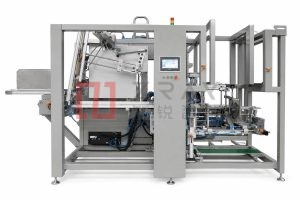
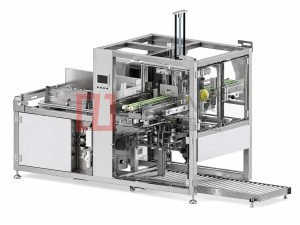
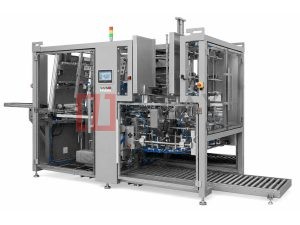
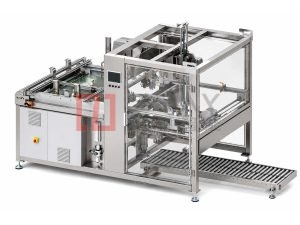
For high-volume heavy freight, a two-lane arrangement such as our Double-Head High-Speed Case Former allows the extended compression dwell that double-wall board requires without sacrificing throughput. For mixed heavy formats, the Single-Piece Carton Erector with quick-release cups and stored recipes keeps changeover short. Tray-style and three-piece heavy designs are handled by the Three-Piece Carton Erector, and specification questions are best raised directly with our Support engineers before ordering board.
PLC Alarms Worth Knowing
| Alarm | Meaning | First three checks |
|---|---|---|
E-12 Vacuum Low |
Pick-up pressure below setpoint on stiff board | Cup count and layout, filter, pump relief valve |
E-21 Glue Head Overtemp |
Tank or nozzle above 185 °C | Thermocouple, PID setpoint, glue circulation |
E-33 Servo Follower Error |
Mandrel deviation beyond 1.5 mm under load | Belt tension, encoder coupling, rail parallelism |
E-47 Compression Time Fault |
Dwell below the recipe minimum | Compression speed setting, rail length, recipe selection |
Maintenance Rhythm for Heavy-Duty Duty
Heavy double-wall board wears a machine faster than light board, and the maintenance interval should reflect that.
Every shift — verify vacuum at the cup face, inspect the compression rails for glue carry-over, and confirm the bead position with a test case.
Every week — clean the nozzle and check bead width against specification; deviations beyond plus or minus 1 mm indicate nozzle wear. Inspect the feed belts for glazing.
Every month — measure squareness against a reference case, check glue grammage by weighing ten sealed cases, and torque the compression rail fasteners, which loosen faster under heavy board.
Every quarter — replace suction cups as a complete set, check mandrel bearing play, and verify that the compression dwell matches the stored recipe.
Annually — replace the nozzle assembly, re-tension the drive chain, replace the vacuum filter, and revalidate against the drop test protocol above.
FAQ
Can a single-wall C-flute case carry 50 lb if it is glued well?
It can survive careful handling, but not a multi-leg parcel journey. The board delaminates at the fold before the adhesive fails, so improving the seal does not raise the ceiling.
Is tape ever acceptable for 23 kg loads?
For palletised freight in a controlled chain, sometimes. For parcel or multi-leg distribution, no — tape peel strength on a bowed bottom panel falls well short of what the load demands.
How do I know if my dwell time is long enough?
Pull a case immediately after sealing and inspect the glue line. If the adhesive is still glossy or strings when separated, dwell is short. It should show fibre tear from the first case.
What is the most common mistake on heavy-duty lines?
Raising glue temperature to fix a weak seal. It degrades the adhesive and carbonises the nozzle. Raise grammage and dwell instead.
Shipping heavy loads and losing money to bottom failures? Send your case dimensions, board grade and load weight to [email protected] or WhatsApp +86 13681839278. Our engineers will specify the glue grammage, dwell time and machine configuration in a written sizing sheet within 24 hours, with no obligation.
Want To Know More About Our Upgraded Machines?
Send your carton specifications and output demand, our engineer will provide free technical scheme & quotation
Latest Products
Subscribe To Get Latest News & Technical Guides
Leave your business email to receive free industry articles and new product updates