
Semi-Automatic vs Fully Automatic Carton Erector Cost: ZRAY ROI Calculation (7–14 Month Payback) | ZRAY
The real question behind “semi-automatic or fully automatic?” is not which machine is cheaper to buy. It is how many boxes per year justify each machine’s cost. We run this calculation with buyers every week, and in most cases the honest answer is: semi-auto pays off under roughly 400,000 boxes a year, full-auto takes over above that. This article walks through our method, the numbers you need to collect, and a worked example, so you can do the math for your own line before you talk to any supplier.
What the two options actually are
Definitions matter because “semi-automatic” means different things to different vendors. In our catalog, this is the split:
- Semi-automatic case erector. The machine holds the blank, forms the box around a mandrel and seals the bottom automatically, but an operator places the flat blank into the magazine or feeds it manually. Output is 6–10 CPM, one operator per shift. Capital cost is roughly 40–50% lower than full-auto.
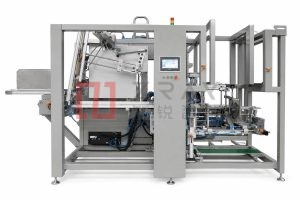
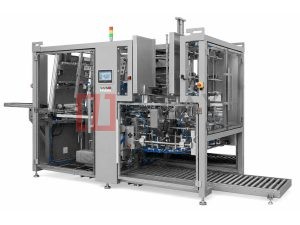
- Fully automatic case erector. The blank magazine, pick arm, forming, sealing and discharge are all automatic. Output is 15–25 CPM on our single-piece platform, and one operator supervises it plus the filling line. This is the machine covered by our Single-Piece Case Erector.
The purchase price gap is real, but it is the smallest number in the whole calculation. Labor, throughput and reliability decide the outcome.
Cost comparison at a glance
| Cost item | Semi-automatic (6–10 CPM) | Fully automatic (15–25 CPM) |
|---|---|---|
| Machine price (indicative) | USD 18,000–28,000 | USD 38,000–55,000 |
| Operators per shift | 1–2 | 0.5–1 (supervises line) |
| Annual labor cost (2 shifts, EU/NA rates) | USD 40,000–90,000 | USD 15,000–40,000 |
| Consumables | Tape/glue + misc. | Tape/glue + misc. |
| Maintenance hours / year | 60–100 | 80–130 |
| Typical changeover | 10–15 min | 5–10 min |
| Effective output at 85% OEE | ~60,000–85,000 boxes/yr/shift | ~150,000–210,000 boxes/yr/shift |
Prices are indicative for a mid-size single-piece platform and vary with box size range, sealing method and board requirements. Use the relative gap, not the absolute numbers, for your own estimate.
The labor math that drives the decision
Take a plant running two shifts, five days a week, 250 days a year. With semi-auto at 8 CPM effective, one operator erects roughly 2,400 boxes per shift. That is about 600,000 boxes a year if the operator does nothing else — which never happens, because the same person also tops up the magazine, changes tape rolls and clears jams.
The practical ceiling for one semi-auto operator is closer to 350,000–400,000 boxes a year. Above that volume, you need a second operator or a second shift’s worth of manual labor, and the labor line doubles. At a fully loaded labor cost of USD 18–25 per hour (EU/NA), one extra operator on two shifts adds USD 45,000–62,000 per year.
That single line item — the extra operator — already exceeds the price difference between semi-auto and full-auto machines within the first year. The fully automatic machine starts paying its own way from month 10–14 depending on your rates.
ROI calculation: the method
We use four inputs. Collect these before you call anyone:
- V (boxes per year) — your actual demand, including seasonal peaks.
- Cₗ (loaded labor cost) — hourly wage × 1.3 for overhead, in your currency.
- O (operators) — how many positions the machine replaces or avoids.
- ΔCAPEX — the price difference between the two machines, delivered and installed.
The yearly saving of full-auto over semi-auto is:
Savings = O × Cₗ × hours per year − ΔCAPEX ÷ payback period
Which rearranges to the figure everyone actually asks for:
Payback (years) = ΔCAPEX ÷ (O × Cₗ × 2,000 hours)
Where 2,000 hours is the standard two-shift annual hours budget. If you run three shifts, it becomes 3,000.
Worked example: 500,000 boxes a year
Let us run a realistic case with a beverage contract packer:
| Input | Value |
|---|---|
| Annual volume V | 500,000 boxes |
| Semi-auto effective rate | 8 CPM → cannot hold 500k with one operator |
| Operators avoided by full-auto | 1 (semi-auto needs two people) |
| Loaded labor cost | USD 20/hour |
| ΔCAPEX (full-auto − semi-auto) | USD 20,000 |
| Extra maintenance, full-auto | USD 2,000/year |
| Consumables delta | ≈ 0 (same sealing method) |
Annual saving from labor = 1 operator × USD 20/h × 2,000 h = USD 40,000. Subtract extra maintenance, and the net saving is USD 38,000/year.
Payback = USD 20,000 ÷ USD 38,000 ≈ 6.3 months.
Even if you halve the labor cost to USD 10/hour (typical in lower-cost regions), payback is 12.6 months. At 250,000 boxes a year with one operator holding output on semi-auto, the gap shrinks: full-auto saves roughly half an operator, payback stretches to 2–2.5 years, and semi-auto is the defensible choice.
Payback table by volume and labor rate
| Annual volume | Labor rate USD 10/h | USD 20/h | USD 30/h |
|---|---|---|---|
| 200,000 boxes | semi-auto wins | ~2.5 yr | ~1.7 yr |
| 400,000 boxes | ~2.5 yr | ~1.3 yr | ~0.8 yr |
| 600,000 boxes | ~1.7 yr | ~0.8 yr | ~0.6 yr |
| 800,000+ boxes | ~1.3 yr | ~0.6 yr | full-auto, consider Double-Head High-Speed Case Former |
A practical rule from these tables: under 300,000 boxes a year, buy semi-auto; 300,000–600,000, calculate carefully; over 600,000, full-auto pays back in well under a year and is the only defensible choice on labor alone.
Hidden costs that flip the answer
Three costs are usually missing from the buyer’s spreadsheet:
- Jam time. A semi-auto operator is also the jam-clearer. Every jam costs 2–5 minutes. At 3 jams per 1,000 boxes on marginal board, that is 1,500 minutes a year at 500,000 boxes — 25 hours of lost line time, which on a filling line with four operators idled is more expensive than the operator’s own wage.
- Board quality tolerance. Fully automatic machines with servo-controlled feeding handle soft recycled board better, because the pick cycle is timed and repeatable. If your supplier switches board grades seasonally, semi-auto will burn more operator time chasing misfeeds.
- Upgrade path. Buying a full platform that can later take a double head, hot melt sealing or a vision system beats buying a dead-end entry machine. We build the frame so these upgrades drop in. See what a high-output former line looks like before you lock in a small semi-auto footprint.
Board compatibility for both tiers
Both machines run the same board family, and this matters more than speed when you choose:
| Board | Thickness | Best match |
|---|---|---|
| E flute | 1.5–1.8 mm | Semi-auto, light cartons |
| B flute | 2.5–3.0 mm | Both tiers; the sweet spot |
| C flute | 3.5–4.0 mm | Full-auto preferred (heavier pick) |
| EB (double-wall) | 4.5–5.5 mm | Full-auto with heavier vacuum pump |
| BC (double-wall) | 6–7 mm | Full-auto heavy-duty only |
| Grammage | 200–500 gsm | Both, with vacuum tuning |
Semi-auto handles 200–500 gsm fine because the operator feeds the blank and can feel the board. Full-auto needs the vacuum and separator settings correct up front — which is exactly what our FAT covers, using your blanks and your board.
Downtime and maintenance budget
Plan maintenance differently per tier:
| Interval | Semi-auto | Full-auto |
|---|---|---|
| Daily | 10 min: clean, check cups | 10 min: same, plus tape/glue path |
| Weekly | 20 min: lube rails | 25 min: lube + check vacuum gauge |
| Monthly | 40 min: filter, seals | 60 min: filter, seals, sensor check |
| Quarterly | 1 h: cups, blade | 2 h: cups, glue nozzles, photo-eyes |
| Semi-annual | 0.5 day | 0.5–1 day |
Downtime on a full-auto line is more expensive per minute (more boxes not produced), so the longer inspection list is an investment, not a cost. Siemens PLC diagnostics with our alarm table cut average fault resolution to under 10 minutes.
Delivery, warranty and service
Both tiers ship with the same service package: CE and EAC certification, 12-month warranty, FAT before shipping with your own blanks (video-witnessed if you cannot travel), 45-day custom delivery, and remote diagnostics after installation. Payment terms: 50% advance, 40% after FAT acceptance, 10% warranty balance; L/C for bulk orders. The engineering team behind the machines built lines for Mars and Duracell and holds 66 patents, 8 of them invention patents.
Decide with numbers, not opinions
Send us your annual volume, box sizes, board type and labor rate. We will run the payback calculation both ways and give you a straight recommendation — including the case where the answer is “stay on semi-auto for another year.” Email [email protected] or message WhatsApp +86 13681839278; a sales engineer responds within 24 working hours with your ROI worksheet. You can also send the data through the contact page.
Want To Know More About Our Upgraded Machines?
Send your carton specifications and output demand, our engineer will provide free technical scheme & quotation
Latest Products
Subscribe To Get Latest News & Technical Guides
Leave your business email to receive free industry articles and new product updates