
Case Study: ZRAY Automatic Case Former Doubles Output for a Leading Household Chemical Manufacturer
Case study | August 2026
A household chemical manufacturer in Southeast Asia — producing detergents, fabric care, and cleaning products for retail chains across five countries — was hitting a packaging ceiling. Their two aging case erecting lines ran at 55–60% of the rated speed of their filling equipment, and every holiday promotion season turned into a scramble of overtime shifts and missed ship dates.
The Customer’s Pain Points
The company packs 45,000–60,000 cases per week across 12 SKUs, with case sizes from 300 × 200 × 150 mm (small laundry pods) to 450 × 300 × 250 mm (5 L liquid detergent). The problems were structural:
- Slow legacy erectors. The two old machines ran at 6–8 CPM each — combined capacity of 14–16 CPM, against a line demand that peaks at 28 CPM during promotions.
- Frequent mis-feeds on coated board. Several SKUs use a coated (glossy) linerboard for retail shelf appeal. The coated surface caused the legacy machine’s vacuum feed to slip, producing one mis-feed every 20–30 minutes.
- No hot-melt reliability. The old machines’ glue systems charred during lunchtime stops, and operators spent 20–30 minutes per day cleaning nozzles.
- Changeover-heavy scheduling. With 12 SKUs and two machines, the plant performed 6–8 changeovers per day, each taking 25–35 minutes with wrenches.
The Solution: Two ZRAY Automatic Case Formers
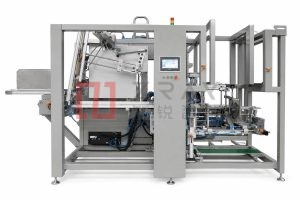
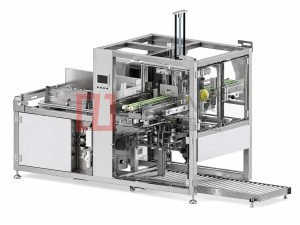
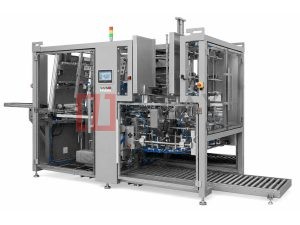
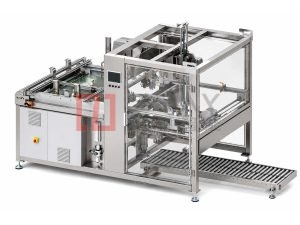
ZRAY supplied two double-head high-speed case formers rated at 24–40 CPM each, replacing the two legacy erectors. Configuration decisions were driven by the plant’s specific board mix:
1. Coated Board Handling
- Reinforced vacuum feed with dual vacuum cups per pick and an adjustable vacuum level — the coated linerboard now picks cleanly every cycle.
- Anti-slip feed rollers with a knurled surface, so glossy blanks do not slip on the infeed conveyor.
2. Hot-Melt Reliability
- Servo-driven glue guns with anti-drip nozzle shut-off: when the machine stops for lunch, the nozzles close positively, and the glue does not char or string.
- Closed-loop tank temperature control at 165 ± 3 °C, with a low-temperature alarm that prevents cold-glue jams.
3. Fast Changeover
- Recipe memory for all 12 SKUs, with servo-positioned guides. Changeover takes under 3 minutes — one operator, no tools.
- Pre-loaded changeover schedule: the production plan for the day can be uploaded to the machine, so the PLC pre-stages the next recipe and confirms blank availability before the operator even walks over.
Results and ROI
The plant measured 6 months before and 6 months after commissioning:
| Metric | Before | After | Change |
|---|---|---|---|
| Combined erecting capacity | 14–16 CPM | 48–80 CPM (2 machines) | 3× capacity |
| Actual line output (cases/week) | ~48,000 peak | ~96,000 peak | 2× output |
| Mis-feed rate (coated board) | 1 per 20–30 min | 1 per 6–8 h | −95% |
| Changeover time | 25–35 min | under 3 min | −90% |
| Changeovers per day | 6–8 | 6–8 (same schedule, 10% of the time) | time saved: 2.5–3.5 h/day |
| Nozzle cleaning time | 20–30 min/day | ~5 min/day | −80% |
The Doubling Story
Output doubled from ~48,000 to ~96,000 cases/week in peak season without adding a shift. The old lines could not run faster than their erectors; the new erectors are not the constraint at all — the plant now considers its filling lines the bottleneck, which is the correct direction for the bottleneck to be.
Annualized financial impact:
- Overtime eliminated: USD 74,000/yr
- Missed ship dates avoided (liquidated damages and lost retail listings): USD 41,000/yr
- Scrap and rework reduction: USD 18,000/yr
- Total: USD 133,000/yr against an investment of USD 158,000 for both machines — payback in 14.2 months.
ROI Summary Table
| Item | Value |
|---|---|
| Investment (2 machines) | USD 158,000 |
| Annual savings | USD 133,000 |
| Payback | 14.2 months |
| Output increase | 2× (peak season) |
| Changeover time | 25–35 min → under 3 min |
What the Plant Director Said
“We ordered the second machine before the first one was even fully commissioned. When you can double output without a single new hire, the decision makes itself.”
Is Your Erector the Ceiling on Your Line?
If your case erecting capacity is below your filling capacity, your erectors are silently capping your revenue. The rule we see across plants: erecting capacity should be 30–40% above peak filling demand to absorb board variability and changeovers.
Send us your SKU matrix, peak line demand, and current erector speeds — we will show you the gap in numbers. Request a capacity gap analysis or message us on WhatsApp at +86 13681839278.
Want To Know More About Our Upgraded Machines?
Send your carton specifications and output demand, our engineer will provide free technical scheme & quotation
Latest Products
Subscribe To Get Latest News & Technical Guides
Leave your business email to receive free industry articles and new product updates