
ZRAY Helps Frozen Food Logistics Provider Boost Box Erecting Efficiency in Cold Storage Environments
Case study | August 2026
A frozen food logistics provider in Northern Europe operates a cold chain that starts at −18 °C in the cold room and finishes at retail. Their packaging bottleneck was the box erecting line inside the cold storage facility — where ice, condensation, and cold board made a legacy erector unreliable and expensive to run.
The Customer’s Pain Points
The provider erects 25,000–30,000 boxes per week for frozen vegetables, seafood, and ready meals, in single-wall B-flute cases (some with moisture-resistant coating). Problems in the cold environment:
- Icing and condensation. The legacy machine’s steel guides and folding shoes iced up between batches. Condensation on the pneumatic circuit caused erratic cylinder speeds and, in winter, frozen pilot lines.
- Cold, brittle board. Below 0 °C, board stiffness increases sharply and the crease becomes brittle. The legacy machine’s aggressive folding produced crease splits on 2–3% of blanks, weakening boxes that then fail in cold storage stacking.
- Slow, unreliable erecting. The machine ran at 55% of its rated speed because operators had to run it slow to reduce jams; effective output was 6–7 CPM.
- Downtime cost. Every erector stop stopped the whole cold chain line — product waiting on conveyors in a cold room costs money even when nothing is damaged.
The Solution: ZRAY Case Erector with Cold-Room Specification
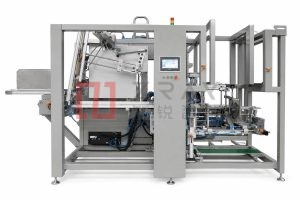
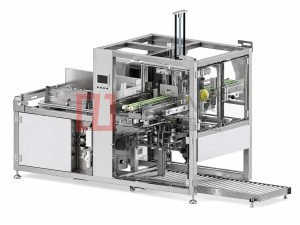
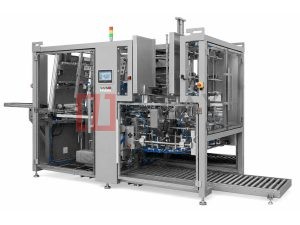
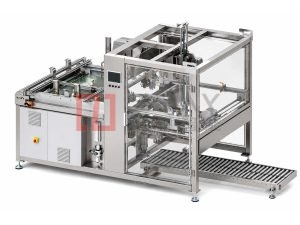
ZRAY supplied a single-piece case erector with the cold-room specification, configured for the provider’s box sizes and the −18 °C environment:
1. Cold-Temperature Pneumatics
- Trace-heated air circuit: the main air line and pilot lines are trace-heated to keep the air above the dew point, eliminating ice in pilot valves and condensation in cylinders.
- Cold-rated pneumatic components with low-temperature seals rated to −30 °C, so cylinder speeds stay consistent at −18 °C.
- Automatic condensate drain on the air filter with a heater band, preventing freeze-up of the drain valve.
2. Cold-Board Folding Profiles
- Gentle folding force profiles with a slow ramp onto the crease, eliminating the crease splits that cold board suffers.
- Pre-tuned recipe for frozen-environment board — calibrated at −18 °C in ZRAY’s cold chamber test before delivery, not tuned in the field during production.
- Moisture-resistant board support: the machine runs coated (moisture-resistant) board with adjusted feed vacuum, preventing the coating from sticking to vacuum cups.
3. Icing-Resistant Construction
- Stainless and anodized guide surfaces that do not ice-bond to blanks.
- Sealed bearings throughout, with cold-rated grease.
- Insulated, heated control cabinet keeping the PLC above the dew point in the cold room.
Results and ROI
The provider measured 10 weeks before and 12 weeks after:
| Metric | Before | After | Change |
|---|---|---|---|
| Effective erecting speed | 6–7 CPM | 12–14 CPM | 2× throughput |
| Crease split rate (cold board) | 2–3% | 0.2% | −90%+ |
| Machine downtime (all causes) | ~70 min/shift | ~12 min/shift | −83% |
| Jam rate | 1 per 30 min | 1 per 4 h | −87% |
| Line output (boxes/week) | 25,000–30,000 | 30,000–36,000 (capacity) | +20% capacity |
The Cold-Room Efficiency Story
The provider gained 20% line capacity without adding shifts or equipment. More importantly, the erecting line stopped being the weakest link in the cold chain: the new machine’s uptime means the cold room’s product flow no longer waits on boxes.
Annualized financial impact:
- Additional throughput (capacity monetized at provider’s margin): EUR 88,000/yr
- Reduced rework (crease-split boxes, repack in cold room): EUR 12,500/yr
- Reduced downtime labor and cold-room waiting time: EUR 9,000/yr
- Total: EUR 109,500/yr against a machine investment of EUR 74,000 — payback in 8.1 months.
ROI Summary Table
| Item | Value |
|---|---|
| Investment | EUR 74,000 |
| Annual savings | EUR 109,500 |
| Payback | 8.1 months |
| Effective speed | 6–7 → 12–14 CPM |
| Crease split rate | 2–3% → 0.2% |
| Machine downtime | −83% |
What the Operations Manager Said
“Everyone assumed slow, jam-prone erecting was normal in a cold room. It wasn’t — it was a design choice of the old machine. The cold-room specification changed the whole line.”
Lessons for Cold Storage Packaging
- Specify the machine for the environment, not the average line. Cold-room erecting has specific failure modes — icing, cold-brittle board, condensation — that a standard machine simply does not handle.
- Pre-tune recipes at operating temperature. Recipes calibrated in the field at ambient temperature will drift when the room is at −18 °C.
- Protect the pneumatics first. Most cold-room erector failures are pneumatic: trace-heating the air circuit eliminates the largest failure class before it starts.
If your cold chain has a slow or unreliable erecting step, send us your room temperature, box sizes, and board grades — we will confirm the cold-room configuration that closes your gap. Request a cold-room specification review or message us on WhatsApp at +86 13681839278.
Want To Know More About Our Upgraded Machines?
Send your carton specifications and output demand, our engineer will provide free technical scheme & quotation
Latest Products
Subscribe To Get Latest News & Technical Guides
Leave your business email to receive free industry articles and new product updates