
ZRAY Compact High-Speed Case Erector (20 CPM, 2.1×1.6 m Footprint) for Small Spaces and Limited Factory Floors | ZRAY
Most case erector buyers assume a machine needs 10 meters of clear floor. That assumption is wrong, and it is the reason a lot of small and mid-size plants still form boxes by hand. Our compact Single-Piece Case Erector configuration packs 20 CPM into a footprint of roughly 2.1 × 1.6 m, with a magazine that loads from the side so you can push it against a wall. This article covers the dimensions you actually need to plan for, the specs we use to guarantee that throughput, and the operational details — alarms, maintenance, changeover — that decide whether the machine earns its floor space.
Why small factories get stuck with manual forming
Walk into a 500 m² packaging room and you will find the same situation repeated: two operators folding RSC blanks by hand, taping bottoms, stacking. Output tops out at 8–12 boxes per minute per person, and quality depends on how tired the operator is at hour seven. The reasons managers hesitate to automate are almost always the same three:
- Floor space. The machine has to share the room with filling stations, pallet wrap, storage racks and a forklift aisle.
- Air supply. A compact plant often runs a small 5.5–7.5 kW compressor and doubts it can feed a forming machine.
- Setup complexity. Teams are afraid of size changeovers eating the savings.
A compact erector with a 2.1 × 1.6 m footprint, side magazine loading and a 0.5–0.7 MPa air requirement directly answers all three. It does not need a dedicated room; it needs a rectangle of concrete with one meter of clearance for access.
Machine layout and what you plan for
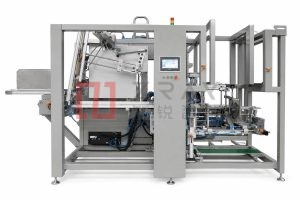
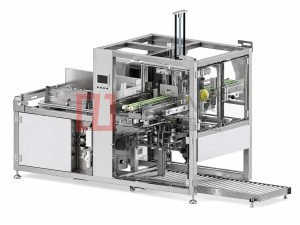
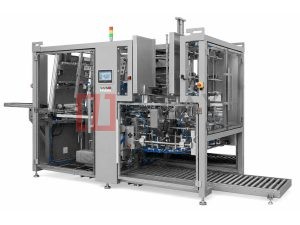
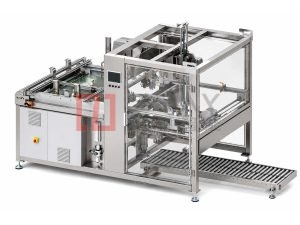
The base configuration is a single-piece erector: blanks stand in a vertical magazine, the pick arm pulls the bottom blank forward, the former plate pushes it through the mandrel, the bottom flaps fold and seal, and the finished box discharges horizontally to a conveyor. Layout numbers that matter:
- Machine footprint: 2100 mm (L) × 1600 mm (W), height 1900 mm to the top of the magazine.
- Clearance: 800–1000 mm on the operator side for magazine loading and control panel access.
- Conveyor direction: discharge can be straight or 90° right/left — specify before we weld the frame.
- Magazine loading height: 900–1100 mm, so a single operator loads blanks without a ladder.
- Weight: 1100 kg on M10 anchor bolts; no special foundation required.
If your floor already has a filling line, you can place the erector so it feeds straight into it. That is the single biggest layout saving: the box never has to be carried, it just rolls out of the machine at discharge height.
Technical specifications
| Parameter | Value |
|---|---|
| Speed | 15–20 CPM continuous, up to 22 CPM burst |
| Box length (L) | 200–500 mm |
| Box width (W) | 150–400 mm |
| Box height (H) | 100–400 mm |
| Board types | Single-wall E (1.5–1.8 mm), B (2.5–3.0 mm), C (3.5–4.0 mm), EB (4.5–5.5 mm) |
| Paper grammage | 200–500 gsm |
| Air pressure | 0.5–0.7 MPa |
| Air consumption | 130–220 L/min at 20 CPM |
| Electrical | 380 V / 50 Hz, 3-phase, 5.5 kW |
| PLC | Siemens, with 7-inch HMI |
| Sealing | Tape 4.8–7.2 cm or hot melt glue 150–170 °C |
| Changeover time | 5–10 min for a single dimension, ~20 min full change |
| Noise level | ≤ 75 dB(A) at 1 m |
Board handling: what this machine is tuned for
Small plants often feed the erector whatever the supplier delivers, and that is exactly where jams start. Our compact machine is set up for the range in the table above, with three practical rules:
- B flute at 2.5–3.0 mm is the sweet spot. It is light enough for the vacuum cups to lift one blank reliably and stiff enough to push through the mandrel without buckling.
- E flute (1.5–1.8 mm) needs the light-blank kit. We change the spring-loaded separators and reduce vacuum flow, otherwise thin blanks can double-feed.
- C flute (3.5–4.0 mm) or EB (4.5–5.5 mm) needs heavier vacuum. For cartons above 4.0 mm, spec the larger vacuum pump at order time — retrofitting later costs more.
Board grammage runs 200–500 gsm. Below 200 gsm we recommend testing your actual blank in our plant during FAT; above 500 gsm, the compact frame is still fine, but throughput drops toward 15 CPM because the mandrel has to work harder.
PLC alarm codes and troubleshooting
The Siemens PLC logs the same fault families you will see across our line. Here are the four alarms that account for most stoppages in compact installations, with the steps we give operators:
E01 Air Pressure Low
- Check the main air valve at the machine inlet; open it fully.
- Confirm supply pressure at the regulator is 0.5–0.7 MPa with the machine idling.
- Inspect the FRL unit (filter-regulator-lubricator) — a clogged filter element restricts flow under load.
- Look for leaks in the blue poly tubing between the manifold and cylinder valves.
E02 Vacuum Low
- Check the vacuum gauge during the pick cycle; it should hold −0.06 to −0.08 MPa.
- Clean or replace the suction cups — worn or hardened cups lose grip on light board.
- Check the magazine separator springs; if blanks are jamming against each other, vacuum cannot build.
- Verify the vacuum generator air supply is not shared with a second machine that peaks at the same time.
E05 Box Not Formed
- Inspect the blank for pre-creased or damaged score lines; supplier board defects cause this.
- Confirm the blank is square to the guide rails; a skewed blank folds crooked.
- Reduce speed by 10% and watch the forming stroke — if the issue disappears, the board stiffness is marginal for that size.
E08 Tape/Glue Unit Fault
- For tape: check the tape roll tension and the blade for adhesive build-up.
- For hot melt: check glue tank temperature is 150–170 °C and the nozzle is not blocked with cured glue.
- Reset the fault from the HMI only after the physical check; never cycle the machine with the fault active.
Each of these clears in 3–10 minutes once the operator knows the sequence. That is why we print the alarm table and bolt it to the inside of the panel door.
Maintenance schedule
| Interval | Task | Time |
|---|---|---|
| Daily | Blow down the FRL unit, drain water from the air filter; check suction cup condition; wipe tape path / check glue tank level | 10 min |
| Weekly | Grease the pick-arm slide rails and mandrel guides; check belt tension on the discharge conveyor; verify vacuum gauge reading | 20 min |
| Monthly | Clean or replace air filter element; inspect cylinder seals for leaks; torque-check anchor bolts | 40 min |
| Quarterly | Replace suction cups (or flip them 180° to double life); clean the glue nozzles and tank if glue-sealed; check photo-eyes and sensors for dust | 1–2 h |
| Semi-annual | Full electrical panel inspection; re-torque all structural fasteners; calibrate photo-eye timing; replace tape blades if worn | 0.5 day |
Following this table keeps the machine at the rated 20 CPM. Plants that skip the weekly lubrication call us about slowdowns that are usually just dry slide rails.
Changeover and mixed production
A compact machine earns its space when it can switch sizes fast, because small plants rarely run one SKU all day. The tooling table mounts on locating pins:
- Width and height change: 5–10 minutes with two wrenches; the servo-driven guides re-position automatically.
- Depth change (new mandrel): add 10–15 minutes.
- Full change to a different board type: about 20 minutes including adjusting vacuum pressure and separator springs.
For mixed production we recommend grouping sizes so consecutive changeovers touch only one dimension. A typical pattern: run two widths in the morning, switch depth at lunch, two more widths in the afternoon. Total changeover time across a shift stays under 45 minutes.
Air and energy in a small plant
The compact machine draws 130–220 L/min. If you run a 7.5 kW screw compressor rated ~1100 L/min, the erector uses roughly 15–20% of available air at full speed, which leaves headroom for the filling line and a pallet wrapper. Where air is genuinely short, the tape-sealed version can run at 15 CPM on a 5.5 kW compressor, and our servo-driven configuration cuts peak air demand by another 30%. See our analysis of low-air-consumption operation if your compressor is the bottleneck. We are also transparent about energy: 5.5 kW connected load, and the machine idles down when the photo-eye sees no blank in the magazine.
Delivery, warranty and FAT
- CE and EAC certified. Built to EU and Russia/CIS compliance.
- 12-month warranty on all components; Siemens, Schneider and SMC parts are standard.
- FAT before shipping with your blanks and your sizes, witnessed remotely by video if you cannot travel.
- 45-day custom delivery. Sales engineers reply within 24 working hours.
- Payment: 50% advance, 40% after FAT acceptance, 10% warranty balance; L/C for bulk orders.
The engineering team behind this machine has built lines for Mars and Duracell, holds 66 patents (8 of them invention patents), and reinvests more than 10% of revenue in R&D. The compact machine is not a stripped-down toy; it is the full platform in a smaller frame.
Does it fit your floor? Send us the numbers
Tell us the room dimensions, the box sizes you run today, and the ones you plan for next year. We will draw the layout and confirm whether one compact unit covers your peak rate, or whether you should look at our Double-Head High-Speed Case Former for output above 35 CPM. Email [email protected] or message WhatsApp +86 13681839278 — a sales engineer answers within 24 working hours with a dimensioned layout and a payback estimate. You can also submit your floor plan through the contact page.
Want To Know More About Our Upgraded Machines?
Send your carton specifications and output demand, our engineer will provide free technical scheme & quotation
Latest Products
Subscribe To Get Latest News & Technical Guides
Leave your business email to receive free industry articles and new product updates