
ZRAY Automatic Case Erector for E-Commerce Fulfillment Centers (Multi-Size, Up to 40 CPM) | ZRAY
Fulfillment centers are a different world from a beverage plant. One SKU can be a 1.2 kg book, the next a 15 kg bag of dog food. The box sizes change every shift, sometimes every batch. A case erector that runs one format beautifully and jams on the next is not a solution — it is a bottleneck with a price tag. This article explains how ZRAY configures automatic case erectors for e-commerce fulfillment center logistics: multi-size handling, fast changeover, and the box quality controls that keep packing stations running.
What Fulfillment Actually Requires from a Case Erector
Through conversations with e-commerce operators in Europe, Russia, and the CIS, we keep coming back to the same five requirements:
- A wide box size window — from small poly-mailer boxes up to double-wall master cartons for pallet orders.
- Fast size changeover — ideally under 10 minutes, with no tools and no mechanic.
- High uptime at moderate speed — 20–40 CPM beats a 60 CPM machine that jams twice an hour.
- Board tolerance — e-commerce buys corrugated on price, so flute and gsm vary between batches.
- Clean square boxes — a skewed box wrecks the automatic cartonization station and slows packers.
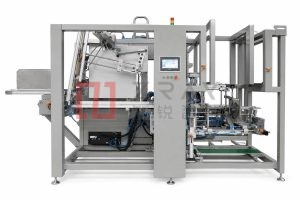
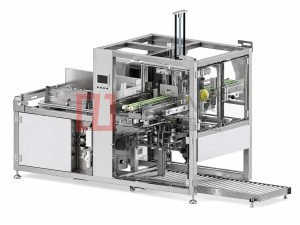
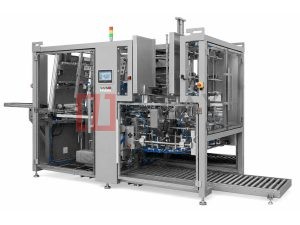
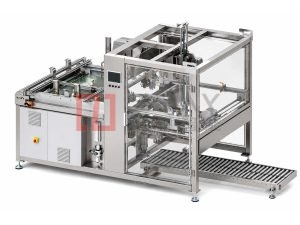
Our Single-Piece Case Erector is the standard answer for multi-size fulfillment lines, and we tune it to your SKU mix during FAT.
Machine Specifications for Fulfillment Configurations
| Parameter | Value |
|---|---|
| Output speed | 15–40 CPM (size-dependent) |
| Box length | 200–600 mm |
| Box width | 150–500 mm |
| Box height | 120–500 mm |
| Board types | Single-wall B/C, double-wall BC/EB |
| Board weight | 200–500 gsm |
| Air pressure | 0.5–0.7 MPa |
| Bottom seal | Hot melt glue (150–170 °C) or tape |
| Magazine capacity | Up to 300 blanks (size-dependent) |
| Changeover | Tool-less width/length, < 10 min |
| Control | Siemens PLC, recipe-based size presets |
The recipe system matters more than raw speed. Each box size is saved with its own magazine settings, suction cup pressure, flap folding timing, and sealing parameters. Changeover is then a two-button operation: recall recipe, confirm, run.
Changeover Time Breakdown
We benchmarked a typical three-size fulfillment shift. Here is the real number that matters:
| Action | Time |
|---|---|
| Recall recipe on HMI | 10 s |
| Adjust width and length rails | 2–4 min |
| Reposition suction cups (tool-less clamps) | 1–2 min |
| Confirm first box, adjust if needed | 1–2 min |
| Total for size change | 5–8 min |
With ten changeovers a day, that is under 80 minutes of lost production versus 3–4 hours on a machine that needs wrenches and a mechanic.
Multi-Size Handling: The Board Is Not Always the Same
E-commerce buyers switch board suppliers with price swings, so the machine must tolerate variation. What we build in:
- Automatic magazine stacker compensation — the blank stack is kept level regardless of gsm, which stops double-feed and misfeed.
- Vacuum pick-up pressure adjustment per recipe — heavy double-wall blanks need stronger vacuum; light E-flute blanks need lower pressure to avoid double-pick.
- Flap folding kickers with adjustable stroke — soft recycled board (common in e-commerce) folds differently from virgin kraft; the kicker stroke compensates.
- Seal verification sensors — the machine checks that the bottom is actually sealed before release. No sealed box, no product damage downstream.
For low-grade recycled corrugated, we also recommend a few operating tweaks — see the maintenance section below.
Common E-Commerce Box Formats and Their Demands
Fulfillment SKUs fall into a handful of box families. Your erector’s magazine, vacuum, and flap settings must cover all of them:
| Format | Typical Size (L×W×H) | Board | Notes |
|---|---|---|---|
| Small carton | 200×150×100 mm | E/B flute, 200–300 gsm | Low vacuum to avoid double-pick |
| Standard carton | 400×300×300 mm | B/C flute, 250–400 gsm | The bulk of volume |
| Medium shipping box | 500×400×400 mm | BC flute, 350–500 gsm | Needs full vacuum and longer compression |
| Master carton | 600×500×500 mm | BC/EB flute | Usually packed by hand or robotic cell |
A machine sized for only one of these families will spend half its shift on changeover. We set up recipe-based handling for the full span, so the same machine runs the small carton and the master carton in the same shift, with the operator recalling a recipe instead of adjusting mechanics.
What Happens When the Mix Includes Soft Recycled Board
E-commerce kraft from recycled fiber is common at 200–350 gsm and is noticeably softer than virgin kraft. Two adjustments keep it reliable:
- Lower pick vacuum — soft blanks stick to the previous blank more easily; recipe pressure prevents double-feed.
- Longer flap fold dwell — soft board springs back; the kicker holds the flap longer before the bottom seal applies.
Box Quality Control for Automatic Cartonization
A fulfillment line downstream runs cartonization software, robotic pick, and automated packing. Every box must be square within a few millimeters or the automation misreads it.
| Defect | Cause | Prevention on ZRAY Machine |
|---|---|---|
| Skewed box | Magazine misalignment, worn cups | Daily cup check; recipe pressure settings |
| Open corner | Flap timing off at high speed | Two-stage bottom forming with mandrel |
| Popped bottom seal | Low glue temp, weak tape | Glue temp alarm at 150 °C; tape sensor |
| Misfold | Soft board, high humidity | Adjust kicker stroke; pre-dry blanks above 80% RH |
| Double-feed | Static, board surface friction | Anti-static brush + recipe vacuum pressure |
These are the checks we run during every FAT with customer blanks, so the machine leaves the factory knowing your specific board behavior.
Layout and Integration
The erector can feed:
- A manual packing bench — operator pulls boxes from a short buffer conveyor.
- A powered buffer conveyor — with photoelectric fill control, sized for 20–40 boxes of buffer.
- A direct handoff to a robotic cartonization cell — synchronized via the PLC, with reject discharge for bad boxes.
Air consumption on a typical fulfillment config is 150–250 L/min at 0.5–0.7 MPa, which matters if your compressor is shared with the rest of the warehouse.
Handling Seasonal Peaks Without Buying a Second Machine
E-commerce demand spikes in Q4. A machine that runs 25 CPM in June must hold 40 CPM in November without mechanical drama. Three things carry the peak:
- Recipe-based speed ramping — the PLC raises cycle rate smoothly per recipe, so the machine does not slam from idle to full speed and trigger flap timing errors.
- Buffer conveyor discipline — keeping 20–40 boxes of buffer between the erector and packing stations absorbs packing speed variation, which prevents the erector from stop-starting.
- Pre-season maintenance — the quarterly service (vacuum filters, glue nozzles, magazine springs) done in October, not December.
If your peak is genuinely double your base volume, we recommend pairing the erector with a second, smaller machine rather than over-sizing one unit. Two machines give redundancy: if one stops, the line still runs at reduced speed instead of zero.
Maintenance Plan for a Fulfillment Case Erector
| Interval | Task |
|---|---|
| Daily | Wipe suction cups; check tape/glue level; blow dust off sensors |
| Weekly | Clean cups and vacuum filter; inspect flap kickers for wear |
| Monthly | Check magazine rails alignment; lubricate pivot points |
| Quarterly | Replace vacuum filters; inspect glue nozzles (glue config) |
| Semi-annual | Full changeover check; verify squareness against test box |
In a dusty fulfillment hall, filter cleaning is the task that keeps vacuum reliable. Skipping it is the most common cause of “machine stopped picking” calls we receive.
When to Step Up to a Double-Head Machine
If your fulfillment operation processes over 500,000 cases a year at sustained speed, consider the Double-Head High-Speed Case Former. Two forming heads alternate, which cuts peak cycle time and gives you a service window on one head while the other runs. The trade-off is a larger footprint and a heavier price — the right call only when volume justifies it.
Cost Per Box in Fulfillment
In fulfillment, cost per box is dominated by consumables and rejects, not machine price:
- Hot melt glue bottoms: 0.0018–0.0024 USD per box at typical glue prices
- Tape bottoms: 0.006–0.011 USD per box
- Each rejected box downstream costs 5–20× its consumable value when repacking labor is counted
So the erector’s job is not just to make boxes fast — it is to make boxes right. That is where ZRAY machines earn their keep.
What Uptime You Should Expect and How to Measure It
We quote fulfillment machines on an availability target of 98%+ over a sustained two-shift run. Track these three numbers from the HMI:
| KPI | Target | Where to See It |
|---|---|---|
| Machine availability | ≥ 98% | PLC shift log |
| Size changeover time | ≤ 8 min | Timer logged per recipe recall |
| Reject rate | ≤ 0.5% | Vision system log |
If availability drifts below 95%, the cause is almost always consumable hygiene — dirty vacuum filters or a dry tape brake. Both are caught by the weekly checklist in the maintenance section above.
Get a Fulfillment-Specific Proposal
Send us your SKU list with box sizes and annual volumes. We will confirm the right model, changeover times, and a cost-per-box estimate within 24 working hours.
- Email: [email protected]
- WhatsApp: +86 13681839278
- Inquiry form: Contact ZRAY
Every machine ships with a 45-day custom delivery, CE and EAC certification, FAT on your carton blanks, and a 12-month warranty on Siemens, Schneider, and SMC components.
Want To Know More About Our Upgraded Machines?
Send your carton specifications and output demand, our engineer will provide free technical scheme & quotation
Latest Products
Subscribe To Get Latest News & Technical Guides
Leave your business email to receive free industry articles and new product updates