
Top 5 Features for a High-Speed Beverage Packaging Case Erector (Up to 60 CPM) | ZRAY
A beverage line is unforgiving: the filler runs at 30,000-60,000 bottles per shift, and every minute the case erector stops costs the plant a pallet of lost output. At 40-60 CPM the machine has no time for second chances — one bad flap and you have a jam behind the packer. This article ranks the five features that separate a beverage-grade high-speed case erector from a general-purpose machine: dual-head architecture, glue reliability at speed, quick changeover, jam containment, and PLC integration. Each feature is tied to a number you can put in a specification table.
Feature 1: dual-head architecture for real 60 CPM
Single-head erectors top out around 30 CPM. Beverage lines in the 40-60 CPM range need two forming heads running in parallel — each head takes its own blank from a shared magazine, forms the bottom, and drops the case onto one of two discharge lanes feeding a single case packer. The architecture matters because it scales linearly: two heads at 30 CPM each give 55-60 CPM combined without forcing a single head to run at the edge of its mechanical limit.
What to verify in the spec:
- Speed per head: 25-30 CPM per head, not one head rated at 60 CPM.
- Lane merging: two discharge lanes feeding the packer — confirm the merge point has a buffer zone so a hiccup on one lane does not stop the other.
- Magazine capacity: at 60 CPM and 500-blank magazine, you reload roughly every 8 minutes. Some beverage plants run a double-length magazine (1,000 blanks) to extend reload cycles across breaks.
Feature 2: glue system that holds temperature at speed
The number-one cause of beverage line stoppage is not mechanics — it is glue. At 55 CPM the machine applies 55 glue patterns per minute, and the system must hold tank temperature, hose temperature, and nozzle pressure simultaneously.
Numbers to demand in the spec:
| Glue parameter | Required value |
|---|---|
| Tank temperature | 150-170°C, stable within ±3°C |
| Hose temperature | tank +5-10°C, insulated, no cold spots |
| Glue consumption | 10-16 g per case at 60 CPM ≈ 45-58 kg per hour |
| Open time | 1.5-3 seconds at 160°C |
| Nozzle pattern | swirl or multi-bead, program changeable per case size |
| Purge cycle | automatic at machine stop, prevents char build-up |
Demand a digital nozzle temperature readout and an automatic purge on stop. If the PLC shows the machine stopping on Glue Temp Low more than twice a shift, the glue system is undersized for the CPM — do not buy that machine. For water and carbonated beverage plants with high humidity, specify the moisture-protected glue hopper; condensation in the hopper is the classic hidden cause of intermittent nozzle failure.
Feature 3: quick changeover for the SKU mix
Beverage plants run 12-can, 24-can, 6-bottle, 24-bottle formats in one shift. Changeover is dead time. The spec you want:
- Tool-less adjustments: crank or servo-driven size change with no hand tools for 70-80% of the adjustments.
- Changeover time: 10-20 minutes for a two-format change on a mechanical machine; under 8 minutes with servo-positioned side guides and folder settings saved in the PLC.
- Recipe storage: PLC must store at least 50 case-size recipes — board grade, case dimensions, folder gap, glue pattern, fold timing — so a format change is a recipe recall, not a re-setup.
Watch for the trap: a machine with a fast changeover on paper but a magazine that must be re-stacked by hand for every new blank size. The magazine should accept different blank lengths without a parts change.
Feature 4: jam containment and anti-jam design
At 60 CPM, jams are not an “if”, they are a “when”. The machine’s value is in how fast it detects, contains, and clears a jam.
The features that matter:
- Photo-eye coverage on every transfer point: blank pickup, square-up, flap folding, case exit. A jam detected at the exact station instead of downstream saves 5-10 minutes per incident.
- Diverter/blow-off: an unformed or half-formed case is blown out of the lane instead of feeding the packer. This single feature prevents the worst failure mode — a jam that forces a full line stop at the packer.
- Clear-out access: hinged guards and a jam-clear procedure under 3 minutes. Lockout is mandatory for safety, but a machine where you must remove 6 screws to reach the flap folder is a downtime multiplier.
- Low carton jamming rate as a KPI: ask the supplier for the machine’s jamming rate in jams per 10,000 cases. ZRAY machines hold a low carton jamming rate by design — this is a spec, not a marketing word.
Feature 5: PLC integration with the filling line
A high-speed beverage erector is a node in a network, not a standalone box. The control spec:
| Control requirement | Value |
|---|---|
| PLC | Siemens — standard across the beverage line, one spare philosophy |
| HMI | touch panel with recipe management, alarm log, counters |
| Integration | start/stop and fault signals to the line controller; speed reference from the packer |
| Remote access | VPN/remote diagnostic port for factory support |
| Electrical components | Schneider contactors and SMC pneumatics — same spares as the rest of the line |
Why this matters operationally: when the packer jams, the erector should stop feeding within one cycle, not fill the buffer. When the erector faults, the line controller should get the alarm before an operator walks by. Machines that cannot talk to the line become islands, and islands create the manual hand-off problems you automated the line to eliminate.
Beverage-line technical parameter table
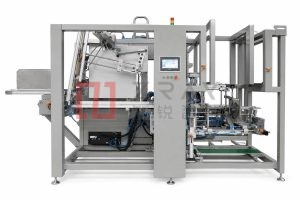
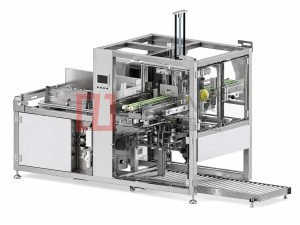
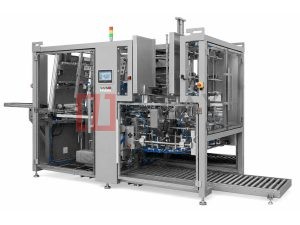
Reference configuration of the ZRAY Double-Head High-Speed Case Former for a beverage plant:
| Parameter | Value |
|---|---|
| Speed | 40-60 CPM combined (2 × 25-30 CPM) |
| Case length | 250-600 mm |
| Case width | 150-450 mm |
| Case height | 80-400 mm |
| Board | single wall B/C, double wall EB/BC up to 7 mm |
| Blank magazine | up to 1,000 blanks, double-length option |
| Air pressure | 0.5-0.7 MPa |
| Air consumption | 600-900 L/min at 55 CPM |
| Glue tank | 150-170°C, automatic purge |
| Power | 8-11 kW |
| Changeover | 10-20 min manual, <8 min with servo recipe recall |
| Control | Siemens PLC, 50+ recipes, remote diagnostics |
Maintenance schedule for a 55 CPM beverage line
At 55 CPM the machine runs about 33,000 cases per 10-hour shift. The maintenance rhythm is different from a low-speed line:
| Interval | Action |
|---|---|
| Daily | check glue tank 150-170°C; verify nozzle pattern (5-10 cases); inspect vacuum pads; clear flute dust from sensors |
| Weekly | clean nozzles and check purge function; measure folder gaps with feeler gauge; lubricate bearings per schedule |
| Monthly | replace vacuum filter; check belt tension; verify recipe parameters against the current case size; inspect glue hoses |
| Quarterly | full calibration: folder timing, glue pattern, magazine centering; review alarm log; test remote diagnostics link |
| Half-year | replace folder liners and vacuum pads; service glue pump; verify all safety interlocks |
The daily nozzle-pattern check is the highest-value preventive task on a beverage erector: five cases per morning catch a failing nozzle before it becomes a 30-minute jam at peak production.
When 60 CPM is overkill
Be honest: most beverage plants do not need 60 CPM. If your filler caps at 20-30 CPM, a high-speed double-head machine buys you nothing but a bigger capital number and a higher air bill. The correct tool is a single-head erector at 20-30 CPM — the ZRAY Single-Piece Case Erector fits that range with the same glue, changeover, and PLC features. Step up to the double-head only when your packer genuinely demands more than 35-40 CPM, or when you plan a second filling line on the same floor in the next 24 months. Review the Double-Head High-Speed Case Former specs against your actual filler output before committing CAPEX.
The bottom line
The five features that decide a beverage-grade case erector are: dual-head speed architecture, a glue system that holds temperature at 55 CPM, sub-20-minute changeover with recipe recall, jam containment with blow-off and low jamming rate, and Siemens PLC integration with the line. Put each one in your RFQ as a number, not a phrase — “glue tank 150-170°C ±3°C” beats “reliable glue system” every time.
Building a beverage line and want the specification checklist for your filler speed and case formats? Send us your line output, case sizes, and board grades. Our engineers will confirm the correct machine class — single-head or double-head — and quote with the full control spec within 24 working hours.
- Email: [email protected]
- WhatsApp: +86 13681839278
- Contact ZRAY engineering
Want To Know More About Our Upgraded Machines?
Send your carton specifications and output demand, our engineer will provide free technical scheme & quotation
Latest Products
Subscribe To Get Latest News & Technical Guides
Leave your business email to receive free industry articles and new product updates