
Single-Wall vs Double-Wall Corrugated: Handling Heavy Board (Up to 7 mm) with ZRAY Case Erectors | ZRAY
Most case erector breakdowns do not start with a mechanical failure. They start with the wrong board spec feeding into a machine that was never set up for it. A 3 mm single-wall B-flute blank behaves completely differently from a 6–7 mm double-wall BC blank: different stiffness, different crease depth, different springback, different vacuum draw. If your line handles both, the erector has to adapt, or you pay for it in jams and rejected boxes.
We have built case erectors for the teams behind Mars and Duracell global packaging lines, and we have tested them on board from 1.5 mm E-flute up to 7 mm double-wall. This article explains the difference between single-wall and double-wall corrugated from the erector’s point of view, what board properties actually affect forming, and how ZRAY machines handle heavy cardboard without slowing down.
What “Single-Wall” and “Double-Wall” Actually Mean
The names refer to the number of fluted layers between liners.
- Single-wall (double-faced) corrugated: one fluted medium glued between two liners.
- Double-wall (double-double) corrugated: two fluted media and three liners. The flutes can be the same type (CC, BB) or different types (BC, EB).
Standard flute profiles you will meet on a case erector line:
| Board structure | Typical thickness | Typical weight | Typical use |
|---|---|---|---|
| Single-wall E-flute | 1.5–1.8 mm | 200–300 gsm | Light e-commerce, retail-ready packaging |
| Single-wall B-flute | 2.5–3.0 mm | 300–400 gsm | Consumer goods, food cans, beverage trays |
| Single-wall C-flute | 3.5–4.0 mm | 350–500 gsm | Export cases, heavier cartons |
| Double-wall EB-flute | 4.5–5.5 mm | 400–600 gsm | Heavy appliances, spare parts, e-commerce bulk |
| Double-wall BC-flute | 6–7 mm | 500–900 gsm | Industrial parts, heavy produce, multi-pack export |
Two more values matter for erecting even though they are rarely printed on a spec sheet:
- Mullen (burst) strength — how much pressure the board takes before the flute collapses. Double-wall BC usually tests 275–350 lb/in² (1937–2465 kPa), well above single-wall C.
- Edge crush test (ECT) — how much stacking force the finished box holds. ECT 32–44 applies to most double-wall export cases.
Why Double-Wall Board Breaks Single-Wall Erectors
A case erector folds a flat blank into a box by creasing and pushing flaps into position. On single-wall board this is routine. On double-wall board, three problems show up:
- Springback. Thicker board resists the fold at the crease line. After the pusher releases, the panel wants to open back. If the machine holds the box only during the fold and not through the sealing station, the side seams open and the box never squares.
- Crease geometry. On BC board the crease must be pressed deeper and wider, otherwise the fold radius stays too large and the panel edges curl instead of folding clean.
- Vacuum draw. Heavier liners mean heavier blanks. A blank that weighs 450 g and has low porosity can slide, drift, or fail to lift if the vacuum cups and manifold are sized for 200 gsm blanks.
These are not operator errors. They are machine design limits.
How ZRAY Machines Handle Heavy Cardboard
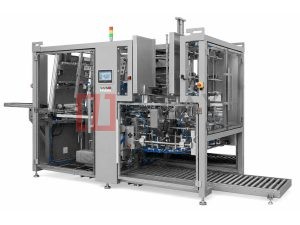
The ZRAY single-piece and double-head case formers treat board weight and thickness as first-class parameters. Here is what changes mechanically when we set up for double-wall:
- Vacuum system sized by blank weight, not by default. We select cup count and manifold bore from the heaviest blank you will run. A 6–7 mm BC blank gets more cups, larger diameter cups, and a higher vacuum threshold than an E-flute blank. The PLC monitors vacuum per station, so a blocked port shows up as an alarm, not as a mystery jam.
- Servo-driven mandrel with adjustable crease depth. The forming head is not a fixed cast block. Servo stroke and timing are programmed per SKU, and crease pressure is tuned for the board caliper. On double-wall we intentionally over-press the crease by a controlled amount and let the mandrel dwell longer before the side seam seal.
- Fold timing compensation. Double-wall springback means the flap follows a different trajectory. The pusher profile and the hot-melt or tape head timing are shifted so the sealing happens while the box is still held in the square position.
- Reinforced side guides. Heavy blanks carry momentum. We widen the guide gap by the measured board caliper plus 1 mm running clearance, and add wear strips so a 900 g blank does not score the frame.
If you are standardizing on heavy board for export, our Three-Piece Case Erector is built for the rigid, thick-corrugated boxes that three-piece construction produces. For mixed production where you switch between E-flute retail boxes in the morning and BC export cases in the afternoon, the Single-Piece Case Erector is the unit our customers run when changeover speed matters as much as board range.
Technical Reference: ZRAY Case Former Parameters
| Parameter | Single-wall setup | Double-wall setup |
|---|---|---|
| Board thickness range | 1.5–4.0 mm | 4.5–7.0 mm |
| Blank weight range | 100–400 gsm | 400–900 gsm |
| Max case size (L×W×H) | up to 800×600×600 mm | up to 800×600×600 mm |
| Min case size (L×W×H) | 200×150×100 mm | 250×200×120 mm |
| Speed, single head | 10–15 CPM | 8–12 CPM |
| Speed, double head | 20–40 CPM | 16–30 CPM |
| Air pressure | 0.5–0.7 MPa | 0.6–0.7 MPa |
| Hot-melt tank temp | 150–170 °C | 160–175 °C |
| Vacuum system | separate blower, per-station monitoring | oversized cups, per-station monitoring |
The speed difference on double-wall is not a compromise we hide. Slower forming on heavy board is a deliberate trade-off so that crease depth, dwell, and glue set do not fight each other. Push the speed and you get open corners and popped seams, not more boxes.
PLC Alarms You Will See When Running Heavy Board
Below are the alarms that appear most often on double-wall lines, with the exact troubleshooting steps our service engineers walk through on a video call:
Alarm: Box Not Formed
- Check the crease depth setting for the current SKU against the board caliper. Increase servo crease depth by 0.5 mm steps and run three test blanks.
- Confirm the side guides are set to board caliper + 1 mm. Too tight and the board catches; too loose and the blank rotates during fold.
- Verify the front suction port is not blocked by liner dust. Blow out the manifold and replace the filter.
- If the box forms but collapses at the sealing station, increase fold dwell 0.2 s and recheck.
Alarm: Air Pressure Low
- Read the pressure gauge at the machine inlet, not at the compressor. The line often loses 0.05–0.1 MPa across filters and dryers.
- Set the regulator to 0.6–0.7 MPa for double-wall. Do not run below 0.55 MPa on heavy board.
- Check the FRL unit for water. A waterlogged filter drops pressure under load.
- If pressure holds when idle but drops during the cycle, you have a cylinder seal leak or an undersized compressor. Measure the drop with a flow meter.
Alarm: Vacuum Low
- Check that the vacuum cups match the blank weight. Light cups on a 900 g blank will alarm on the first lift.
- Inspect cup lips for wear; a worn lip on a heavy blank loses 30–40% of holding force.
- Confirm the blower is running at rated RPM. Belt slippage is the first thing to check after a pressure alarm.
Maintenance Schedule for Heavy-Board Operation
Heavy board generates more dust and more wear. The schedule below is what we put in the manual for double-wall users.
| Interval | Task |
|---|---|
| Daily | Blow out vacuum cups and manifold ports; check hot-melt tank level; wipe crease bars |
| Weekly | Inspect vacuum cup lips; check side-guide wear strips; drain FRL water |
| Monthly | Verify crease depth on a caliper; check servo belt tension; test all safety interlocks |
| Quarterly | Replace vacuum filters; grease slide rails; calibrate glue nozzles |
| Semi-annual | Replace vacuum cups; check mandrel wear surface; full electrical cabinet inspection |
On single-wall lines running E and B flute, this schedule stretches to weekly/monthly/quarterly without the daily step, because dust and caliper stress are far lower.
Verdict: Do Not Buy One Machine “For Everything” Blind
A single case erector can cover the full 1.5–7 mm board range only if the design gives you independent control of vacuum, crease depth, and fold dwell. That is exactly what ZRAY machines do. But the honest advice is to size the machine around your heaviest blank, not your average one. If the heavy board runs once a week, keep the single-piece unit and program the heavy SKU as a slow, high-hold-down recipe. If heavy double-wall is your daily reality, the three-piece line removes more headaches because the box is formed from separate panels with pre-cut, pre-creased edges that fold with much less force.
Talk to an engineer before you commit. Send your board samples (we accept them for FAT testing before shipment), and we will run the actual blank through a machine, remotely or on site, so you see the formed box before you sign anything.
Need to run 1.5 mm to 7 mm board on one line? Contact us with your board specs and box sizes. We reply within 24 working hours.
- Email: [email protected]
- WhatsApp: +86 13681839278
- Inquiry page: Contact ZRAY for Case Erector Sizing
Want To Know More About Our Upgraded Machines?
Send your carton specifications and output demand, our engineer will provide free technical scheme & quotation
Latest Products



Subscribe To Get Latest News & Technical Guides
Leave your business email to receive free industry articles and new product updates