
Multi-Size Carton Erecting Changeover in Under 8 Minutes | ZRAY
Changeover time is the quiet killer of OEE on multi-SKU packaging lines. When a plant runs 15 box formats through one carton erecting machine, the number of size changes per shift often exceeds the number of scheduled maintenance stops. Every minute spent resetting flap folders, vacuum cups and glue nozzles is a minute the machine is not forming cases. At 30 CPM, one 30-minute changeover costs roughly 900 cases of output you never get back. This guide shows what actually consumes changeover time on multi-size carton erecting lines, how ZRAY machines are built to cut it, and what your maintenance team should standardize to reach consistent sub-8-minute format switches.
Where the 30 Minutes Actually Goes
Most changeover time is not spent turning wrenches. Break down a typical format switch on a conventional carton erector and you will see the real distribution:
| Activity | Typical time | Share of total |
|---|---|---|
| Find the correct setup values (paperwork / memory) | 8–12 min | 30–40% |
| Adjust feed magazine width guides | 3–5 min | 12–16% |
| Reset vacuum cup positions and suction timing | 3–6 min | 12–20% |
| Adjust flap folders, mandrel and squaring rails | 4–7 min | 15–25% |
| Fine-tune hot melt nozzle position and glue pattern | 3–5 min | 12–16% |
| Run first boxes, verify, re-tweak | 4–8 min | 15–25% |
The takeaway: less than half of the clock time is actual mechanical work. The rest is searching for parameters, trial-and-error tuning, and verifying the first output. That is why simply giving the operator a faster wrench only saves a couple of minutes. The real levers are parameter storage, mechanical repeatability and standardized procedure.
What Drives Changeover Time on a Multi-Size Erector
We have shipped erectors to beverage, e-commerce, food and appliance plants for years, and the changeover bottlenecks are almost always the same five:
- Flap folders and squaring rails without scale markings. If the operator has to measure from scratch each time, add 2–4 minutes and a real risk of a crooked box.
- Vacuum cup blocks that are bolted in a fixed pattern. Moving a suction cup row on a drilled aluminum profile takes two wrenches and one ruler; on a ZRAY machine it is a slide-and-clamp action.
- Glue nozzles aimed by eye. Nozzle height, angle and gap to the flap change with board thickness. Without a fixed reference, you get stringing or missed glue lines.
- No stored recipes. Manual re-entry of dimensions, air delays and glue timings invites typos. A stored recipe removes the “find the value” step entirely.
- Trial boxes wasted on first-run tuning. Every test blank is a lost blank, and at USD 0.30–0.80 per printed case the cost adds up over a year of daily changeovers.
The ZRAY Approach: Recipe-Based Changeover
On ZRAY machines the setup philosophy is “store once, recall every time”. Every format you run can be saved as a recipe that stores:
- Blank dimensions and feed magazine position
- Vacuum cup coordinates and feed timing
- Flap folder and squaring rail positions
- Hot melt nozzle coordinates, temperature setpoint and glue timing
- Air cylinder dwell values for forming and compression
The operator selects the recipe, the servo-driven axes move to the stored positions automatically, and the remaining manual steps are limited to physically re-positioning tooling that is keyed to the stored values. On our servo-driven models a full recipe recall plus tooling verification lands at 6–8 minutes per format, versus 25–40 minutes on a purely pneumatic machine with manual scales.
For plants that change size fewer than twice a shift, we recommend the mid-range configurable single-piece machine. For plants with continuous multi-format output, the double-head high-speed line pays for the extra automation quickly.
Step-by-Step Changeover Procedure (Sub-8-Minute Target)
Standardize the sequence below and time it. The order matters: air-off work first, then mechanical, then electrical/recipe, then glue.
- Pre-changeover preparation (done before the last box of the previous run):
- Stage the next blank stack on a pallet beside the machine
- Pre-melt the glue and confirm the tank is at temperature
- Confirm the next size’s recipe exists and has been verified
- Stop the line, drain residual air in the forming station. Lock out air at the FRL unit.
- Adjust the feed magazine width guides to the new blank width plus 2–3 mm clearance on each side.
- Move vacuum cups to the new pick-up pattern. On ZRAY servo machines, positions are already in the recipe; you only confirm and clamp.
- Set flap folders and squaring rails against the new case dimensions. Use the scale markings, not guesswork.
- Position the hot melt nozzles at the reference distance from the flap surface (see our nozzle adjustment guide for the exact values).
- Load the recipe on the HMI, restore air, and run the first three boxes at reduced speed.
- Verify the first box: squareness (corner-to-corner diagonal check), bottom flap overlap, glue line position and bond strength. Log the result.
If step 8 fails twice, do not keep tuning by eye. The board batch may be the problem: see the corrugated variables below.
Corrugated Board Variables That Affect Changeover
Board is not a constant, and neither is changeover. Two batches of “the same” box can behave completely differently if the flute and grammage differ. These are the working numbers our engineers use when setting up a multi-size line:
| Board type | Total thickness | Typical grammage | Notes for changeover |
|---|---|---|---|
| Single wall E flute | 1.5–1.8 mm | 200–350 gsm | Snappy creases; use higher vacuum, lower feed speed |
| Single wall B flute | 2.5–3.0 mm | 250–400 gsm | Most forgiving; good default for testing recipes |
| Single wall C flute | 3.5–4.0 mm | 300–450 gsm | Stiffer; increase squaring rail pressure slightly |
| Double wall BC | 6–7 mm | 400–500 gsm | Heavy flaps need slower forming and longer glue bond time |
| Double wall EB | 4.5–5.5 mm | 350–450 gsm | Good crush resistance; watch nozzle clearance to flap |
When you change both size and board grade at once, changeover time will be at the upper end of the range. Plan dual changes for between-shift windows.
Technical Parameters (ZRAY Multi-Size Configurations)
| Parameter | Single-piece config | Double-head config |
|---|---|---|
| Forming speed | up to 30 CPM | up to 40 CPM per head |
| Case size range (L × W × H) | 200–600 × 150–500 × 100–500 mm | 200–600 × 150–500 × 100–500 mm |
| Air pressure | 0.5–0.7 MPa | 0.5–0.7 MPa |
| Air consumption | approx. 150–300 L/min | approx. 300–500 L/min |
| Glue tank temperature | 150–170 °C | 150–170 °C |
| Typical changeover | 6–8 min | 8–12 min per head |
| Standard changeover tooling | slide-and-clamp, scale-marked | servo recipe recall + clamp verification |
PLC Alarm Codes to Expect During Changeover
Two alarms account for most first-run issues after a format switch:
- Alarm 105 Vacuum Low. The new blank is heavier (higher gsm) than the recipe default, or a cup missed the blank center. Fix: raise vacuum pressure 0.01–0.02 MPa, re-center the cup block on the blank, then re-save the recipe.
- Alarm 207 Box Not Formed. Flap folder position or squaring rail gap is off for the new size. Fix: re-check folder set points against the blank width, confirm rails are square, then re-test at low speed.
- Alarm 312 Glue Temp Low. You changed size but the glue tank had been idle during the changeover. Fix: let the tank recover to setpoint (usually 5–10 min) before the first cycle; schedule glue checks in the changeover sequence so this does not block you.
Write these three into your operator’s quick card. In our field data they cover roughly 70% of changeover-related first-run stops.
Maintenance That Keeps Changeover Fast
A machine that is maintained only on failure will drift between size changes. Creep in rail play, worn cup rubber, dried glue residue — each adds 30 seconds to a step and pushes the total past the target. The schedule that keeps sub-8-minute changeovers repeatable:
| Interval | Action |
|---|---|
| Daily | Blow down FRL water separator; check cup rubber for cracks; wipe glue nozzles |
| Weekly | Re-check scale-marked positions against a test blank; verify cup timing against photo-eye |
| Monthly | Check flap folder and rail play; re-torque bolted cup clamps; clean glue tank residue |
| Quarterly | Replace worn suction cups (typical life 6–12 months); verify HMI recipe backup |
| Semi-annual | Full glue module service; calibrate servo axes; audit recipe values vs. as-built |
Which Machine Fits Your Changeover Profile
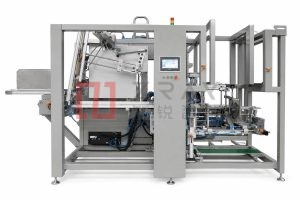
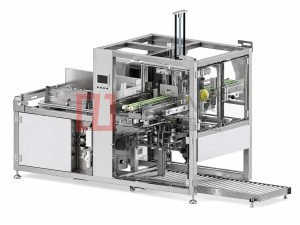
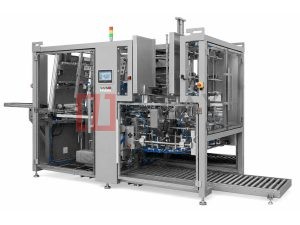
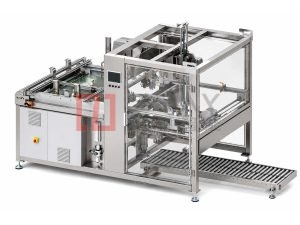
If you change size once or twice per shift and run 500,000+ cases a year, look at the Double-Head High-Speed Case Former, which keeps one head running while the other is being re-set. If you have smaller batches and limited floor space, the Single-Piece Case Erector gives you recipe-based multi-size capability at a fraction of the footprint.
The Bottom Line
Changeover time is a design property, not an operator skill. Stored recipes, scale-marked tooling, servo positioning and a written procedure are what move a plant from 30-minute switches to 8-minute switches. Measure your current changeover time this week — record the breakdown table above on a clipboard for ten switches and you will see exactly where the minutes live.
Get a Changeover-Focused Quote
We build the machine around your SKU mix, not the other way around. Send us your box size range, board grades and shift pattern, and our engineers will return a changeover time estimate with the quotation. We respond to every inquiry within 24 working hours.
- Email: [email protected]
- WhatsApp: +86 13681839278
- Inquiry form: https://www.cartonerecting.com/en/contact/
Want To Know More About Our Upgraded Machines?
Send your carton specifications and output demand, our engineer will provide free technical scheme & quotation
Latest Products
Subscribe To Get Latest News & Technical Guides
Leave your business email to receive free industry articles and new product updates