
How ZRAY Custom Carton Erecting Machines Solved High Jam Rates for a Global E-commerce Hub
Case study | August 2026
A global e-commerce fulfillment hub in Central Europe was running 24/7 through peak season with one persistent problem: their carton erecting line jammed more often than their network benchmark allowed. Average erecting uptime sat at 78%, and every jam meant a cascade of downstream stops — packers idling, sortation queues backing up, and rework crews hand-folding blanks that the machine had rejected.
The Customer’s Pain Points
The hub processes 45,000–60,000 orders per day, with boxes ranging from small E-flute cartons to large double-wall shipping cases. Their pain points were specific and measurable:
- Jam rate of 6–8%. The legacy erector jammed on roughly one in every 15 blanks. The root causes were never pinned down because the machine had no diagnostic logging.
- Five board types in rotation. The hub ran E-flute, B-flute, and C-flute single-wall, plus BC-flute double-wall for heavy items, and a coated (moisture-resistant) grade for cosmetics. Each grade had slightly different caliper and crease behavior, and the fixed-mechanics erector could not adapt.
- Seasonal 3× throughput. November traffic tripled order volume, and the erector’s jam rate roughly tripled with it — exactly when downtime cost the most.
- Manual rework cost. Rejected blanks were folded by hand. During peak weeks, the hub hired 12–15 temporary workers just for blank rework and jam recovery.
The Solution: A Custom-Configured ZRAY Case Erector
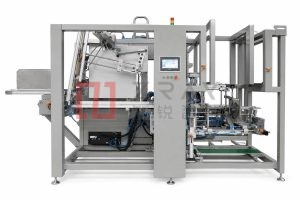
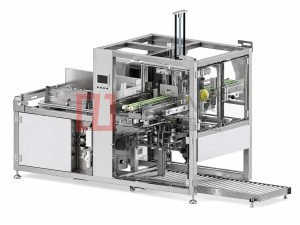
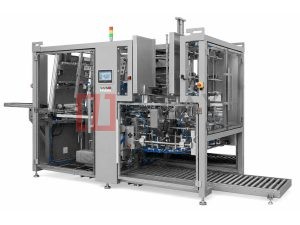
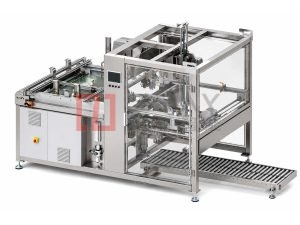
ZRAY built a custom configuration around the single-piece case erector platform, with three key modifications driven by the hub’s data:
1. Board-Adaptive Feed and Folding
- Servo-driven pick-and-place feed with vacuum detection on every cycle: if a blank is picked partially or doubles up, the machine rejects it cleanly instead of feeding it into the folder.
- Per-recipe folding pressure profiles for all five board types, stored in the PLC. The folding force, timing, and crease compensation are tuned per grade — the coated cosmetics grade runs a gentler profile to avoid crease splitting.
- Caliper auto-sensing at the feed gate: an optical sensor measures blank thickness every 50th blank and triggers a recipe re-check if the board runs out of tolerance.
2. Jam Prediction Instead of Jam Reaction
- PLC with 500-event fault logging and an Ethernet link to the hub’s SCADA, so every mis-feed, double-pick, and sensor timing fault is time-stamped and categorized.
- Feed-speed ramping: the machine starts each batch at 60% speed and ramps to 100% over the first 60 blanks, letting operators see any board issue before full-speed jamming.
- Predictive wear alert: the PLC tracks cycle count on vacuum cups and folding shoes, flagging replacement at the manufacturer’s recommended interval rather than after a jam spike.
3. Peak-Season Capacity Design
- The machine is rated at 18 CPM continuous but sized with a 40% duty-cycle headroom, so the hub’s peak-week demand (13 CPM sustained) runs without the machine near its limits.
- A quick-change magazine allows the second operator to preload the next board grade while the first batch is running, cutting grade changeover from 20 minutes to under 3 minutes.
Results and ROI
The hub measured 8 months of data before and 6 months after commissioning:
| Metric | Before | After | Change |
|---|---|---|---|
| Erector jam rate | 6–8% of blanks | 0.9% | −87% |
| Erector uptime | 78% | 95.2% | +17.2 pp |
| Temporary rework staff (peak weeks) | 12–15 workers | 0 | eliminated |
| Grade changeover time | 20 min | under 3 min | −85% |
| Manual blank rework | ~4,500 blanks/week (peak) | ~300/week | −93% |
Annualized savings:
- Temporary labor eliminated: USD 68,000
- Rejected blank scrap reduced: USD 19,500
- Downstream packer idle time recovered: USD 31,000
- Total: USD 118,500 per year, against a machine investment of USD 96,000 — payback in 9.7 months.
Beyond the dollars: the erector’s diagnostic logging fed directly into the hub’s continuous improvement program. The SCADA link identified that 60% of all remaining mis-feeds traced to one board supplier’s batch variance — a finding that became a supplier quality negotiation point, not a machine problem.
ROI Summary Table
| Item | Value |
|---|---|
| Investment | USD 96,000 |
| Annual savings | USD 118,500 |
| Payback | 9.7 months |
| Jam rate reduction | −87% |
| Temporary staff eliminated | 12–15 workers in peak |
The Pattern We See Repeatedly
High jam rates are rarely “just a machine problem.” They are usually a mismatch between board variability and fixed mechanics, amplified by a lack of diagnostics. A custom-configured erector with adaptive feed, recipe-based folding, and real fault logging closes that gap in a way that generic machines cannot.
If your erecting line is running below 90% uptime, tell us your jam log — even a screenshot is enough to start. Request a jam-rate reduction analysis or message us on WhatsApp at +86 13681839278.
Want To Know More About Our Upgraded Machines?
Send your carton specifications and output demand, our engineer will provide free technical scheme & quotation
Latest Products
Subscribe To Get Latest News & Technical Guides
Leave your business email to receive free industry articles and new product updates