
How to Prevent Carton Jamming in Automatic Case Erector at 30-40 CPM High-Speed Runs | ZRAY
A case erector that jams once every 3,000 boxes costs more than the machine itself. We have seen it on beverage, detergent, and food lines: at 35-40 CPM, one jam inside the forming station takes 3-8 minutes to clear, and at that rate you lose 100-300 boxes of output per jam. Run a line at 95% OEE and you can absorb that. Run it at 30-40 CPM and you cannot.
This article is written from the maintenance floor, not the brochure. We walk through the five root causes of carton jamming at high speed, the PLC alarm codes you will actually see, the board specifications that matter, and a maintenance schedule that keeps a ZRAY case erector running 24/7 without surprises.
Why Jamming Gets Worse as Speed Rises
Mechanical jams are rare at 10 CPM. They become routine at 35+ CPM for a simple reason: every cycle is a race between the vacuum pickup and the forming mandrel, and the window between “box fully open” and “mandrel enters” shrinks as cycle time drops below 1.7 seconds.
At 40 CPM, one full cycle is 1.5 seconds. Within that window the machine must:
- Pick a flat blank from the magazine with four vacuum cups
- Pull the blank against the back plate to break the score lines
- Rotate the blank 90° while a second cup set holds the trailing panel
- Open the four flaps square against stops
- Drive the mandrel through, fold the bottom flaps, and apply tape or glue
Any one of these steps falling out of tolerance — low vacuum, a soft board, a sticky flap, worn cup — produces a jam. At high speed there is no time for the servo or PLC to recover, so the machine faults instead.
Root Cause 1: Vacuum Loss on the Pickup Cups
The pickup is the single most common jamming point on any case erector. We measure suction at the cup face, not at the pump. A pump rated at 200 m³/h with a clogged filter can deliver less than half that to the cup.
Check this first:
- Vacuum level at the cup: target −0.055 to −0.065 MPa (−55 to −65 kPa) for standard B/C-flute boards. Below −0.045 MPa with a 40 CPM cycle, the blank will slip or only partially lift, and the magazine feed jams on the next cycle.
- Suction cup condition: EPDM cups on a high-speed line last 4-6 months of 24/7 operation. A hardened or glazed cup loses grip on dusty recycled board. Replace cups as a set, not one at a time.
- Filter and silencer: clean or replace the vacuum filter every 2 weeks on dusty lines. A blocked silencer raises backpressure and drops pickup force.
- Check-valve response: the anti-drop check valves must close in under 0.2 s. Sluggish valves cause the blank to sag into the guide rails.
In our own machines, the vacuum system uses SMC vacuum generators per cup set with individual pressure switches. If one zone drops below setpoint, the PLC faults before the blank is fed — this is the difference between a controlled stop and a jam you have to clear by hand.
Root Cause 2: Board Quality and Moisture
You cannot tune a machine around bad board, but you can protect against the common variations:
- High moisture (>9%) softens the score lines. The flaps fold, then spring back. On a fast mandrel stroke the flap edge catches the mandrel corner and jams. Mitigation: store blanks on pallets off the concrete floor, keep the warehouse at 50-70% RH, and do not run boards that have been stored under a leaking roof.
- Low-grade recycled board with short fibers is brittle. The score lines crack instead of folding, and the resulting flap lip catches. Mitigation: increase fold dwell at the flap-folding station by 100-150 ms in the HMI parameters, or switch to a slightly heavier single-wall grade.
- Warped blanks (cup or bow across the length) will not seat in the magazine stack. Set the magazine side guides to board thickness + 2 mm, and use the rear pusher force within the range in the parameter table below.
Board grades our machines run consistently
| Grade | Thickness | Typical use | Notes |
|---|---|---|---|
| E-flute single wall | 1.5–1.8 mm | cosmetics, electronics | runs fine, keep vacuum −0.06 MPa |
| B-flute single wall | 2.5–3.0 mm | general freight | standard for most lines |
| C-flute single wall | 3.5–4.0 mm | beverage, canned goods | heavy blanks, check magazine capacity |
| EB-flute double wall | 4.5–5.5 mm | high-value electronics | needs stiffer vacuum cups |
| BC-flute double wall | 6.0–7.0 mm | 20-25 kg freight | use Three-Piece machine for 30 kg+ |
Board basis weight on our lines: 200–500 gsm liner + fluting. For jamming control, what matters is not the gsm alone but the flute crush resistance — a C-flute board crushed at the score area jams the mandrel entry every time. If your supplier crush-scores instead of rotary-scores, ask for the crease depth spec.
Root Cause 3: Magazine Feed and Blank Separation
The magazine is the second most common fault zone. At high speed the friction between the bottom blank and the feed belt must be exactly right:
- Too little friction: the blank does not reach the stop fingers; the pickup grabs air and faults.
- Too much friction: two blanks feed together (double feed). The machine detects this via a thickness sensor and faults, but a fast double feed can still wedge between the guides.
Separation rules:
- Use magnetized or brushed separators for coated and glossy boards.
- Set the feed belt pressure so a single blank weighs 1.5-2.0 kg of belt force (measure with a pull gauge at the stop finger).
- For double-wall blanks over 5 mm thick, reduce magazine stack height to 400 mm to cut the weight pressing on the bottom blank.
Root Cause 4: Pneumatic Pressure Drops Under Load
A case erector uses 0.5–0.7 MPa shop air. The problem is not the steady pressure — it is the pressure dip during simultaneous cylinder strokes. When the forming mandrel, the four flap folders, and the pusher all fire in the same 200 ms window, the line pressure can drop 0.1-0.15 MPa if the air receiver is undersized.
Symptoms of a dip: random jam at the same cycle position, alarms that appear only during full-speed runs, no fault when you jog the machine slowly.
Fixes:
- Air receiver: minimum 100 L for a single machine, 200 L for two machines on one compressor.
- Pipe diameter: 1/2″ minimum to the machine, 3/4″ preferred over 15 m runs.
- Set the machine’s inlet pressure regulator at 0.6 MPa, never at the compressor limit.
- Check the SMC regulator and the moisture separator weekly; water in the line kills cylinder speed and causes late flap closure.
PLC Alarm Codes and Reset Steps
These are the alarms you will see on a ZRAY machine with Siemens PLC and HMI. The codes are consistent across our case erector family.
| Code | Alarm text | Meaning | Reset procedure |
|---|---|---|---|
| E01 | Air Pressure Low | inlet below 0.45 MPa | check compressor, receiver, regulator; restore ≥0.5 MPa, press RESET |
| E02 | Vacuum Low | pickup zone below −0.045 MPa | clean filter, check cups, check generator; press RESET after vacuum restores |
| E05 | Double Feed Detected | thickness sensor sees 2 blanks | remove stuck blanks from magazine, realign stack, press RESET |
| E08 | Box Not Formed | box sensor after mandrel did not detect open box | open guard, remove blank from forming area, check mandrel position sensor |
| E12 | Servo Torque Fault | mandrel or feed servo overloaded | check for jam in forming station, check board thickness vs guide setting |
| E15 | Glue Temp Low | hot-melt tank below 150°C | wait for tank to reach setpoint, check heater and thermocouple |
| E22 | Tape Not Applied | tape head cycle incomplete | check tape roll, threading, and head piston |
Golden rule for clearing jams safely: always isolate the machine (E-stop), open the interlocked guard, and only then remove the wedged blank. Never reach into the forming station while the PLC is in auto mode — the mandrel retract can cycle without warning.
Preventive Maintenance Schedule
A 30-40 CPM machine running 16 h/day accumulates ~35,000 cycles a week. The schedule below keeps jams near zero.
| Interval | Task |
|---|---|
| Daily | blow down vacuum filter and water separator; check air pressure on HMI; wipe photoelectric sensors (flap, box, magazine) |
| Weekly | inspect suction cups for wear/glaze; check tape roll and thread; verify magazine guide clearance = board + 2 mm |
| Monthly | clean vacuum generator filters; lubricate flap folder pivots and mandrel guide; check belt tension on feed conveyor |
| Quarterly | replace vacuum filter element; check all pneumatic fittings for leaks (soap test); verify sensor alignment and target marks |
| Half-year | replace suction cups as a set; service tape heads (new rollers, springs); check PLC battery; torque-check mandrel mount bolts |
| Annual | full FAT-style inspection with our engineers; replace feed belts; recalibrate sensors; review alarm history log with our service team |
Keep a jam log — every fault with time, code, and board grade. In our experience the log tells you in two weeks whether the problem is machine or material, and that is the fastest path to zero-jam operation.
Troubleshooting Flow for a Recurring Jam
When the same jam repeats at the same cycle position:
- Log the fault code and cycle position (the HMI records it).
- Run the cycle at 50% speed. If it disappears, suspect vacuum, air pressure dip, or servo timing.
- Check the board. Measure moisture and thickness against the guide setting.
- Clean the sensors in the fault zone. A dust film on a flap sensor can be the whole problem.
- Check the cups. A worn cup is the #1 hidden cause of “intermittent” jams.
- If it persists, run the alarm history export and send it to ZRAY — our remote diagnostic support reads the Siemens log directly.
Why High-Speed Lines Need the Right Machine Architecture
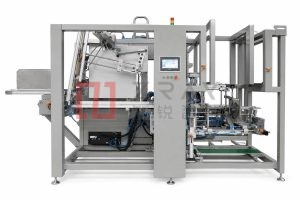
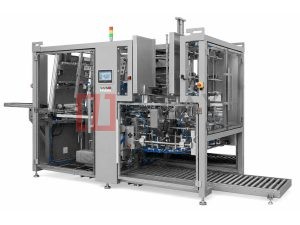
The best prevention is a machine designed so jams cannot wedge. In our Double-Head High-Speed Case Former Series, the two forming heads alternate, giving each head a full 2.5-3.0 s cycle at a combined 40 CPM. The longer effective cycle time means vacuum recovery, flap folding, and mandrel entry each get more time — and that is the single biggest structural reason our high-speed machines hold a low carton jamming rate at sustained speed.
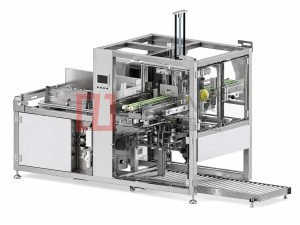
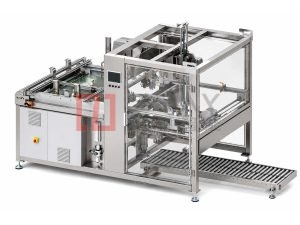
For facilities running 20-25 CPM in a compact footprint, our Single-Piece Case Erector uses the same vacuum-monitoring PLC logic, so the same alarm codes and maintenance schedule apply across your line.
Closing Checklist for Zero-Jam Operation
- Vacuum at cup: −0.055 to −0.065 MPa
- Air supply: ≥0.5 MPa at the inlet, no dip under load
- Board moisture: 7-9%, no crushed scores
- Cup set replaced every 6 months
- Sensors cleaned daily
- Jam log reviewed weekly
Do those six things and 30-40 CPM runs without the jam-clear drama. When you need a machine that keeps running through a 3-shift beverage or food line, talk to us.
Get a machine sized for your board grade and speed target. Email [email protected] or WhatsApp +86 13681839278 with your board spec, box size range, and target CPM. Our engineers reply within 24 working hours with a quotation, a layout drawing, and a FAT acceptance plan where you test with your own blanks before shipping. You can also send your box drawings and board specs directly via our inquiry page.
Want To Know More About Our Upgraded Machines?
Send your carton specifications and output demand, our engineer will provide free technical scheme & quotation
Latest Products
Subscribe To Get Latest News & Technical Guides
Leave your business email to receive free industry articles and new product updates