
How a Major Bottling Plant Saved $45,000 a Year with ZRAY Hot-Melt Case Erectors
Case study | August 2026
A regional bottled-water producer in Southeast Asia was doing what most mid-size bottlers still do: forming corrugated cases by hand. Three filling lines, 18 operators rotating on case erecting shifts, and a monthly scrap bill that nobody wanted to talk about. This is the story of how two ZRAY hot-melt case erectors changed the numbers — and why the plant now budgets for automation instead of overtime.
The Customer’s Pain Points
The plant runs three lines: two for 0.5 L PET bottles at 12,000–15,000 bph, and one for 1.5 L bottles at 9,000 bph. Total output crosses 1.2 million cases per year — well past the volume where hand erecting starts to break down.
What they were dealing with:
- Labor cost and turnover. Case erecting consumed 18 operator-hours per shift. In a tight labor market, the plant re-trained new packers every month, and output per shift varied by 30% depending on who was on the line.
- Inconsistent case quality. Hand-formed cases often had incompletely folded bottom flaps, which jams the case packer downstream. The plant logged an average of 4–6 jams per shift caused by bad cases.
- Leaking hot-melt glue joints. The manual glue application — a handheld gun — produced uneven bead profiles. Bottom-seal failures showed up on the palletizer as collapsed cases, roughly 120–150 collapsed cases per month.
- Hidden costs. Scrapped blanks, re-packing labor, and line stoppages were booked to different cost centers, so nobody had a single number for “bad case handling.” That number, once we helped them measure it, was USD 7,800–9,500 per month.
The Solution: Two ZRAY Hot-Melt Case Erectors
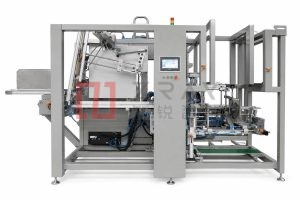
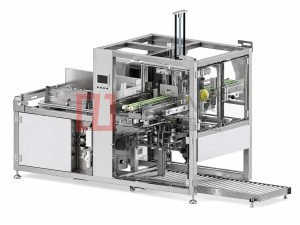
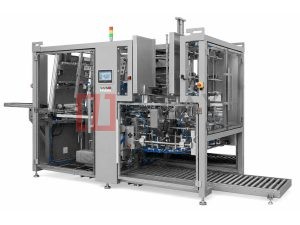
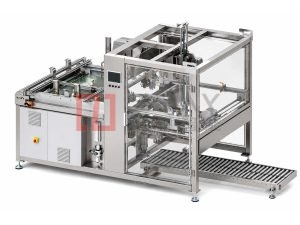
After a site survey, ZRAY deployed two double-head high-speed case formers with hot-melt systems — one on the 0.5 L lines, one on the 1.5 L line. Key configuration choices:
- Double-head erecting at 24–40 CPM, sized so each machine covers the fastest line with 30% headroom.
- Hot-melt glue system with four-gun bottom application and a closed-loop temperature controller holding the tank at 165 ± 3 °C. For the plant’s single-wall B-flute blanks, we specified a 1.0 mm glue bead with a 2.5 mm offset from the fold line — enough bond area for the 14 kg case weight without starving the fibreboard of adhesive.
- PLC recipe memory for three board sizes (335×245×120 mm, 420×300×170 mm, 485×335×215 mm), so changeover takes under 2 minutes with no tooling.
- Safety interlocks on all guards, meeting the CE guarding standard, so the plant could reallocate the former hand-erecting team without new safety training overhead.
The machines were installed during a scheduled weekend stop; line integration took 48 hours including conveyor synchronization with the existing case packers.
Results and ROI
Six months of production data, audited with the plant’s own ERP figures:
| Metric | Before | After | Change |
|---|---|---|---|
| Operators on case erecting | 18 per shift | 2 per shift (line supervision) | −89% labor |
| Jam rate from bad cases | 4–6 per shift | 0.3 per shift | −93% |
| Collapsed cases on palletizer | 120–150 / month | 5–8 / month | −95% |
| Glue usage | 2.1 g per case (hand gun) | 1.4 g per case (metered system) | −33% adhesive |
| Line availability | 82% | 94.5% | +12.5 pp |
The annualized savings break down as:
- Labor: USD 31,000 (16 reallocated operators at blended cost)
- Glue: USD 6,400
- Scrap blanks + collapsed-case rework: USD 5,200
- Line stoppage recovery (extra production): USD 2,400
Total: USD 45,000 per year, against a machine investment that the plant financed over 24 months. Payback landed at 11 months, and the two machines have run over 6,000 hours combined with one scheduled hot-melt tank service.
What the Plant Manager Said
“The first month we didn’t believe the numbers. Then we looked at the overtime budget, and it just disappeared. We’ve ordered a third machine for a new line opening next quarter.”
Is Your Volume at the Tipping Point?
As a rule of thumb, if you are hand-erecting more than 300,000–500,000 cases per year, the payback math on an automatic case erector usually works in your favor — and the benefits in consistency and uptime go beyond the spreadsheet.
Tell us your line speed, case sizes, and current board grades, and our engineers will build you a cost-comparison sheet before you spend a dollar. Request a case-erecting ROI calculation or message us on WhatsApp at +86 13681839278.
Want To Know More About Our Upgraded Machines?
Send your carton specifications and output demand, our engineer will provide free technical scheme & quotation
Latest Products
Subscribe To Get Latest News & Technical Guides
Leave your business email to receive free industry articles and new product updates