
Hot-Melt Glue vs Tape Sealing for Heavy Beverage Case Formers (Up to 30 CPM, BC Flute 6–7 mm) | ZRAY
Every beverage plant that upgrades from manual case setup to an automatic case erector hits the same fork in the road: glue-sealed bottom or tape-sealed bottom. The choice is not cosmetic. It decides your adhesive cost per case, your line uptime, your flap quality, and how much space the machine eats on the floor. This article compares hot-melt glue and tape sealing specifically for heavy beverage cases — 24-bottle water crates, 12-can packs, and export beverage cartons that ride on BC-flute double-wall board — and tells you what we configure on ZRAY machines.
What “heavy beverage case” means in board terms
Before you compare adhesives, you need to know what board you are actually sealing. Beverage cases sit at the heavy end of corrugated board:
| Board grade | Flute | Caliper (thickness) | Typical grammage | Typical use |
|---|---|---|---|---|
| Single wall B | B | 2.5–3.0 mm | 250–320 gsm | 6-packs, lightweight juice cartons |
| Single wall C | C | 3.5–4.0 mm | 300–400 gsm | 12-bottle crates, export retail boxes |
| Single wall E | E | 1.5–1.8 mm | 200–300 gsm | printed retail display cases |
| Double wall BC | BC | 6.0–7.0 mm | 450–500 gsm | 24-packs, export beverage shippers |
| Double wall EB | EB | 4.5–5.5 mm | 400–450 gsm | high-print premium beverage cartons |
The takeaway: a 24-pack of 0.5 L cans in a BC-flute case weighs 12–16 kg loaded. The bottom flaps carry that whole weight on the conveyor, through the palletizer, and across the truck. The seal joint on those flaps gets stressed in ways a light e-commerce box never sees.
How the bottom flap actually gets closed on a case erector
A case erector forms the box from a flat blank, closes and seals the bottom flaps, then delivers the open-top case to your packing line. On ZRAY machines, the bottom-forming sequence is:
- Blank pickup from the magazine (vacuum suction feed, one blank at a time).
- Square-up station opens the blank and forces all four crease lines.
- Flap folding — the short flaps (minor flaps) fold first, then the long flaps (major flaps) close over them.
- Sealing station — glue is applied to the minor flap tips, or tape is laid across the major flap seam, then a compression section holds the joint while the adhesive sets.
- Case exit — the erected case transfers to the packing conveyor, typically at 20–30 CPM on a single-head beverage line.
That sealing station is where the glue-vs-tape decision is physically made. Let’s look at both methods with the numbers that matter.
Hot-melt glue: how it behaves on heavy board
Hot-melt adhesive is a thermoplastic — an EVA (ethylene-vinyl acetate) base for most beverage applications. It is solid at room temperature, melted in a tank, and applied as a thin bead or swirl pattern on the flap tips.
The numbers that matter on a ZRAY glue system:
- Tank temperature: 150–170°C (302–338°F). Run it colder and the adhesive stays viscous and strings; run it hotter and you get charring, smoke, and carbonized particles in the nozzle.
- Hose and applicator temperature: held 5–10°C above tank setpoint to prevent cold spots in the delivery line.
- Typical consumption: 2.5–5 g of glue per case bottom (two flap tips × bead width). At 25 CPM and 4 g/case, that is roughly 3.6 kg of hot melt per hour.
- Open time: 1.5–3 seconds at 160°C depending on ambient temperature. Your compression section must hold the flaps inside that window.
- Compression time: 3–5 seconds for heavy BC board. If you use a cold-cure or slower-adhesive grade, extend compression to 6–8 seconds.
Why glue wins on heavy beverage cases:
- Creep resistance. Loaded 24-packs sit in stacks of 12–14 high. EVA hot melt holds the bottom seam under static load; tape joints in the same warehouse conditions can creep and bulge.
- No tape flap bulk. Tape creates a raised seam on the outside. In humid bottling plants the tape edges peel, collect dust, and snag on conveyor guides.
- Lower consumable cost at volume. At 4 g/case, hot melt costs roughly $0.004–0.008 per case in adhesive, versus $0.015–0.03 per case in quality tape, depending on board width and your region.
- Faster machine cycle. Glue sealing needs no tape head timing, no tape knife, no roll change every few thousand cases.
Where glue demands discipline:
- Temperature control is mandatory. A Glue Temp Low alarm stops the machine at the right moment — you should never run a batch with the tank below 145°C.
- Board moisture matters. Recycled board with high moisture absorbs heat from the adhesive bead and shortens the effective open time.
- Daily purge of the nozzle tips prevents char build-up.
Tape sealing: what it costs and where it fails
Pressure-sensitive tape (typically 48–75 mm wide, polypropylene or PVC) is applied across the major flap seam, folded around both edges. Tape units are simpler to run — no heated tank, no nozzle cleaning, no warm-up time.
Tape unit specs on case erectors:
- Tape width: 48 mm (standard), 60–75 mm for heavy export cases.
- Roll length: 750–1,000 m typical. At 25 CPM and ~400 mm of tape per case, one roll runs roughly 1.5–2 hours.
- Air pressure to tape head: 0.5–0.7 MPa (same plant air the rest of the machine uses).
- Blade sharpness: a dull blade causes tape pull-back — one of the most common reasons we see a “tape head fault” logged on the PLC.
Where tape fails on heavy beverage cases:
- Peeling under humidity. Bottling plants run 60–85% RH. Tape adhesion drops, and the seam lifts on the truck.
- Creep under stack load. Twelve pallet layers of 14 kg each compress the bottom tape joint; over weeks the case bulges and starts to rack.
- Cost at volume. Tape is a fixed cost per linear meter; glue cost scales with the tiny bead. Above roughly 150,000–200,000 cases per year, glue almost always wins on consumables alone.
- Changeover time. Every tape roll change is a 3–5 minute stoppage. Glue tanks run continuously; you only stop for granule refill every few hours.
Where tape genuinely makes sense: short production runs (under 50,000 cases/year), multi-format lines where you want zero warm-up, cold warehouse environments, and plants that cannot guarantee a stable glue-tank temperature.
Head-to-head: glue vs tape on a beverage case erector
| Factor | Hot-melt glue | Tape |
|---|---|---|
| Consumable cost per case | $0.004–0.008 | $0.015–0.03 |
| Speed impact | None (continuous tank) | Roll changes every 1.5–2 h |
| Bottom joint strength under stack load | High (creep-resistant) | Moderate (creep over time) |
| Humidity performance | Stable | Peels above 60% RH |
| Warm-up time | 20–30 min (tank from cold) | None |
| Housekeeping | Nozzle purge daily, tank clean weekly | Blade swap, tape dust |
| Best fit | >150,000 cases/yr, heavy board, export | Short runs, cold stores, light board |
The ZRAY configuration for heavy beverage lines
When we build a case erector for a beverage customer running BC-flute export cartons at 25–30 CPM, the typical specification looks like this:
| Parameter | Value |
|---|---|
| Output speed | Up to 30 CPM (single head) |
| Case size range (L × W × H) | 200–500 × 150–400 × 100–400 mm |
| Board | BC double wall, 6–7 mm, 450–500 gsm |
| Glue system | EVA hot melt, twin 20 L tank |
| Tank temperature | 150–170°C |
| Compression section | 4–5 s hold, pneumatically timed |
| Air supply | 0.5–0.7 MPa, ~600 L/min |
| Control | Siemens PLC, Schneider contactors, SMC pneumatics |
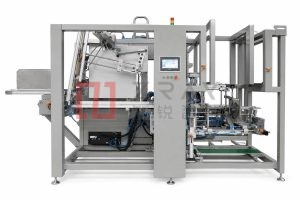
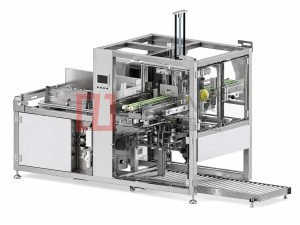
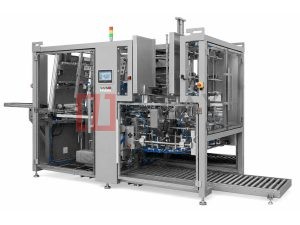
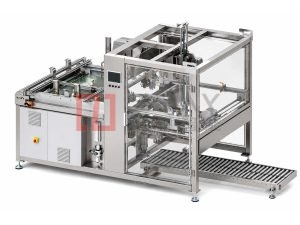
If your output is higher — say a double-head line doing 50–60 CPM on heavy beverage shippers — the same sealing logic applies but you run two glue systems with independent temperature control. That configuration is exactly what we ship on the Double-Head High-Speed Case Former Series, which holds glue temperature per head and logs both zones on the HMI.
PLC alarms you will meet on a glue-sealed machine
We wire three sealing-related alarms into every ZRAY glue-equipped erector. Treat them as control points, not failures:
- Glue Temp Low (Alarm A-210): tank below setpoint. Do not feed blanks — adhesive will not wet out on BC board. Check heater relay, thermocouple, and that the tank is actually filled.
- Glue Pressure Low (Alarm A-211): pump pressure dropped below 0.3 MPa. Check the pump diaphragm, the filter screen in the tank, and trapped air in the feed line.
- Nozzle Block (Alarm A-212): pressure spikes above 0.8 MPa. Purge the nozzle, check for char, and confirm the nozzle tip is not too close to the flap.
On tape-equipped machines the equivalent alarms are Tape Low and Tape Head Fault — both resolved by roll change, blade inspection, and cleaning the applicator roller.
Maintenance schedule that keeps the seal joint honest
| Interval | Task |
|---|---|
| Daily | Purge glue nozzles 5 s before startup; check tank fill; inspect tape roll (tape machines); wipe photoeyes and vacuum ports |
| Weekly | Drain condensate from air filter/regulator; check glue pump pressure; inspect compression rollers for adhesive build-up |
| Monthly | Clean the glue tank and change the filter screen; check hose and nozzle temps against HMI log; inspect flap folders for wear |
| Quarterly | Check calibration of glue pump output (grams per stroke); replace wear strips on the magazine; inspect all SMC valves for leaks |
| Semi-annual | Full tank teardown, check heater coils and thermocouples; replace belts; verify CPM output against spec |
Decision matrix: which sealing method for your line
Choose hot-melt glue when:
- You run more than 150,000 cases per year on heavy BC/EB board.
- Your cases go through humid filling halls or long warehouse dwell.
- You stack 10+ pallet layers and need the seam to hold under static load.
- You want the lowest per-case consumable cost at high volume.
Choose tape when:
- Runs are short and formats change often.
- Your plant has no compressed air or you want a fully electric tape head.
- Board is light (B/E single wall) and loads are low.
- You operate in cold storage where glue open-time gets unpredictable.
For heavy beverage work we recommend glue sealing on single-wall B or C board for lighter packs, and on BC double wall for anything over ~10 kg packed weight. If you process over 500,000 cases per year on heavy shippers, explore our Automatic High-Speed Case Former Series to reduce material costs per box. For medium-volume beverage lines and 6–12 pack formats, the Single-Piece Case Erector is the workhorse — same sealing quality, smaller footprint.
Ask us to run the numbers on your actual case
Adhesive and tape suppliers quote differently, board moisture varies by region, and your packed weight decides the safety factor. What we can do is pull your real blank, your real packed case weight, and your real annual volume, then hand you a per-case cost comparison and a recommended sealing configuration. Every ZRAY machine ships with CE & EAC certification, a 12-month warranty, and FAT acceptance where we run your actual carton samples before delivery.
Email us at [email protected], or message us on WhatsApp at +86 13681839278. Send us your blank dimensions, board grade, and annual volume, and we will come back with the glue-vs-tape recommendation and a quote within 24 working hours. Prefer the inquiry form? Fill it out on our contact page — our sales engineers respond with the machine spec and pricing, typically the same day.
Want To Know More About Our Upgraded Machines?
Send your carton specifications and output demand, our engineer will provide free technical scheme & quotation
Latest Products
Subscribe To Get Latest News & Technical Guides
Leave your business email to receive free industry articles and new product updates