
High-Speed Tray & Case Formers for Bulk Fresh Produce (Up to 50 CPM) | ZRAY
Fresh produce lines punish machines that were designed for dry goods. High humidity, cold washdown areas, heavyweight wet-packed blanks, and a belt speed that never drops during the season — these conditions expose every weak point in a case former. We have built tray and case formers for high-volume food packers, and the machines we ship into produce plants are speced differently from a standard dry-goods erector: stainless contact surfaces, sealed vacuum paths, higher glue capacity, and motors that handle longer duty cycles.
This article covers how to run bulk fresh produce packaging at speed, what the ZRAY high-speed tray and case formers change versus a standard erector, and the operating details that keep a produce line at target CPM from the first shift to the last day of harvest.
What Makes a Produce Line Different
A tomato, apple, or potato packing line is not a typical corrugated consumer goods line. The differences are structural:
- Moisture everywhere. Blanks stored on a produce floor pick up humidity. Board that reads 8% moisture at the door reads 12% by the second shift. Wet board is softer, creases differently, and jams more.
- Heavy per-case weight. Bulk packs for apples, citrus, or potatoes run 10–20 kg per case. The blank is thicker (usually B or BC flute), and the formed box has to carry that load in stacking.
- No tolerance for down time. In season, the line runs 16–20 hours a day. A 10-minute jam twice a day costs real tonnage.
- Graded SKU changes. Produce is sorted by size grade, so box size changes every hour or two as the grade changes.
The Tray + Case Two-Step, and How to Speed It Up
Bulk produce often ships in a two-part system: a tray that holds the product (open-top, short sides) and a case that covers and protects it, or a tray that is later topped by a telescoping cover. Running these two formats on the same machine is where the CPM target usually dies.
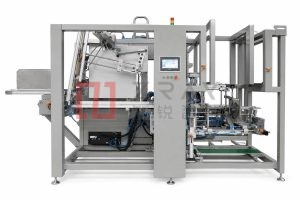
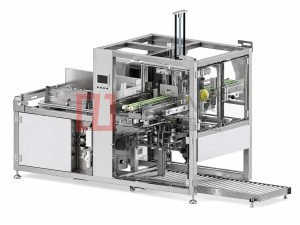
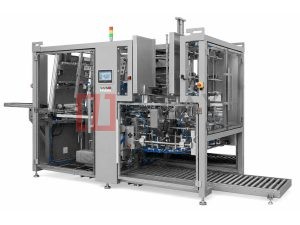
The ZRAY double-head high-speed case former handles this in one piece of equipment:
- Two forming heads alternate, so while head one is folding and sealing a tray, head two is picking a blank for the next case. Effective output is the sum of both heads without a pick-and-place dead zone between cycles.
- Tooling changeover between tray and case mode is handled by recipe recall. Servo strokes, crease depth, fold timing, and glue pattern are stored per format; switching takes minutes, not an hour of manual wrench work.
- Hot-melt application is adjustable per station. Trays use a minimal glue pattern (fewer nozzles, lower output) so the tray does not weep glue onto wet product; cases use a full perimeter seal.
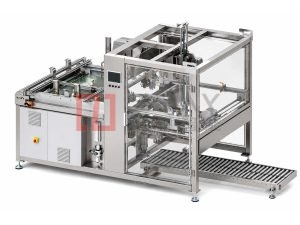
If you process over 500,000 cases per year and your produce output is gated by the former, explore our Double-Head High-Speed Case Former Series — it is the machine we install when a single head cannot hold the line rate. For lower volumes or cold-floor plants where space is tight, the Single-Piece Case Erector gives you the same forming quality at a smaller footprint and lower air consumption.
Technical Reference: ZRAY High-Speed Tray & Case Former
| Parameter | Single-head | Double-head |
|---|---|---|
| Output | 10–15 CPM | up to 50 CPM (both heads combined) |
| Case size range (L×W×H) | 200×150×100 – 800×600×600 mm | 200×150×100 – 800×600×600 mm |
| Board types | Single-wall B/C, double-wall EB/BC | Single-wall B/C, double-wall EB/BC |
| Board thickness | 1.5–7.0 mm | 1.5–7.0 mm |
| Air pressure | 0.5–0.7 MPa | 0.6–0.7 MPa |
| Hot-melt tank temp | 150–170 °C | 150–170 °C |
| Hot-melt tank capacity | 15–30 kg | 30–50 kg |
| Glue nozzles per station | 4–6 | 4–8 |
| Changeover time (recipe recall) | 3–5 min | 3–5 min |
| Vacuum source | blower, per-station monitoring | blower, per-station monitoring |
Note the hot-melt tank capacity on the double-head machine. In season you do not want to stop for a melt refill in the middle of a shift. At 50 CPM with a perimeter seal, melt consumption runs high enough that a 50 kg tank is the difference between one refill per shift and three.
PLC Alarms Specific to Produce Lines
The alarms below are the ones our service engineers actually walk through on produce lines, usually by remote video during season.
Alarm: Glue Temp Low
- Confirm the tank thermocouple reading against a contact thermometer. Produce-plant washdown water can freeze a cold splice on a bad connection.
- Check the melt level. An empty or low tank shows a temp drop before the heater trips.
- Inspect the heater element and wiring; in high-humidity rooms, terminal corrosion is the usual cause.
- Set the tank to 155–165 °C for standard EVA hot-melt. Do not run above 170 °C — wet board scorches and the glue degrades.
Alarm: Vacuum Low
- Blow out the cups and manifold. Produce dust and pulp fines are finer than dry-goods dust and block ports faster.
- Check cup lips; humidity accelerates wear on the lip edge.
- Confirm the blower inlet filter is dry. A wet filter collapses flow dramatically.
- If the alarm repeats on the same station only, check that station’s cup for a cracked stem.
Alarm: Box Not Formed
- Recheck the crease depth after a grade change. Board moisture shifted the caliper; add 0.3–0.5 mm and rerun.
- Verify the side guides against wet-swollen board. Guides set for dry board catch on swollen edges.
- Increase fold dwell by 0.2 s. Wet board springs back harder and needs a longer hold before sealing.
Maintenance Schedule for Produce Duty
| Interval | Task |
|---|---|
| Daily | Blow out vacuum cups and manifold; wipe hot-melt nozzles; check tank level; clear washdown water from control cabinet floor |
| Weekly | Drain FRL water (twice daily in wet season); inspect cup lips; check guide wear strips; verify glue pattern on a test box |
| Monthly | Calibrate glue nozzles; check servo belt tension; test safety interlocks; inspect electrical cabinet seals |
| Quarterly | Replace vacuum filters; grease slide rails; check tank heater and thermocouple; inspect pneumatic fittings for condensation |
| Semi-annual | Replace vacuum cups; full cabinet inspection; verify all guards and light curtains |
In a washdown plant we also recommend checking the electrical cabinet seals monthly. It sounds like housekeeping, but a fine water mist from a hose near the cabinet is the most common cause of intermittent electrical alarms on produce lines we troubleshoot remotely.
Produce SKU Profiles and Board Selection
A produce line rarely runs one board type. Grade changes and product families force a range. The table below is what we actually see on bulk produce lines, and it drives both the tooling and the recipe library:
| Product | Typical board | Thickness | Case weight |
|---|---|---|---|
| Apples (bulk) | BC double-wall | 6–7 mm | 15–18 kg/case |
| Citrus | B/C single-wall | 3–4 mm | 10–12 kg/case |
| Potatoes | BC double-wall | 6–7 mm | 18–20 kg/case |
| Tomatoes | B-flute | 2.5–3.0 mm | 8–10 kg/case |
| Onions | B/C single-wall | 3–4 mm | 12–15 kg/case |
Three rules for the board spec sheet when you quote a produce former:
- Specify ECT, not just the flute name. A BC board with ECT 32 stacks 10–12 cases high; ECT 23 does not. The erector must not crease the board so deeply that it drops the ECT below your stacking target. We tune crease depth on the servo mandrel to protect edge crush.
- Declare the moisture band. Board at 6% and board at 12% crease differently and spring back differently. If your plant is humid, set the wet-board recipe before the season starts, not when the first jam appears.
- Verify print-to-crease registration. On printed produce cartons a mis-registered crease makes the box skew even when the machine is perfect. Confirm your die-cut supplier’s tolerance during FAT so you are not debugging the machine for a board problem.
Layout Advice That Keeps CPM Up
Speed on a produce line is rarely a machine problem. It is a feed and discharge problem:
- Feed: Blanks should sit on a dry, tilted magazine that feeds the lowest-resistance corner first. On wet floors, elevate the magazine so the bottom blank never wicks water.
- Discharge: Match the former output to the case packer or the palletizer. If the packer is the bottleneck, a double-head former just stacks cases on the conveyor. Buy the machine that matches the system, not the fastest one that fits.
- Glue: Use a hot-melt that is specified for humidity. Standard EVA works, but PVA and low-temperature hot-melts have different open times that matter on wet board. Ask our engineers to match the adhesive to your board moisture before FAT.
Season Readiness: FAT and Remote Commissioning
Produce equipment has a brutal deadline: the harvest does not wait. Two practices keep the season start clean:
- FAT with your actual blanks. Ship a case of your real blanks (including some from the wet end of your storage) to our factory before shipment. We run them through the machine, form boxes, and record the recipe settings on video. You see the formed box before the machine leaves the floor.
- Remote video commissioning. Our engineers commission and tune the machine remotely with your team on site, walking through the alarms in this article live. On produce lines this has consistently shortened startup from days to a single shift.
- Spare parts before the season. Vacuum cups, cup stems, hot-melt nozzles, and a spare thermocouple cost little and are the difference between a 20-minute fix in season and a 3-day freight wait.
Verdict
Bulk fresh produce is a brutal application, but it is a solved one. The requirements are fixed: double-head output for season rates, humidity-resistant design, big glue capacity, recipe-based changeover for grade changes, and a maintenance schedule that matches the environment. The ZRAY double-head former delivers that package, and the single-piece unit covers smaller and colder floors.
Planning a produce line upgrade? Send us your case sizes, board spec, and target CPM. We respond within 24 working hours, and we can run FAT with your actual blanks and board moisture before shipping.
- Email: [email protected]
- WhatsApp: +86 13681839278
- Inquiry page: Contact ZRAY about High-Speed Produce Formers
Want To Know More About Our Upgraded Machines?
Send your carton specifications and output demand, our engineer will provide free technical scheme & quotation
Latest Products
Subscribe To Get Latest News & Technical Guides
Leave your business email to receive free industry articles and new product updates