
Fully Automatic vs Manual Box Folding: Labor Cost Analysis (Up to 40 CPM) | ZRAY
We have sat in enough break rooms and listened to enough shift managers to know that “manual folding is cheaper” is usually an argument made by someone who has never put a stopwatch on the line. A trained folder opens an RSC by hand in 12–18 seconds. A good one, working a full shift, tops out around 200–300 boxes per hour with an error rate you can see in the reject bin. An automatic erector runs at 12–40 CPM with nobody standing over it. The real question is not whether automation wins on throughput — it does — but how the numbers look when you include labor burden, defects, and the box sizes you actually run.
This is the analysis ZRAY engineers run before we quote anything, and it is the same model we use to justify a machine to a plant manager’s finance department.
What “Manual Box Folding” Really Costs
Manual folding looks simple because the labor rate looks small. The arithmetic falls apart when you add the real burden:
- Cycle time per box. 12–18 seconds per RSC at comfortable pace; call it 15 s average = 240 boxes/hour at 100% uptime.
- Realistic throughput. Nobody folds for 7.5 hours straight. Fatigue, drink breaks, and conversation cut a shift to 55–65% of theoretical = roughly 130–155 boxes per person-hour.
- Full labor burden. In the US/EU a packaging operator costs $18–35/hour all-in (wage + benefits + overhead). In high-wage regions that number passes $45.
- Defect cost. Hand-folded boxes get opened corners, mis-folded bottoms, and tape that lands crooked. A 2–4% defect rate on a line doing 300,000 boxes a year is 6,000–12,000 rejects.
- Headcount churn. Folding is the lowest-retention job on a packaging floor. Recruiting, training, and covering absences are real line costs.
The three-shift comparison
| Shift setup | Operators | Boxes per shift (8 h) | Annual boxes (3 shifts × 250 days) |
|---|---|---|---|
| Manual, single shift | 2 folders | 2,100–2,500 | 525,000–625,000 |
| Manual, two shifts | 4 folders | 4,200–5,000 | 1,050,000–1,250,000 |
| Automatic, one operator | 1 operator + machine | 11,500–17,000 | 2,900,000–4,300,000 |
The automatic line is not a “better manual line.” It is a different throughput class. That is the first mistake managers make: they compare one folder to one machine as if the machine were doing the same job. It is doing the job of five to eight people while one operator handles changeover and infeed.
The Break-Even Calculation ZRAY Engineers Actually Use
We calculate payback on four lines of cost. Build the table for your own plant before you talk to any supplier:
| Cost line | How to estimate | Example (mid-size food plant) |
|---|---|---|
| A. Direct labor saved | Manual operators removed × burden rate × hours | 6 operators × $22/h × 4,000 h = $528,000/yr |
| B. Defect reduction | Reject rate delta × annual volume × box cost | (4% − 0.8%) × 2,000,000 × $0.09 = $57,600/yr |
| C. Overtime/agency eliminated | Overtime hours × rate premium | $38,000/yr |
| D. Energy + maintenance | Machine kW × hours × rate + spares | ≈ $9,500/yr (added cost, subtract from savings) |
| Net annual saving | A + B + C − D | ≈ $614,100/yr |
Then divide machine price by net saving to get payback in years. A ZRAY machine with hot-melt bottom sealing costs roughly the same as 12–18 months of manual labor at that volume. Everything after month 18 is money you keep.
Rule of thumb: if your plant folds more than 500,000 boxes per year by hand, an automatic erector pays for itself on labor alone — before you count defect savings. Under 150,000/year, look hard at a semi-automatic unit or ask us about a used/entry machine.
Board Specs Matter More Than You Think
Labor cost is the headline, but board quality decides how much labor you actually need. We test every quote against real blanks, and these are the ranges that matter:
- Single wall: E flute 1.5–1.8 mm (200–350 gsm), B flute 2.5–3.0 mm (250–400 gsm), C flute 3.5–4.0 mm (300–500 gsm).
- Double wall: BC flute 6–7 mm (400–650 gsm), EB flute 4.5–5.5 mm (350–550 gsm).
- Burst strength: single wall 1,100–1,500 kPa; double wall 1,800–2,200 kPa.
Manual folding hits a wall at double wall. Two people are required just to break the score lines on a BC-flute box, and the opened box fights the folder the whole shift. This is where manual labor cost stops being linear. If your master cartons are double wall, the case for automation gets stronger, not weaker — an erector’s servo mandrel breaks those scores mechanically and does not tire.
PLC Alarms You Will Meet in the First Month
First-month learning is where manual-minded teams hesitate. Here are the alarms that actually show up, and the fix in three steps each:
Alarm: Air Pressure Low
- Check the compressor outlet: 0.5–0.7 MPa at the machine inlet, not at the tank.
- Inspect the FRL filter — a clogged filter element drops pressure at the machine even when the compressor runs.
- If pressure is fine at the inlet, check the regulator lock ring; vibration walks it down over a shift.
Alarm: Vacuum Low
- Verify the vacuum generator supply air and the filter inside the unit.
- Check suction cup lips for cuts; a 2 mm tear on one cup loses the whole pick pattern.
- Clean the vacuum line — paper dust packs in bends, and the first symptom is intermittent pickup on the bottom board.
Alarm: Box Not Formed
- Confirm the blank is within the size range for the active recipe.
- Check the crease depth — shallow creases on double wall produce incomplete folds.
- Look at the pick-up timing; a blank that arrives late to the mandrel misses the fold window.
Write these three onto a card next to the HMI. They cover 80% of first-month stoppages. Everything else is board variation, and we cover that in commissioning.
Maintenance Schedule That Keeps Labor Saving Real
A machine that stops is labor you still pay. The schedule below is what we ship with every unit and what keeps the labor-saving math true:
| Interval | Task |
|---|---|
| Daily | Clean vacuum cups; check tape/glue level; blow down filters; verify air pressure |
| Weekly | Inspect suction cup lips for wear; check guide rail clearance; lubricate slide bearings |
| Monthly | Test safety interlocks; inspect servo couplings; calibrate glue nozzle position |
| Quarterly | Replace FRL filter element; check vacuum generator; verify knife/tape head tension |
| Semi-annual | Full bearing inspection; electrical cabinet torque check; run a full-size test box |
Changeover and Product Mix
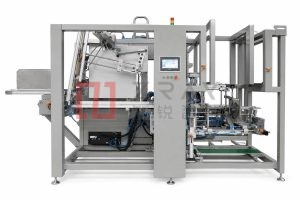
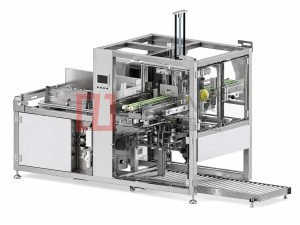
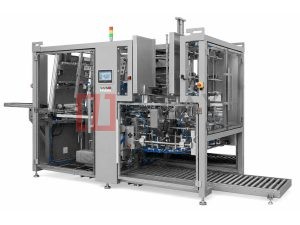
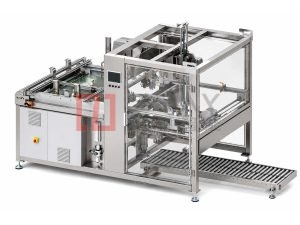
The second objection after labor is flexibility: “We run 30 SKUs.” We size the machine to your three highest-volume SKUs and set the rest as recipes. On our Single-Piece Case Erector, changeover between sizes takes 3–5 minutes with tool-less adjustments for length and width; height changes take under 10 minutes. One operator handles the changeover while the line keeps running downstream.
If you are running continuous 24/7 with a wide mix, the Double-Head High-Speed Case Former gives you up to 40 CPM per head and lets you switch SKUs without dropping below line speed. That is the machine to quote when the manual line is the bottleneck holding back the whole plant.
When Manual Still Makes Sense
Be honest: manual folding is not wrong in every plant.
- Volume under 150,000 boxes/year, single shift.
- Box size above 600 mm long where handling gets awkward and jams cost more than labor.
- Extreme board variation where every bundle is a different caliper and the operator’s hands absorb the variance.
Even then, a semi-automatic approach — manual feeding, machine forming — is worth pricing. What we rarely recommend is keeping a three-shift manual team at 1–2 million boxes a year. At that volume the payback arithmetic is not close.
Verdict
Run your own numbers with the table above. At 500,000+ boxes per year, an automatic erector pays for itself in 12–18 months on labor alone, then keeps saving the full labor burden every year after. At 2 million boxes, the comparison is not close: a ZRAY erector with one operator replaces 8–10 hand folders at 1/3 the defect rate.
Want us to run the payback calculation for your exact volume and labor rate? Send us your annual box volume, average box size, board spec, and operator burden rate. Our engineers reply within 24 working hours with a cost model you can take to your finance team.
- Email: [email protected]
- WhatsApp: +86 13681839278
- Inquiry page: Request a Labor Cost Analysis from ZRAY
Want To Know More About Our Upgraded Machines?
Send your carton specifications and output demand, our engineer will provide free technical scheme & quotation
Latest Products
Subscribe To Get Latest News & Technical Guides
Leave your business email to receive free industry articles and new product updates