
Case Erector vs Carton Former: What Is the Difference? ZRAY Engineers Explain (Up to 40 CPM) | ZRAY
In packaging procurement conversations, “case erector” and “carton former” get used interchangeably. On a technical data sheet they are not the same machine, and quoting the wrong one wastes weeks and thousands of dollars. The short version: a carton former opens and squares a pre-glued, flat-folded blank (single piece, side-seam glued); a case erector does the same job but on a heavier class of box — either a one-piece RSC or a three-piece box whose panels arrive unglued and must be assembled and fastened before they can be squared.
The rest is geometry, board weight, and speed. This article is the ZRAY engineering take on the difference, with the numbers that matter when you spec a line.
The Core Difference: What Goes into the Machine
| Feature | Carton former | Case erector |
|---|---|---|
| Incoming blank | Pre-glued side seam, fold-flat | RSC one-piece or 3-piece unglued panels |
| Board weight | 200–400 gsm typical | 250–650 gsm, often double wall |
| Board thickness | 1.5–4.0 mm (E/B/C single wall) | 2.5–7.0 mm (B/C single, BC/EB double wall) |
| Forming method | Open + square on mandrel | Open + square + fasten (glue or tape) |
| Output speed | Up to 40 CPM per head | 12–40 CPM per head |
| Typical case | Retail cartons, e-commerce boxes | Shipping master cartons, beverage cases |
The blank is the whole story. If your blank is delivered with a side seam already glued and folds flat, you are in carton former territory. If your boxes arrive as flat RSC blanks — or worse, as three separate panels — you need a case erector, and a three-piece one at that.
Two Sub-Families You Must Not Confuse
Case erectors split into two completely different machines, and this is where most quote errors happen:
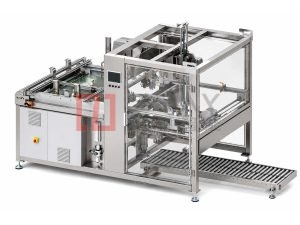
One-piece case erector. Takes a knocked-down RSC, opens it, squares it on a mandrel, and seals the bottom — usually hot-melt glue or tape. One operator, one blank, one machine. This is the workhorse for any plant running standard slotted boxes.
Three-piece case erector. Takes three separate panels: one long panel that forms the bottom and one side, plus two end panels. The machine feeds the panels, folds them into the box shape, applies glue to the leading edges, and presses the joints in a compression section while the adhesive sets. Three-piece boxes use roughly 15–25% less board than an RSC for the same volume, which is why heavy and awkward products ship in them.
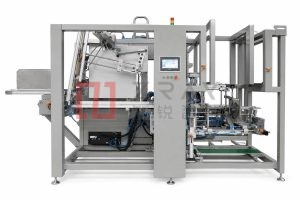
ZRAY builds both. The Three-Piece Case Erector is the machine to quote for master cartons that will carry 20 kg or more — double wall, heavy duty, freight-grade construction.
How the Forming Geometry Differs
The mandrel work looks similar on video and is nothing alike on the floor:
- Carton former geometry: blank is shallow, side seam already closed, so the former mainly pops the box open and pushes down the bottom flaps. Fold force is light; a servo mandrel or even a cam holds the shape while glue sets.
- One-piece erector geometry: the blank has four score lines on each face, two panels on each side, and a manufacturer’s joint. The mandrel must break both bottom scores, fold both side panels, and hold all four bottom flaps inside the glue/tape zone simultaneously.
- Three-piece erector geometry: the machine must register three independent panels in space. Panel feed timing, glue placement on both leading edges, and compression dwell are all servo- or PLC-coordinated, because a panel arriving 20 ms late produces a box that will not square.
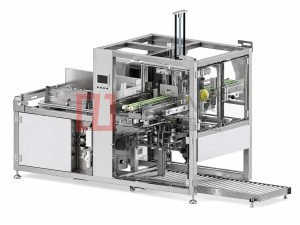
That is why the Single-Piece Case Erector runs a servo mandrel with ±0.05 mm positioning repeatability: on double-wall board, score-breaking force, dwell, and release timing decide whether the bottom corners stay at 90°. On a lightweight carton former those margins are far more forgiving.
Speed and Output Realities
“Up to 40 CPM” appears on both machine types, but it means different things:
- Carton former at 40 CPM forms, squares, and seals a pre-glued blank in under 1.5 seconds. The board is light, the folds are easy, and the limiting factor is usually the glue cure time in the compression section.
- Case erector at 40 CPM is the top of the class and typically only reached on double-head machines running single-wall board. A one-piece RSC in BC double wall runs closer to 12–20 CPM on a single head; trying to force 40 CPM cracks the liner at the scores.
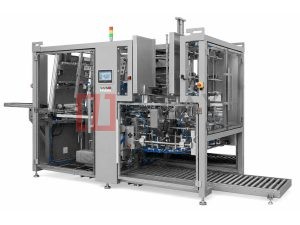
If your line genuinely needs 40 CPM on RSC boxes, the honest answer is two heads. The Double-Head High-Speed Case Former runs two forming heads alternately — each head gets twice the cycle time of the machine’s output, so the board has time to fold cleanly. That is the machine beverage and canning plants use when the packer downstream is waiting on boxes.
Box Dimensions That Decide the Machine
Beyond board weight, the box envelope decides which machine family fits. The dimension ranges overlap, but the selection logic does not:
| Dimension | Carton former | One-piece erector | Three-piece erector |
|---|---|---|---|
| Length | 80–400 mm | 200–600 mm | 300–800 mm |
| Width | 60–300 mm | 150–400 mm | 200–600 mm |
| Height | 30–200 mm | 100–500 mm | 100–600 mm |
| Max blank weight | 0.3 kg | 1.5 kg | 2.5 kg |
A beverage case at 400×300×250 mm sits firmly in erector territory. A folded paper food carton at 120×90×40 mm belongs on a carton former, where the smaller footprint and lighter tooling run that format economically. When a plant’s SKU range spans both, we spec two machines rather than one oversized unit — the changeover economics usually favor it.
Board Specs That Change the Machine Choice
We spec machines against board, not against a picture of a box. The deciding table:
| Board construction | Thickness | Grammage | Typical machine |
|---|---|---|---|
| E flute single wall | 1.5–1.8 mm | 200–350 gsm | Carton former |
| B flute single wall | 2.5–3.0 mm | 250–400 gsm | Carton former / one-piece erector |
| C flute single wall | 3.5–4.0 mm | 300–500 gsm | One-piece case erector |
| BC flute double wall | 6–7 mm | 400–650 gsm | One-piece / three-piece erector |
| EB flute double wall | 4.5–5.5 mm | 350–550 gsm | One-piece erector |
Burst strength is the other gate: double-wall board at 1,800–2,200 kPa needs the heavier frame, larger servo, and stronger vacuum pattern of a case erector. A carton former with 200 gsm suction cups will simply not pick a 650 gsm blank reliably.
PLC Alarms on Both Machine Types
Same platform, different failure modes. The three alarms we see most on erectors:
Alarm: Carton Not Formed / Box Not Formed
- Check the active recipe size against the blank in the magazine.
- On three-piece machines, verify panel feed timing in the recipe; the end panels must lead the long panel.
- Inspect the vacuum cup pattern — a blocked cup under the panel skips that fold.
Alarm: Glue Temp Low
- Allow the tank to reach 150–170 °C before running; cold glue does not wet out on double wall.
- Check the temperature probe seating — a loose probe reads low and keeps the heater on.
- Verify the glue is the grade specified for the board and ambient temperature.
Alarm: Squeeze Time / Compression Fault
- Confirm compression section length matches line speed; the box must stay under pressure until the glue sets.
- Reduce output speed by 10% and re-test — if the alarm clears, the cure time was marginal.
- On tape-sealed machines, check the tape head for a worn brake shoe.
Maintenance Schedule (Shared Platform)
| Interval | Task |
|---|---|
| Daily | Blow down the magazine vacuum line; check glue tank level; verify air pressure 0.5–0.7 MPa |
| Weekly | Inspect suction cup lips; check guide rails; lubricate mandrel slides |
| Monthly | Test interlocks; inspect servo couplings; clean glue nozzles |
| Quarterly | Replace FRL elements; check vacuum generators; verify tape-head tension |
| Semi-annual | Bearing inspection; electrical cabinet torque check; full-size test box |
Which One Do You Actually Need?
Ask your warehouse three questions:
- How does the blank arrive? Side-seam glued and flat → carton former. Knocked-down RSC → one-piece erector. Three separate panels → three-piece erector.
- What board weight? Under 400 gsm, single wall → carton former territory. 400 gsm and up, or any double wall → case erector.
- What load will the box carry? Under 15 kg → carton former or one-piece erector. Over 20 kg, heavy or freight → three-piece erector.
Most plants discover they need a case erector, not a carton former, once they put a caliper on the board. That single measurement saves a wrong quotation.
Verdict
A carton former and a case erector are not synonyms. The blank type, board weight, and forming geometry are all different, and the machines split further into one-piece and three-piece families. Quote against the blank and the board, and the right machine names itself.
Not sure which machine matches your box? Send us a sample blank, your board spec (flute, thickness, grammage), and your target output. ZRAY engineers reply within 24 working hours with a machine recommendation and a cycle-time estimate for your exact box.
- Email: [email protected]
- WhatsApp: +86 13681839278
- Inquiry page: Contact ZRAY for a Machine Sizing Recommendation
Want To Know More About Our Upgraded Machines?
Send your carton specifications and output demand, our engineer will provide free technical scheme & quotation
Latest Products
Subscribe To Get Latest News & Technical Guides
Leave your business email to receive free industry articles and new product updates