
Cardboard Jamming in Automatic Case Erectors: Root Causes and PLC-Based Fixes (Up to 40 CPM)
A jam on an automatic case erector is rarely a mystery. In almost every case we are called out to investigate, the board was already telling the machine something for days before the first stop — vacuum was drifting, moisture was wrong, or timing had crept a fraction of a degree out of phase.
At 35 to 40 cases per minute, a single jam costs more than the seconds it takes to clear. It costs the four or five cases already in the transfer section, the operator’s attention for the next ten minutes, and — if it happens three times a shift — the credibility of the whole line with the production manager.
This article maps where jams actually start, gives the diagnostic order that resolves most of them in under fifteen minutes, and lists the PLC alarms that point straight at the cause.
The Short Answer
Roughly eight out of ten jams on an erector trace back to one of four things: vacuum below specification, board outside its moisture or flatness window, mechanical timing drift, or a suction cup that has reached end of life. Mechanical failure of the machine itself — a broken rail, a seized bearing — accounts for a small minority.
That matters because it changes the first move. Operators tend to adjust the machine. The correction should almost always start with the board and the vacuum, because those are the two variables that change every time a new pallet of blanks is loaded.
A machine that jams more than once per shift is not experiencing bad luck. It is experiencing a specification that has drifted, and it will keep jamming until the drift is measured.
Where Jams Actually Start: Four Zones
Treat the machine as four zones and the fault-finding becomes mechanical rather than intuitive.
Zone 1 — magazine and blank feed. Blanks sit in the magazine and are drawn forward by vacuum-assisted feed. Jams here look like a blank that travelled half way and stopped, or two blanks that moved together. The usual cause is insufficient separation: blanks pressed too tightly in the magazine, or a blank that has absorbed moisture and swollen at the cut edge, effectively welding itself to the one beneath.
Zone 2 — suction pick-up and transfer. The picking head lifts one blank and rotates it onto the mandrel. This is the most frequent jam zone on high-speed machines, and it is almost always a vacuum problem rather than a mechanical one. A cup with a hairline crack will still read acceptable static vacuum and still fail intermittently under motion — which is why the fault appears random and why operators keep clearing it instead of fixing it.
Zone 3 — mandrel forming and folding rails. The blank is folded around the mandrel and the flaps are closed by rails. Jams here are typically board-stiffness problems: a grade that is too stiff for the rail radius, a rail that has drifted out of parallel, or excessive glue acting as a brake on the flap surface. Look for a consistent pattern of crushed corners on one side only — that points to a rail alignment issue rather than a board issue.
Zone 4 — sealing and discharge. The case is sealed and ejected. Jams here usually mean the case is not square: a skewed case catches the discharge guides. Squareness problems almost always originate earlier in the cycle, in Zone 3, and simply reveal themselves at the exit.
The Root Causes That Account for Most Stops
Vacuum below specification is the single largest contributor. Verify at the picking head, not at the pump — a clean gauge reading at the pump can still mean 0.25 bar at a worn cup when the system is partly obstructed. The working target is 0.4 to 0.6 bar at the cup face.
Board moisture outside the 6 to 9 per cent window changes stiffness and friction simultaneously. Board that is too dry becomes brittle and cracks at the fold; board that is too wet becomes flaccid, will not hold a fold, and separates poorly in the magazine. Humidity below 40 per cent RH in winter warehouses is a common cause of a line that jammed perfectly well in summer.
Warped blanks — anything beyond about 3 mm of deviation across the blank — will lift unevenly, break the vacuum seal on one cup, and rotate slightly on the mandrel. Warp comes from how the pallet was stored, not from the board supplier, and the fix is storage discipline before it is a machine adjustment.
Timing drift of even a fraction of a degree in the transfer cam shows up as jams that cluster at a specific speed. If the machine runs cleanly at 30 CPM and jams at 38, the problem is timing, not the board.
Consumable wear is the fifth cause and the easiest to schedule. Suction cups harden and lose elasticity; belts stretch; rails wear at the point where flaps pass. None of these fail suddenly, which is why they are best managed by calendar rather than by symptom.
Board Condition: The Variable Nobody Audits
Most plants measure machine performance obsessively and board condition not at all. Four measurements catch the vast majority of board-related jams.
Moisture content should be checked on every incoming pallet with a pin or capacitance meter, targeting 6 to 9 per cent. Flatness should be checked by laying a blank on a granite or steel surface and measuring the maximum lift, which should stay under 3 mm. Cut-edge quality matters more than it appears: a dull die leaves a fibre fringe that interlocks with the blank beneath and causes double-feeds. Finally, stacking height and compression — blanks stacked above about 1.2 m compress the lower sheets and cause exactly the separation failures that look like a vacuum fault.
Storage discipline pays for itself faster than any machine upgrade. Pallets should sit on dunnage rather than directly on concrete, be kept at least 100 mm from external walls, and be allowed to stabilise in the production area for 12 to 24 hours before use if the warehouse and the line differ in humidity by more than 15 per cent.
PLC Alarms That Point at the Cause
Modern erectors announce the fault before the jam completes. The four messages below cover most of what you will see, and clearing them without investigating is what turns a one-off stop into a recurring one.
| Alarm | Meaning | First three checks |
|---|---|---|
E-12 Vacuum Low |
Pick-up pressure below setpoint | Cup condition, filter element, pump relief valve |
E-29 Blank Feed Timeout |
No blank detected at the feed sensor within the cycle window | Magazine separation, feed belt tension, sensor alignment |
E-33 Servo Follower Error |
Mandrel position deviation beyond 1.5 mm | Belt tension, encoder coupling, squareness datum |
E-41 Flap Detect Missing |
Flap not present at the folding sensor | Board warp, folding rail position, glue carry-over on the flap |
Diagnostic Order That Works
Work in this sequence and most jams resolve inside fifteen minutes. Do not skip steps because the answer seems obvious — the obvious answer is wrong about as often as it is right.
- Stop and observe before clearing. Photograph the jam in place. Where the blank stopped tells you the zone, and the zone tells you the likely cause.
- Measure vacuum at the cup, with the machine in cycle, not at rest.
- Check the board — moisture, flatness, and whether the pallet has just been changed.
- Check the last parameter change. Nine times out of ten a jam that started this week correlates with a speed or glue setting changed last week.
- Then check mechanics — belts, rails, cup wear, bearing play.
- Run three validation cases before restarting full speed, and confirm squareness on each.
Preventive Schedule
Following the rhythm below is what keeps an erector above 98 per cent uptime across three shifts.
Every shift — inspect the picking cups for cracks and dust, confirm the magazine is loaded squarely with no more than 1.2 m of stack height, and clear the feed sensor lens.
Every week — verify vacuum at the cup face, inspect the feed belt for glazing, check folding rails for parallel alignment, and clean the filter element.
Every month — measure squareness against a reference case, check cam timing against the machine datum, torque the transfer assembly fasteners, and inspect the discharge guides for wear marks.
Every quarter — replace suction cups on the picking head as a set rather than individually, check bearing play on the mandrel shaft, and verify that the PLC clock and recipe memory are intact.
Annually — replace the vacuum pump filter and check its flow rate against the original curve, replace feed belts, re-tension the main drive chain, and re-validate the machine against a certified reference case.
Replacing cups as a set matters more than it sounds. Mixed-age cups deform differently under load, which reintroduces exactly the intermittent vacuum fault you were trying to eliminate.
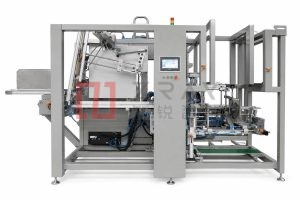
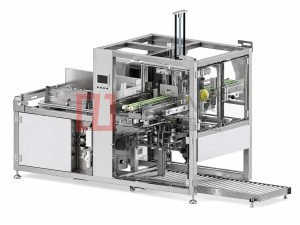
For operations running a single box size at high daily volume, the two-lane Double-Head High-Speed Case Former is the configuration most resistant to jamming, because each lane carries half the cycle demand. Where many sizes run on one machine, the Single-Piece Carton Erector with quick-release cups and stored changeover recipes removes the most error-prone part of the process. Our Support team can walk through a jam log with you line by line, and recurring board-related questions are collected in our FAQ.
FAQ
Why does the machine jam only at high speed?
Because timing and vacuum both degrade with speed. A 2 per cent phase error that is invisible at 25 CPM becomes a full jam at 38 CPM. Re-check cam timing before reducing speed permanently.
Can I run thin E-flute on a machine set up for B-flute?
Usually yes, with reduced vacuum, smaller cups and lower compression pressure. Running the B-flute settings on E-flute board is a reliable way to produce double-feeds.
The machine ran clean for two years, then started jamming weekly. What changed?
In our service experience it is almost always a supplier or storage change rather than machine wear: a new board source, a different recycled content, or a pallet stored against an external wall.
How often should suction cups be replaced?
On a two-shift operation, every 12 months or 3 million picks, whichever comes first — and always as a complete set.
Still losing uptime to repeat jams? Send your jam log, board specification and line speed to [email protected] or WhatsApp +86 13681839278. Our engineers will identify the failing zone and return a corrective checklist within 24 hours, with no obligation.
Want To Know More About Our Upgraded Machines?
Send your carton specifications and output demand, our engineer will provide free technical scheme & quotation
Latest Products
Subscribe To Get Latest News & Technical Guides
Leave your business email to receive free industry articles and new product updates