
Auto Tape Change Technology That Eliminates Micro-Stoppages at 40 CPM | ZRAY
Most lines do not die from big failures. They die from micro-stoppages — the 30-second to 3-minute stops that happen eight, ten, twelve times a shift. Each one looks harmless. Logged together, they eat 30 to 45 minutes of productive time per shift, which is exactly the difference between a line that makes plan and a line that does not. On a case former, the single most predictable micro-stoppage is the tape roll change.
A standard BOPP sealing tape roll on a manual machine runs out after roughly 2,500 to 3,500 boxes, depending on roll length and box circumference. At 40 CPM that is about an hour of run time. An operator who spots the low-tape sensor, walks over, cuts the tape, loads a new roll, re-threads, and re-seals the splice takes 4 to 6 minutes in a good case, 10 minutes if the roll is stored at the other end of the line. Every one of those minutes is a stop. ZRAY’s auto tape change (ATC) system removes that stop from the shift entirely.
This article covers how ATC works on our case formers, the tape and roll specifications that make it reliable, the alarms you should expect, and the maintenance that keeps the splice quality stable.
How Manual Tape Change Steals Your Shift
Time the next tape change on your line. Watch the operator from when the low-tape light comes on until the first good case exits the taping head. The steps are:
- Walk to the machine (20–40 seconds depending on line length).
- Open the tape cabinet and remove the empty core (15–30 seconds).
- Fetch a new roll (30–90 seconds if it is not at the machine).
- Load the roll, cut the tape end square, thread through the applicator (60–120 seconds).
- Pull out several meters and re-establish the splice on the box top and bottom (60–180 seconds).
- Restart, run 3–5 boxes to verify the seal, and discard or rework any cases that came out half-taped.
Total: 4 to 10 minutes of line time per roll. At two rolls per shift — which is normal on a line that runs 16 hours — that is 8 to 20 minutes of downtime per day, before you count the half-taped cases that get rejected at the palletizer.
Here is the annual view for a 40 CPM line:
| Variable | Manual change | ZRAY ATC |
|---|---|---|
| Rolls consumed per 16-h shift | 2 | 2 |
| Change time per roll | 6 min average | 0 (spliced on the fly) |
| Lost cases per day | 240–480 | 0 |
| Lost cases per year (300 days) | 72,000–144,000 | 0 |
| Profit at USD 0.10/case | USD 7,200–14,400 | USD 0 |
The math is blunt: at 40 CPM, one automatic splice per roll is worth more than a full shift of overtime once a month. That is before you count operator labor, rework of half-taped boxes, and the effect on downstream robots that jam on a loose flap.
What Auto Tape Change Actually Does
The ATC system on ZRAY case formers uses a twin-roll magazine: roll A is live, roll B is parked. A low-tape sensor measures the remaining diameter on roll A. When the diameter crosses the splice threshold, the machine — while still running — does the following sequence:
- Splice at speed. The new tape end from roll B is pressed onto the live tape path by a pneumatically actuated splice arm. No pause, no operator.
- Core release. The exhausted core on roll A is released by a solenoid-actuated mandrel clamp and drops into a catch tray.
- Position swap. Roll B moves into the live position. A loading door lets the operator add a fresh roll to the magazine at any time without stopping the machine.
The entire sequence takes 3 to 5 seconds and does not interrupt case flow. The machine keeps sealing cases while the swap happens. That is the difference between a micro-stoppage and no stoppage at all.
The system also handles tape break. If the tape snaps mid-run, a break sensor stops the taping head only — the case former holds position — and the HMI displays the alarm. An operator re-threads and restarts in under 2 minutes, versus a full jam cleanup when a loose tape wraps around the top belt drive.
Tape and Roll Specifications That Keep ATC Reliable
ATC is only as good as the tape you feed it. On ZRAY machines, the tape path and sensor logic are calibrated for standard BOPP sealing tape, but the splice reliability depends on three specifications you control:
| Parameter | Recommended spec | Why it matters |
|---|---|---|
| Tape width | 48 mm (36–60 mm supported) | 48 mm is the bottling/beverage standard; wider tape changes the splice arm overlap |
| Roll outer diameter | Up to 400 mm | Larger rolls mean fewer splices; sensor threshold is calibrated to the O.D. |
| Core inner diameter | 76 mm | Standard core; mandrel clamp is sized for it |
| Tape thickness | 38–45 micron | Thinner tape splices cleanly; over 50 micron the splice arm pressure may need adjusting |
| Adhesive | Hot-melt BOPP, acrylic | Acrylic has better low-temperature performance for cold-chain packaging |
Do not mix suppliers mid-roll on a spliced run. We see the most ATC alarms — spliced tape that separates at the joint — when an operator replaces roll B with tape from a different converter whose backing film thickness differs by more than 5 micron. The splice press is set for a nominal thickness; a thicker backing gets a weak splice, and the joint pops open inside the applicator 20 boxes later.
Board and case dimensions that affect tape consumption
Tape consumption scales with the box circumference you seal. The sealing length per case is roughly the top flap span plus the bottom flap span. For a typical beverage RSC:
- Single-wall B-flute, 2.5–3.0 mm board, 400 × 300 × 300 mm box: about 1.2 m of tape per case.
- Double-wall BC, 6–7 mm board, 600 × 400 × 400 mm box: about 1.8 m of tape per case.
At 40 CPM on the BC example, that is 72 m of tape per minute, or roughly 4,300 m per hour. A 1,000 m roll lasts about 14 minutes. That is why the twin-roll magazine and the on-the-fly splice are not a luxury on high-speed lines — a manual machine would stop every 14 minutes to change tape.
Alarms You Will See with ATC
ATC adds two alarms to the standard case former alarm list. Our field data shows these are the only ATC-specific codes you will normally encounter, and both are operator-resolvable.
| Code | Alarm | Probable cause | Exclusion steps |
|---|---|---|---|
| AL-521 | Tape Low | Roll A diameter below splice threshold; splice arm cylinder not reaching full stroke | Verify roll B loaded and spliced; check air pressure 0.5–0.7 MPa; inspect splice arm linkage for debris |
| AL-524 | Tape Break | Tape snapped at applicator; splice joint separated | Open taping head, remove loose tape, re-thread, re-splice; verify new roll thickness within ±5 micron of live roll |
Two practical notes from the field:
- If AL-524 repeats twice in one shift, check the tape tension on the live path. If the tension spring has stretched, the tape rides loose and flutters into the top belt. It is a 10-minute adjustment, not a tape problem.
- Log the splice quality visually at the start of each shift: run three consecutive cases and check that the splice joint passes cleanly through the applicator. If it sticks, wipe the splice plate with a dry cloth — paper dust accumulates on the plate and grabs the tape.
Maintenance Schedule for the Tape Section
The tape path has few parts, but they are wear parts. The table below is what we hand to line maintenance at commissioning, based on a two-shift operation.
| Interval | Task | Detail |
|---|---|---|
| Daily | Wipe splice plate and tape path | Remove paper dust with dry cloth; check for tape residue |
| Weekly | Inspect splice arm pivot | Verify free movement; add one drop of light oil |
| Weekly | Check tension spring | Confirm no stretching; adjust to factory mark |
| Monthly | Clean sensors | Low-tape and break sensors: clean faces, verify trigger by hand |
| Monthly | Inspect mandrel clamps | Confirm solenoid actuation; clean tape residue off clamps |
| Quarterly | Replace applicator rollers | If top belt shows grooving or tape slip, replace bushings |
| Half-year | Full tape path audit | Replace tension springs, splice plate, and roller bushings |
Keep one set of splice arm seals and one splice plate in your spare parts kit. These two parts cover the majority of ATC hardware failures, and both are field-replaceable in under 30 minutes.
Retrofitting ATC vs. Buying It Integrated
If you already run a ZRAY case former, ask your sales engineer whether your machine’s tape section can accept the ATC retrofit kit. The upgrade adds the twin-roll magazine, splice arm, and the two new alarm codes to the existing Siemens PLC logic. If you are buying new, specify ATC in the RFQ from the start — it is cheaper integrated than retrofitted, and the machine is shipped calibrated for the tape specs in the table above.
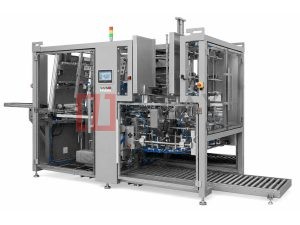
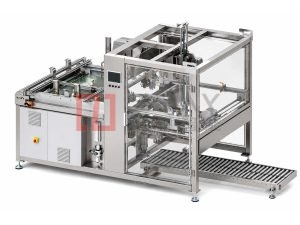
For standard bottling volumes, the Single-Piece Case Erector with the ATC option gives you the twin-roll magazine and on-the-fly splice at a footprint that fits most line layouts. If you run over 500,000 cases per year on two or more fillers, the Double-Head High-Speed Case Former combines ATC on both heads with 70+ CPM combined output, which is where tape consumption really starts to dominate your maintenance schedule.
Lines that process heavy double-wall BC board and long sealing spans will feel the tape economics most. Explore our Double-Head High-Speed Case Former Series to see the tape path layout and splice sequence documented for that board class.
The Shift-Length View
Run the ATC math over a real shift and the result is consistent across beverage, food, and e-commerce lines we have installed:
- Micro-stoppages from tape change: from 2 per shift to 0
- Recovered line time: 8–20 minutes per 16-hour shift
- Recovered cases at 40 CPM: 320–800 per shift
- Half-taped case rejects: to zero once the splice threshold is set correctly
Recovered time does not show up in the maintenance log as a “big fix.” It shows up as the line finishing the plan at 17:00 instead of 19:30, and as the operator spending the saved time on case quality checks instead of running to fetch tape. That is the kind of improvement engineers can take to a budget meeting with numbers attached.
Bottom Line
Micro-stoppages are the largest addressable waste on most case-forming lines, and tape change is the most predictable one. A twin-roll magazine with an on-the-fly splice removes the stop entirely, not faster. The payback period on the ATC option is short — at 40 CPM, the recovered cases alone justify it within months, before counting labor and rework.
Every ZRAY case former with ATC ships CE and EAC certified, with the 12-month warranty and remote diagnostics standard. We will run the splice sequence on your actual tape during remote video FAT, so you can see the 3–5 second splice before the machine leaves the factory.
Want the numbers for your line? Email [email protected] or message us on WhatsApp at +86 13681839278. Send us your case dimensions, tape spec, and shift pattern, and our sales engineers — who reply within 24 working hours — will calculate how many minutes per shift ATC gives back to you.
Request a quotation with your tape specification, and we will confirm the ATC compatibility with your board and roll parameters before quoting.
Want To Know More About Our Upgraded Machines?
Send your carton specifications and output demand, our engineer will provide free technical scheme & quotation
Latest Products


Subscribe To Get Latest News & Technical Guides
Leave your business email to receive free industry articles and new product updates