
Auto-Tape Change Case Erectors: Eliminating Tape Micro-Stoppages on 24/7 Production Lines
A tape roll runs out every 60 to 70 metres of case seam. On a line producing 35 cases per minute at 0.75 metres of tape per case, that is a roll change roughly every two and a half minutes of running time — and each change costs the line output while an operator walks to the machine, cuts the tape, threads a new roll and restarts.
None of those stops is a breakdown. That is exactly why they are so expensive. They never appear in a maintenance report, and no single one of them justifies a capital request. Together they quietly consume a measurable share of annual output.
This article quantifies the cost of tape micro-stoppages, describes how automatic tape change removes them, and states plainly what it does not solve.
The Short Answer
A tape roll change on a conventional erector costs 25 to 40 seconds of line output. On a line running 35 cases per minute across three shifts, and on a box size consuming 0.75 metres of tape per case, that works out at roughly 18 to 22 roll changes per shift — between 12 and 24 minutes of lost production per shift.
Over a three-shift week that is 36 to 72 minutes, or 1,260 to 2,520 cases of output that never existed. At a conservative value of USD 0.06 per case, the loss is USD 75 to 150 per week, or USD 4,000 to 8,000 per year — per machine, and entirely invisible in every report the plant produces.
Automatic tape change does not make the change faster. It removes the operator from the sequence.
What a Micro-Stoppage Actually Costs
The obvious cost of a stop is the output during the stop itself. The larger cost is what happens afterwards.
A line that stops and restarts takes time to return to steady state. Cases already in the transfer section may need clearing, the first two or three cases after restart are frequently rejected on seal quality, and the operator’s attention moves away from whatever else they were doing. Real recovery time after a 30-second stop is closer to 60 seconds when measured against a steady-state baseline.
There is also a scheduling cost that rarely gets quantified. Operators learn to change the roll before it runs out, which means discarding tape that still had 10 to 15 metres on it — roughly 15 to 20 per cent of tape purchased, thrown away to avoid a stop. Automatic change eliminates that habit as well as the stop.
And there is the honest measurement problem: because tape changes are routine tasks rather than faults, they are almost never timestamped. A plant that measures “downtime” will report very little of it. A plant that measures actual output against theoretical output will find it immediately.
The Four Tape-Related Stops
Roll exhaustion is the one everyone knows, and the largest single contributor.
Misthreading happens when a new roll is not routed correctly through the guide rollers. It produces a stop, a rejected case, and often a second stop within a minute. It is the most common cause of unplanned stops on tape-sealed erectors, and it clusters on the shift with the least experienced operator.
Tape snap occurs mid-run when the knife is dull, roll tension has drifted, or the tape has a manufacturing defect. A snap requires the head to be rethreaded, which is a full changeover-length stop.
Adhesion failure at low tension is subtler: tension drifts to the low side, cases seal poorly, and the problem is discovered downstream rather than at the machine. No stop is logged because none occurred.
How Automatic Tape Change Works
The mechanism is straightforward in principle and demanding in execution. The machine carries two tape heads, or one head with a second roll staged. When the active roll reaches its end — detected by an optical or mechanical sensor rather than by tension loss — the head switches to the staged roll automatically.
The critical engineering details are three. First, the splice must be clean: a poorly aligned splice produces a wrinkled tape path that fails within a few cases. Second, the knife must be actuated independently of the roll change, so that a blade change does not require a tape stop. Third, the sensor must detect the roll end before the tape runs out, leaving enough of a tail to complete the current case.
With those three elements in place, the operator’s task changes from reacting to a stop to reloading an idle roll during a scheduled walk-round. The line does not stop because the roll ended; it stops, if at all, when the operator chooses to reload.
What It Changes in Practice
| Metric | Conventional tape head | Auto tape change head |
|---|---|---|
| Roll changes per shift | 18 – 22 | 0 (during production) |
| Lost output per shift | 12 – 24 min | 0 – 2 min |
| Tape discarded to pre-empt stops | 15 – 20 % of rolls | Under 5 % |
| Misthreading events | Regular, operator-dependent | Near-eliminated |
| Operator skill dependence | High | Low |
The last row matters more to a plant manager than the others. Manual tape change performance depends on who is on shift. Automatic change performance does not.
The additional capital cost of a dual-head configuration is typically USD 3,000 to 6,000 depending on the model. Against an annual loss in the range of USD 4,000 to 8,000, payback is usually inside one year for a three-shift operation, and the figure improves with the cost of the product being packed.
What Auto Tape Change Does Not Solve
Being precise about the limits matters, because the technology is sometimes sold as a solution to all tape problems.
It does not fix board adhesion problems. If the board is dusty, coated, or below 110 g/m² liner weight, tape will not hold regardless of how automatically it is applied. Those are board and environment problems, not head problems.
It does not fix squareness, which determines whether the tape line lands on the centre seam. A skewed case tapes badly on any head.
It does not remove the need for knife maintenance. Blades still dull, and a dull blade produces a ragged cut and intermittent snaps.
And it does not help a line whose real constraint is board feed, not tape. Measure the stop distribution before specifying the feature; on some lines tape accounts for a minority of micro-stoppages and the capital is better spent elsewhere.
PLC Alarms Worth Knowing
| Alarm | Meaning | First three checks |
|---|---|---|
E-27 Glue Pattern Fault |
Photo-eye missed the flap edge | Sensor lens dust, encoder slip, belt tension |
E-61 Tape Roll End |
Active roll at end-of-roll sensor | Roll identification, sensor alignment, staged roll present |
E-63 Tape Splice Fault |
Head failed to transfer to the staged roll | Splice alignment, transfer cylinder pressure, sensor timing |
E-33 Servo Follower Error |
Mandrel deviation beyond 1.5 mm | Belt tension, encoder coupling, squareness datum |
Maintenance Rhythm for a Dual-Head Machine
Every shift — confirm a staged roll is loaded, inspect the tape path for debris, and check the knife for tape build-up.
Every week — clean the roll-end sensor, verify the splice transfer with a test cycle, and check guide roller alignment for wear grooves.
Every month — inspect the knife blade and replace at the first sign of ragged cutting, check the transfer cylinder for pressure drift, and verify the tape path against the machine reference.
Every quarter — verify the roll-end sensor across two different roll brands, which have different core opacity and end-of-roll reflection, and inspect the head mounting for play.
Annually — replace the knife assembly and transfer cylinder seals, and revalidate splice transfer across three consecutive cycles.
The quarterly check on roll brands is worth doing deliberately. Roll-end sensors that work perfectly on one supplier’s core can fail consistently on another’s, and the symptom looks like a head fault rather than a sensor setting.
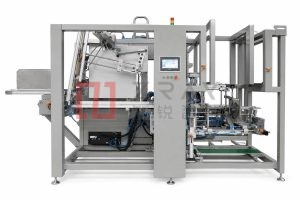
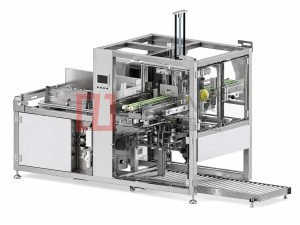
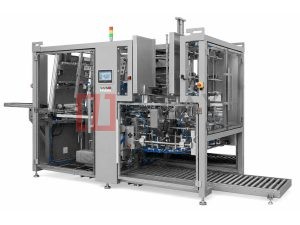
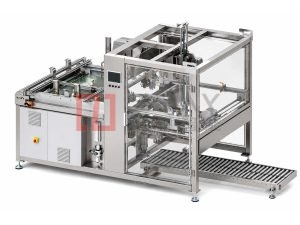
For high-volume lines running one or two box sizes, the auto tape change feature is available on our Single-Piece Carton Erector and on the two-lane Double-Head High-Speed Case Former where a single operator can oversee both lanes from one position. Pre-formed tray and specialty formats are covered by the Three-Piece Carton Erector, and our Support engineers can review a stop-distribution log to confirm where your micro-stoppages actually come from.
How to Size a Roll Change Model Before You Buy
The decision turns on three numbers: roll changes per shift, manual change time, and the cost of a minute of line downtime. Two of the three are almost always estimated rather than measured, and the estimate is nearly always wrong in the same direction.
Roll changes per shift follows from consumption. At a roll length of 1,000 metres and a consumption of roughly 0.6 metres per case, one roll covers about 1,650 cases. On a machine running at 40 CPM that is a roll change every 40 minutes of running time — which means 10 to 12 changes in an eight-hour shift, not the two or three an operator will typically recall. The discrepancy is the whole argument: nobody counts roll changes because they feel trivial individually.
Manual change time, including restart and checking the first few cases, runs 2.5 to 4 minutes. Of that, about a minute is threading the tape; the rest is finding the roll end, removing the stretched section, restarting and verifying the first seals. It is worth being precise about what automatic change eliminates: it removes the threading and the restart, not the need to load a new roll eventually.
Put the two together and the number is larger than most buyers expect. At 11 changes per shift and 3 minutes each, manual roll handling accounts for 33 minutes per shift — roughly 34 hours per year on a 4,000-hour operating year, before any allowance for the cases lost at each restart. Automatic change, which continues delivering cases from the buffer while the splice is made, recovers the majority of that.
The honest conclusion is that the size of the return depends entirely on the baseline being real. A plant that has never logged tape-related stops cannot know whether auto tape change is a 34-hour-per-year saving or a 4-hour one. Log the stoppages by cause for four weeks before deciding — that measurement is free, and it is the only figure that matters in the payback calculation.
FAQ
How long does a manual tape roll change take?
Between 25 and 40 seconds of line output, plus recovery time that typically doubles the real cost.
Can auto tape change be retrofitted?
On many models, yes, if the head mounting and PLC have capacity. Budget two to three days of downtime including validation.
Does it work with any tape brand?
Mechanically yes, but the roll-end sensor must be calibrated per core type. Validate on the brand you actually buy.
What if my line’s main stoppage cause is not tape?
Then it will not pay back. Log the stop causes by category for two weeks before deciding.
Losing output to tape changes you never record? Send your line speed, box size and shift pattern to [email protected] or WhatsApp +86 13681839278. Our engineers will calculate the micro-stoppage cost and confirm whether automatic tape change pays back on your line, with no obligation.
Want To Know More About Our Upgraded Machines?
Send your carton specifications and output demand, our engineer will provide free technical scheme & quotation
Latest Products
Subscribe To Get Latest News & Technical Guides
Leave your business email to receive free industry articles and new product updates