
Core Parameter Adjustment Skills of Carton Forming Machines for Processing Cardboards with Different Thickness and Grammage
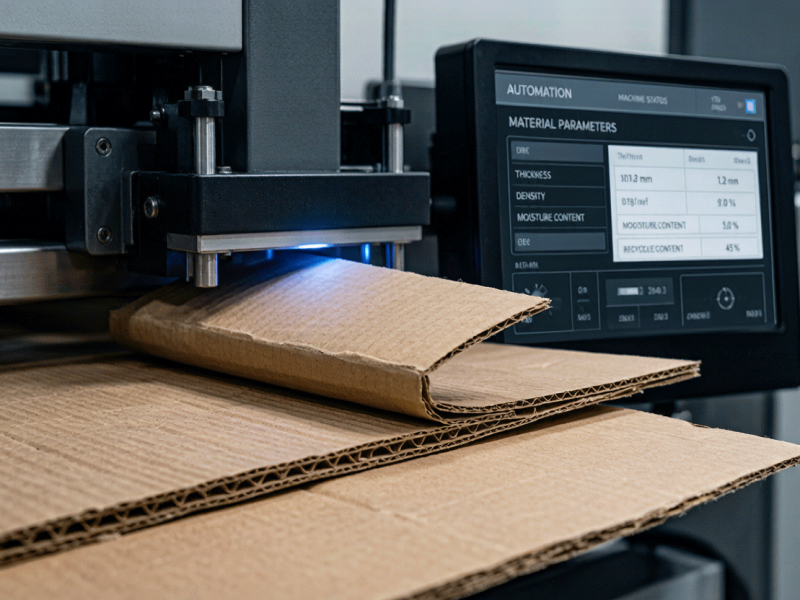
The Day 400 GSM Board Destroyed a Production Schedule
A consumer electronics packaging plant in Shenzhen switched their carton material from 350 gsm single-wall corrugated to 400 gsm B-flute board without telling their machine setup team. The production manager assumed the difference was negligible — “it’s just slightly thicker cardboard.” By 10 AM, the carton former had produced 4,200 reject cartons, jammed 23 times, and worn the pre-fold scoring blades to the point where they needed replacement. Cost of the morning’s chaos: roughly 18,000 RMB in scrap, three hours of lost production, and a set of scoring blades at 2,400 RMB.
Cardboard grammage and thickness are not cosmetic specifications. They determine every critical parameter on a carton forming machine: magazine separator gap, scoring pressure, folding force, glue application volume, and compression dwell. Changing board without adjusting these parameters is like swapping tires without checking the pressure — it might roll, but it won’t roll right.

The Five Parameters That Change with Board Specification
Scoring depth (the most expensive to get wrong): Corrugated board must be scored — partially crushed along the fold line — before folding. The scoring depth should be 50-60% of the board thickness for single-wall and 40-50% for double-wall. On a 400 gsm B-flute board measuring 3.0 mm thick, the score depth should be 1.5-1.8 mm. Too shallow and the fold line cracks the outer liner. Too deep and the board tears during folding. The scoring blade height is adjustable via a threaded stop; measure the gap with feeler gauges, not by eye.
A useful field check: after scoring, the board should fold to 90 degrees with light finger pressure and hold its position when released. If it springs back more than 15 degrees, the score is too shallow. If it shows visible cracking on the outer surface, the score is too deep.
Magazine separator gap: The gap between the separator plate and the magazine face must be 2.0-2.5 times the board thickness. For 3.0 mm board, set 6.0-7.5 mm. If the gap is too tight, the vacuum cups pull a double blank (which jams the forming station). If too wide, the separator fails to reliably single-feed, causing missed picks. The separator gap should be checked with a go/no-go gauge at three points across the magazine width, as uneven wear on the separator plate can create a wedge-shaped gap.
Vacuum cup size and count: Thin, lightweight boards (250-300 gsm) can be handled with four 30 mm suction cups. Boards above 400 gsm typically need six 40 mm cups, or four 50 mm cups with higher vacuum flow. The selection rule: a single cup must hold at least 25% more than its share of the blank weight. A 400 gsm blank measuring 500 × 400 mm weighs approximately 80 grams. With four cups, each cup carries 20 grams — a 30 mm cup generating -65 kPa has roughly 4.5 kg of holding force, which is adequate. But paper dust, cup wear, and acceleration forces during transfer eat into that margin, so upsizing is cheap insurance.
Folding cylinder pressure: The air pressure driving the folding plates directly affects fold quality. Insufficient pressure leaves loose folds; excessive pressure crushes the flute structure at the corners. Starting points: 0.35 MPa for 250-300 gsm, 0.45 MPa for 300-400 gsm, 0.55 MPa for 400-500 gsm. These are starting points, not recipes — adjust based on the first 50 cartons after setup and verify with a squareness gauge.
Compression dwell time: The time the formed carton spends under compression while the hot-melt adhesive sets. This is directly proportional to board thickness because thicker board insulates the glue line from ambient cooling. Baseline: 1.2 seconds for 2.0 mm board, plus 0.3 seconds for each additional millimeter of thickness. A 3.5 mm board starts at 1.2 + (1.5 × 0.3) = 1.65 seconds minimum.
The Board Change Checklist That Prevents Monday Morning Disasters
Every board specification change should trigger this five-minute verification sequence:
1. Measure actual board thickness with a micrometer at five points on five different sheets. The supplier’s nominal spec and the actual spec often diverge by 0.2-0.4 mm, which is enough to matter.
2. Set scoring depth to 55% of measured (not nominal) thickness.
3. Set magazine separator to 2.2× measured thickness.
4. Calculate blank weight from grammage × area and verify vacuum cup adequacy.
5. Set folding pressure to the starting point for the grammage range, then run 50 test cartons and trim based on results.
This checklist takes five minutes. Skipping it costs hours. The Shenzhen plant learned that lesson the hard way and now tapes a printed copy of this checklist to the operator panel of every carton former.
Want To Know More About Our Upgraded Machines?
Send your carton specifications and output demand, our engineer will provide free technical scheme & quotation
Latest Products




Subscribe To Get Latest News & Technical Guides
Leave your business email to receive free industry articles and new product updates