
Tray Erecting for Fresh Produce: Venting, Cold Chain and Farm-Pack Automation
Fresh produce packaging has a constraint that no other sector has: the pack must let the product breathe. A tray that seals too tightly traps field heat and respired moisture, and the product that arrives looking perfect leaves the distribution centre as waste.
That single requirement reshapes the specification of a tray or case erecting station, and it is the reason fresh produce packhouses buy different tooling from a general industrial plant.
The Short Answer
Tray and case erecting for fresh produce is driven by three requirements in this order.
Ventilation. The tray or case must have an open area of 5 to 12 per cent of its surface, achieved through die-cut vents or through a tray design that leaves gaps at the corners. Venting is part of the blank, not the machine, but it changes what the machine must handle — vented blanks are weaker, more flexible and harder to pick.
Cold chain integrity. The pack must survive pre-cooling, cold storage at 0 to 4 °C, and transport without collapsing. Board that performs at ambient temperature can become soft and lose compression strength in a high-humidity cold room.
Speed matched to harvest. Produce arrives in batches, and the packhouse must keep pace with the harvest rather than with a production schedule. Machines are usually specified at 20 to 35 trays per minute with the ability to run intermittently without efficiency loss.
What Makes Produce Packaging Different
The product is alive. It respires, generating heat and moisture after harvest. A pack that traps that heat accelerates ripening and decay. This is why venting is a functional requirement rather than a design preference — a tray with no vents will fail in the cold chain whatever its mechanical strength.
The product is delicate. Soft fruit, tomatoes and stone fruit cannot tolerate compression, so the pack must be rigid in the vertical direction while the tray itself is not loaded by the product’s weight. Waxed or coated board is often used for moisture resistance, and coated board behaves differently in a forming machine.
Volumes are seasonal and volatile. A packhouse may run three shifts during harvest and one shift for the rest of the year. The machine must handle both without the fixed costs of a large installation.
Field heat removal happens inside the pack. Pre-cooling, whether by forced air or vacuum, draws air through the pack. Effective pre-cooling depends on the vent area and vent placement, which means the vent pattern has a direct effect on shelf life.
Board and Tray Specification
| Parameter | Recommended range | Note |
|---|---|---|
| Construction | Single wall B or C, sometimes E for retail trays | Balance of strength and vent area |
| Vent open area | 5 – 12 per cent of surface | Higher for soft fruit and leafy crops |
| Coating | Waxed or moisture-resistant liner for wet produce | Uncoated board loses strength above 85 per cent RH |
| Compression strength | Sized for 4 – 6 trays stacked | Box compression test at 50 per cent RH and at cold-room RH |
| Moisture content | 7 – 9 per cent at packing | Below 6 per cent cracks when vented blanks are folded |
| Glue | Water-resistant hot-melt for cold chain | Standard EVA softens in high-humidity cold rooms |
The coating row deserves emphasis. A waxed or moisture-resistant liner changes both the surface behaviour in the suction cups — coated surfaces seal differently — and the glue behaviour, since many adhesives bond less strongly to a coated surface. A machine specified for uncoated board and then fed coated board will show pick failures and weak seals, and neither is a machine fault.
Vent Patterns and Machine Handling
Ventilation is created in the blank by die-cutting, and the die-cut pattern has machine consequences.
Vent holes reduce blank stiffness. A blank with 8 per cent open area is measurably more flexible than a solid blank of the same grade. Flexible blanks deflect under vacuum pick-up, which is exactly the condition that causes double-feeds and pick failures.
Vents near the picking zone cause vacuum loss. If cups are positioned over vent apertures, the vacuum leaks straight through the hole. Cup placement must be designed around the vent pattern, and this is a specification item rather than an adjustment.
Vents near the score line weaken the fold. A vent within 10 mm of a score line reduces the board’s ability to hold a fold. Where the vent pattern is dense, fold rail gap must be set tighter to compensate, which increases the risk of crushing the flutes.
Corner vents affect squareness. Trays with die-cut corners have less material at the corner, and a corner with less material is less able to resist the forming force. Squareness tolerance on such trays is necessarily wider.
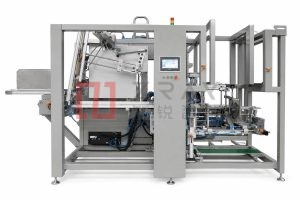
The practical implication is that the vent pattern should be agreed between the packhouse, the blank supplier and the machine supplier before the machine is ordered. Changing the vent pattern after delivery requires re-validating cup positions, fold rails and glue placement. Where a packhouse runs a case format rather than a tray — for example for bulk root vegetables — the forming requirement reverts to a standard case sequence, and the Single-Piece Carton Erector covers single-format high-volume work of that kind.
Cold Chain Considerations
Produce packaging spends a significant part of its life between 0 and 4 °C at high relative humidity, and both conditions change board properties.
Compression strength falls as humidity rises. Corrugated board loses a substantial proportion of its compression strength between 50 per cent RH and 90 per cent RH. A pallet of trays sized for ambient conditions will collapse in a cold store after a few days under load.
Adhesive behaviour changes at low temperature. Hot-melt adhesive that bonds well at 20 °C can become brittle and fail at 2 °C if it is not formulated for cold environments. The specification matters more than the application settings: a cold-chain-rated adhesive applied at the correct temperature will hold, and a standard adhesive will not hold however well it is applied.
Condensation forms on the pack during temperature transition. Moving a pallet from a cold store to a warm loading bay creates condensation on the board surface, which softens the liner and can loosen tape. Where tape is used, a moisture-resistant tape is required.
Trays must vent to permit air circulation once palletised. A tray that vents well on its own but is stacked so that vent patterns are blocked will not pre-cool. Stacking patterns are part of the packaging design, not an afterthought.
Machine Specification for a Packhouse
| Parameter | Typical specification |
|---|---|
| Rated speed | 20 – 35 trays per minute |
| Case or tray size range | 300 × 200 × 80 mm to 600 × 400 × 300 mm |
| Board range | E-flute 1.6 mm to C-flute 4.0 mm, coated or uncoated |
| Sealing | Hot-melt, cold-chain rated, or interlocking tray design |
| Suction cup type | Larger diameter with soft lip for vented, flexible blanks |
| Changeover | Recipe-based, under 8 minutes for seasonal format changes |
| Duty pattern | Capable of intermittent running without efficiency loss |
| Construction | Washdown-capable where produce contact requires it |
The washdown row matters in packhouses where the machine sits in a zone that is cleaned with water. A standard machine will corrode; a machine specified with stainless fasteners, IP-rated electrical enclosures and sealed bearings will not.
Alarms in a Packhouse Environment
| Alarm | Meaning | First three checks |
|---|---|---|
E-12 Vacuum Low |
Pick-up vacuum below setpoint | Cup position over vents, cup condition, filter |
E-29 Blank Feed Timeout |
No blank detected at feed | Magazine stack, blank flexibility causing mis-feed, belt tension |
E-41 Flap Detect Missing |
Flap not detected in position | Sensor lens, fold rail gap, coating affecting fold |
E-21 Glue Head Overtemp |
Nozzle or tank above 185 °C | Thermocouple, PID setpoint, adhesive grade suitability |
E-12 Vacuum Low on a vented blank has a mechanical cause that general plants never encounter: cups positioned over vent apertures. When vacuum alarms begin after a vent pattern change, the vent pattern is the first thing to check, not the vacuum circuit.
Maintenance Rhythm
Every shift — inspect suction cups for glazing, check the magazine for blank alignment, and verify glue line position on a sample tray.
Every week — clean the vacuum filter, check fold rail gap against specification, and inspect the machine for corrosion or moisture ingress after cleaning.
Every month — verify tray squareness on five pieces, inspect the glue nozzle for charring, and check the magazine guides for wear caused by coated board’s lower friction.
Every quarter — inspect cam followers and bearings, re-baseline glue consumption, and re-verify pick reliability on each vent pattern in use.
Annually — replace suction cups and belts, re-grease all points with a moisture-resistant grease, and re-baseline squareness and speed across the tray range.
FAQ
Can a standard case erector handle produce trays?
A tray former is a different machine from a case erector, though the mechanisms overlap. A tray with a shallow depth and an interlocking corner is formed by a different motion from a case with four bottom flaps. State which you need at the enquiry.
Does venting reduce pack strength?
Yes, and it must be accounted for. The compression strength test should be run on the vented blank, not on a solid blank of the same grade.
Is waxed board hard to run?
It is harder, because coated surfaces seal differently under suction cups and accept glue differently. Both are solvable with cup selection and adhesive grade, but they must be specified.
Can the same machine run seasonal format changes?
With recipe memory and tool-free adjustment, yes. A packhouse that changes tray format between crops needs changeover under eight minutes to avoid losing shift time to setup. The product range lists which configurations carry that capability, and the common board and blank questions are answered in the FAQ.
Setting up a produce packing line? Send your tray dimensions, vent pattern, board specification and required rate to [email protected] or WhatsApp +86 13681839278. Our engineers will confirm cup and fold settings for vented blanks and return a specification sheet within 24 hours.
Want To Know More About Our Upgraded Machines?
Send your carton specifications and output demand, our engineer will provide free technical scheme & quotation
Latest Products
Subscribe To Get Latest News & Technical Guides
Leave your business email to receive free industry articles and new product updates