
Hot-Melt Nozzle Adjustment on Case Erectors: Pressure, Distance and Temperature Settings
Hot-melt sealing fails far more often at the nozzle than at the tank. The adhesive is correct, the board is correct, and yet the line throws stringing, misses the score, or lays a bead that the case sealer later crushes into a leak. Nine times out of ten the cause is a nozzle set outside its window for temperature, distance or pressure — and the fix is a ten-minute adjustment, not a parts order. This article gives the setting windows we hold on every erector, the five failure modes that come from leaving them, and the maintenance rhythm that keeps the bead clean.
The short version is that a clean glue application is the product of four numbers held together: nozzle temperature 150 to 180 °C for EVA, a 1 to 2 mm gap to the board, a glue line kept 6 to 10 mm from the score, system pressure 2 to 4 bar, and glue mass 0.7 to 1.2 g per case. Miss any one of them and the defect name changes, but the root cause is the same: the nozzle is not where the board and the adhesive need it to be.
The Short Answer
For a standard FEFCO 0201 case in single-wall B-flute board, 400 x 300 x 250 mm, a correctly set single slot nozzle lays a 3 to 5 mm wide bead of 0.7 to 1.0 g of EVA at 40 CPM without stringing. The machine holds this when the nozzle heater sits at 160 to 175 °C, the orifice is 1.5 mm off the flap, the bead runs 8 mm parallel to the score, and the supply pressure is 3 bar. Change one of those and the bead degrades in a predictable way, covered below.
Two facts decide most field calls. First, EVA thermoplastic has an open time — the window between laying the glue and the flap being compressed — and if the line speed or the compression dwell stretches that window too far, the seal never sets and the case opens in the stack. Second, the nozzle wears: a bead whose width has drifted more than ±1 mm from its set point is a worn nozzle by definition, and no amount of temperature fiddling restores it.
The Three Nozzle Types and Where Each Belongs
Not every joint needs the same applicator. The three standard hot-melt nozzles differ in how they deposit adhesive, and the choice sets both the glue line width and the mass per case.
| Nozzle type | Bead / pattern | Glue line width | Glue mass range | Best use |
|---|---|---|---|---|
| Slot (narrow slit) | Continuous bead | 2 – 6 mm | 0.5 – 1.2 g/case | Straight seams, bottom flaps |
| Spray (atomised) | Wide misted band | 10 – 40 mm | 0.3 – 0.8 g/case | Dusty or recycled board, large area |
| Multi-orifice | Multiple dots in line | 3 – 12 mm (dot pitch) | 0.6 – 1.5 g/case | High-tack spots, display-ready |
The slot nozzle is the default on most erectors because it lays a controllable, repeatable bead with the lowest air consumption — it needs no atomising air at all. The spray nozzle trades mass for coverage: it wets a dusty or clay-coated liner that a slot bead would simply sit on top of, at the cost of more adhesive per area and an atomising-air circuit to maintain. The multi-orifice nozzle is the specialist for cases that need discrete high-tack points — display-ready trays and awkward flap geometry — where a continuous bead would either starve or flood.
The Settings That Decide a Clean Bead
The window below is what we validate on every machine before sign-off. Each value is a range, not a single point, because board caliper and line speed move the optimum within it.
| Setting | Window | What happens outside it |
|---|---|---|
| Nozzle temperature (EVA) | 150 – 180 °C | Below 150 °C: cold, brittle, poor wetting. Above 180 °C: charring, open-time collapse |
| Nozzle-to-board gap | 1 – 2 mm | Below 1 mm: drag and board strike. Above 2 mm: misting and weak placement |
| Glue line to score distance | 6 – 10 mm | Too close: glue catches the fold. Too far: weak seam, bottom leak |
| System pressure | 2 – 4 bar | Below 2 bar: starved, broken bead. Above 4 bar: spitting, slinging |
| Glue mass per case | 0.7 – 1.2 g | Below 0.7 g: open seam. Above 1.2 g: squeeze-out, stringing |
Note the interaction: raising temperature to fix a “cold” bead that is actually a pressure problem only moves the failure to charring. The settings are coupled, and the calibration routine in our Single-Piece Carton Erector walks the operator through them in the right order — temperature first, then gap, then pressure, then position.
Five Causes of Stringing and Slinging
Stringing (thin threads of glue trailing behind the nozzle) and slinging (adhesive flung onto the machine frame) are the two defects operators report most. Each has a root cause, and each has a fix that does not involve a new part.
Temperature too high. Above 180 °C the EVA thins past its design viscosity and bridges the orifice as the case moves away, drawing a thread. Lower to 160 to 175 °C and re-check the bead width.
Nozzle worn or scored. A damaged orifice cannot cut the bead cleanly; glue tails off the edge instead of snapping. The digital criterion is simple: if the laid bead width differs from set point by more than ±1 mm, the nozzle is worn and must be replaced, not cleaned.
Open time too long. If the flap is not compressed within the adhesive’s open window, the surface skins over and the later compression merely presses a cold crust. Raise line speed slightly or lengthen compression dwell; on double-wall BC or AB board the open time is 2.5 to 4.0 seconds, far longer than the 0.8 to 1.8 seconds of single-wall B or E.
Back pressure too low. Insufficient back pressure lets the bead sag and the cut-off fail, so glue keeps weeping after the valve closes. Verify the system holds 2 to 4 bar at the head; a monthly back-pressure and filter check (below) catches the drift before it reaches the case.
Speed and dispense out of sync. When the encoder or belt slip means glue is laid while the case is not where the pattern expects, you get both stringing and missed registration. This is the E-27 Glue Pattern Fault path, and the first check is the photo-eye lens and encoder coupling, not the nozzle.
Why Glue Line Position Breaks the Seal
The distance from the glue line to the score is the single setting operators fiddle with most and understand least. It is also the one with the most expensive consequences.
A bead laid too close to the score — inside 6 mm — puts adhesive on the fold radius itself. When the flap folds, that glue transfers to the opposing panel or to the mandrel, the case jams in the erector, and you get a glued-shut flap or a stuck mandrel. We see this most often after an untrained changeover shortens the pattern to “use less glue.”
A bead laid too far from the score — beyond 10 mm — leaves a gap between the bond and the case edge. The seam then relies on a thin glue bridge instead of a full-width bond, and under stack compression the bottom opens: the classic bottom-leak complaint from the warehouse. The fix is never “more glue”; it is moving the line back to 6 to 10 mm and re-validating squareness against an FEFCO 0201 reference case. The resulting bond is then checked per ASTM D2860 / TAPPI T-812 before the changeover is accepted.
The Digital Criterion: When a Nozzle Is Worn
Modern erectors log bead width from the pattern camera, and that log is the most honest maintenance signal on the machine. The rule we apply is absolute: a measured glue line width deviating more than ±1 mm from the set point is a worn nozzle, regardless of how clean the bead looks by eye.
Operators tend to tolerate drift because a slightly wider or narrower bead still seals. But drift is the leading indicator of orifice erosion, and erosion is what turns a clean cut-off into stringing overnight. When the log shows the deviation, replace the nozzle assembly at the next scheduled window rather than waiting for a jam. This single discipline removes most unplanned glue stops on a three-shift line.
Cleaning and Maintenance Rhythm
The bead stays clean only as long as the nozzle and the adhesive path are kept that way. The rhythm below is a list, not a table, because the point is the cadence.
Every shift: wipe the nozzle face and orifice with a non-abrasive cloth while the head is at temperature; check that the bead is continuous and centred on the flap; clear any stringing before it hardens on the mandrel.
Every week: inspect the nozzle orifice for scoring or carbon build-up; verify the bead width against the set point; blow out the pattern-air line if the machine uses a spray nozzle.
Every month: check system back pressure at the head (must hold 2 to 4 bar) and replace or clean the inline glue filter; look for pressure creep that signals a failing regulator.
Every quarter: replace the nozzle assembly as a wear item even if it still seals — the ±1 mm rule above makes this a scheduled change, not a breakdown response; re-validate the temperature controller against a reference probe.
Every year: calibrate the temperature controllers across the tank and all heads; audit the pattern camera and re-teach the bead-width set points; review the adhesive open-time spec against the current board grade. A line on this rhythm typically holds 98 per cent uptime across three shifts, and the glue module is rarely the cause of a stop.
PLC Alarms You Will Actually See
The glue head reports its own faults, and the four below account for nearly all unplanned hot-melt stops in the field.
| Alarm | Meaning | First three checks |
|---|---|---|
E-21 Glue Head Overtemp |
Tank or nozzle above 185 °C | Thermocouple, PID setpoint, glue circulation |
E-15 Back Pressure Low |
Head supply below 2 bar | Regulator, inline filter, pump output |
E-27 Glue Pattern Fault |
Photo-eye missed the flap edge | Sensor lens dust, encoder slip, belt tension |
E-33 Servo Follower Error |
Mandrel deviation beyond 1.5 mm | Belt tension, encoder coupling, squareness datum |
E-21 Glue Head Overtemp is almost always a thermostat or circulation fault, not a setting you should simply lower — dropping the setpoint hides the symptom and invites cold, weak seals elsewhere. E-15 Back Pressure Low points upstream at the regulator or filter, which is why the monthly back-pressure check exists. Both are cheaper to prevent than to clear.
Choosing Nozzles for Your Line
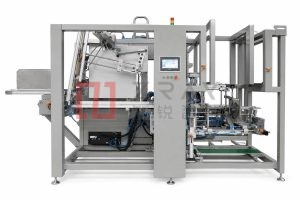
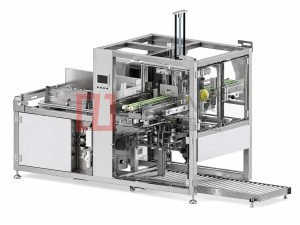
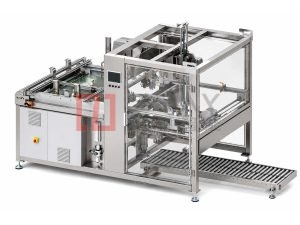
The nozzle decision follows the board and the case, not the brand of applicator. For clean, uniform single-wall board running one box size, the slot nozzle on a Single-Piece Carton Erector is the right default and the cheapest to maintain. For dusty or heavily recycled board — the 60 to 70 per cent recycled grades that defeat a slot bead — the spray nozzle earns its air circuit by actually wetting the surface. For display-ready or multi-flap formats, the multi-orifice nozzle on our Three-Piece Carton Erector lays the discrete tack points those cases need.
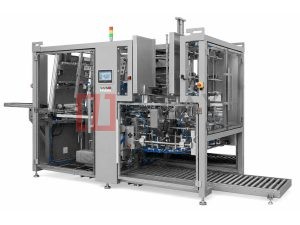
Where volume is high and the line is two-lane, the same nozzle logic applies to the Double-Head High-Speed Case Former, with the addition that each head carries its own temperature and back-pressure log so a worn nozzle on one lane cannot silently degrade the other. Specification questions on board grade, open time and bead width are answered in our FAQ section; for a sizing sheet matched to your case, the contact details are below.
FAQ
What temperature should the nozzle be?
For EVA, hold 150 to 180 °C, with most lines happiest at 160 to 175 °C. Above 180 °C you char the adhesive and trigger stringing; below 150 °C the bead never wets the board.
How far should the glue line sit from the score?
6 to 10 mm. Inside 6 mm the glue catches the fold and jams the erector; beyond 10 mm the seam is weak and the bottom leaks under stack load.
How do I know the nozzle is worn, not just dirty?
Measure the bead width from the pattern camera. If it differs from set point by more than ±1 mm, the nozzle is worn and must be replaced — cleaning will not restore the orifice.
Can I use one nozzle type for every board?
No. Single-wall clean board takes a slot; dusty or recycled board needs spray to wet the surface; display-ready formats need multi-orifice. Matching the nozzle to the board is the cheapest reliability upgrade available.
Ready to cut your cost per case? Send your carton specifications — length, width, height, flute grade, target cases per minute and current glue defect — to [email protected] or WhatsApp +86 13681839278. Our engineers will return a nozzle-setting sheet and a sealing-cost model within 24 hours, with no obligation.
Want To Know More About Our Upgraded Machines?
Send your carton specifications and output demand, our engineer will provide free technical scheme & quotation
Latest Products
Subscribe To Get Latest News & Technical Guides
Leave your business email to receive free industry articles and new product updates