
ZRAY Carton Erector with Flat Blank Magazine Feeder (Up to 40 CPM, 3–5 Min Changeover) | ZRAY
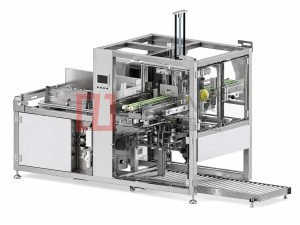
Every erector has a magazine; not every magazine is worth writing about. The ZRAY flat blank magazine feeder earns the article because it is the part of the machine that decides how much operator time the line really consumes. A machine that forms at 25 CPM but needs an operator every six minutes to fight a crooked stack is not a 25 CPM machine — it is a machine that runs at whatever speed the operator can feed it. The flat blank magazine changes that math: pre-glued, flat-folded blanks load in bundles, separate one at a time, and feed the forming head without a human standing over it.
What “Flat Blank Magazine” Means on a ZRAY Erector
The magazine holds fold-flat, side-seam glued blanks — the same blanks a carton former uses. The blanks are stacked flat, face up, in a cassette that holds between 150 and 400 blanks depending on board thickness:
- E flute (1.5–1.8 mm): up to 400 blanks per load
- B flute (2.5–3.0 mm): up to 300 blanks per load
- BC double wall (6–7 mm): up to 150 blanks per load
At 20 CPM, a 300-blank load runs 15 minutes between reloads. That is the practical number: one operator can load, change over, and manage two machines instead of babysitting one.
How the Feed System Works
The feed cycle is the part engineers argue about, so here is how ZRAY does it:
- Blank stack registers against a rear stop and a side fence; the top of the stack is sensed by a laser sensor, not a mechanical follower, so stack height is maintained within ±3 mm.
- Vacuum cups lift the top blank from the center, breaking the first blank away from the stack.
- A separation blower blows air between the lifted blank and the stack below — this is the anti-double-feed step. The air film separates the blanks so only one feeds into the pick-up station.
- The transfer section moves the separated blank to the forming mandrel, where the erector opens and squares it.
The separation blower is the detail that makes or breaks flat-blank feeding. On thin E-flute blanks, static and moisture make blanks stick together; without the air film you get double feeds that jam the mandrel. ZRAY sizes the blower for the blank grammage range (200–650 gsm) and monitors separation with a photocell — if two blanks travel together, the PLC faults before the mandrel hits them.
Loading Efficiency: The Numbers That Matter
| Parameter | Value |
|---|---|
| Magazine capacity (E flute) | Up to 400 blanks |
| Magazine capacity (B flute) | Up to 300 blanks |
| Magazine capacity (BC double wall) | Up to 150 blanks |
| Reload time | 30–60 s per load |
| Automatic run between reloads | 7–15 min (at 20 CPM, by board) |
| Machine speed | 12–40 CPM (by model and head count) |
| Blank grammage range | 200–650 gsm |
| Air pressure | 0.5–0.7 MPa |
| Changeover (size) | 3–5 min |
The efficiency win is not the reload time — 30–60 seconds is small. The win is that the reload is the only thing the operator does. Compare that to a machine where the operator re-aligns the stack, breaks double feeds, and resets jams every few minutes. The flat magazine moves the operator’s job from “watching the feeder” to “loading a bundle and walking away.”
On a typical shift the arithmetic is easy: at 20 CPM with 300-blank loads, the operator reloads roughly 26 times per 8-hour shift — about 20 minutes of total reload time. The rest of the shift is free for changeover, QC checks, and the next machine. On a hopper-fed machine at the same throughput, we measured operators spending 40–60 minutes per shift fighting wedges and re-aligning stacks.
Flat Magazine vs. Hopper Drop-Feed: What We Learned on the Floor
Not every “magazine” feeds the same way, and the difference shows up in uptime. A drop-feed hopper relies on gravity and a mechanical wiper to push the bottom blank forward; it works on thick board and fails on light E-flute, where blanks flex and wedge between the wiper and the stack. A flat magazine with vacuum separation lifts from the top of the stack, which is tolerant of board condition — the separation blower handles the stickiness that jams a hopper.
Field data from our installations:
| Feed method | Light E-flute | Standard B-flute | Double wall BC |
|---|---|---|---|
| Drop-feed hopper | Frequent wedges | Acceptable | Good |
| Flat magazine, vacuum separation | Good | Good | Good |
If you run any light board or a mixed SKU range, the flat magazine removes an entire failure class. That is why we fit it as standard on the single-piece platform rather than as a premium option.
PLC Alarms Specific to the Magazine Feeder
Alarm: Double Feed (Two Blanks Detected)
- Check the separation blower pressure and nozzle alignment — the air film is the first line of defense.
- Verify blanks are within grammage range; very light E-flute blanks need more separation air.
- Check the blank edges for bent corners or glue bleed — stuck blanks are often the cause.
Alarm: Magazine Empty / No Blank
- Load a new bundle; the laser stack sensor triggers the alarm at the pre-set low level.
- If the stack is not empty, check the laser sensor lens — paper dust blocks it.
- Confirm the rear stop and side fence hold the stack square; a tilted stack trips the sensor early.
Alarm: Blank Jam in Feed
- Remove the jammed blank via the feed access door — the safety interlock cuts power first.
- Check the transfer belt tension and the vacuum cup lift height.
- Re-test with three blanks at low speed before returning to full speed.
Each alarm is designed to fault before the mandrel, which protects the forming tooling — the most expensive part of the head. That is why the feed section has its own sensors and its own alarm codes on the Siemens HMI.
Board Compatibility and Setup
Flat-blank feeding works across the full ZRAY board range:
| Board | Thickness | Grammage | Feed notes |
|---|---|---|---|
| E flute | 1.5–1.8 mm | 200–350 gsm | Needs separation air; 400-blank loads |
| B flute | 2.5–3.0 mm | 250–400 gsm | Standard feed, 300-blank loads |
| C flute | 3.5–4.0 mm | 300–500 gsm | Standard feed |
| EB double wall | 4.5–5.5 mm | 350–550 gsm | Heavier pick vacuum; reduce load to 200 |
| BC double wall | 6–7 mm | 400–650 gsm | Max pick vacuum; 150-blank loads |
Setup is three numbers on the HMI: stack height set point, separation air pressure, and pick vacuum timing. Changeover between sizes takes 3–5 minutes with tool-less adjustments for the side fences. Height changes add a few minutes; they are stored per recipe, so the next run of that SKU recalls the setup.
Maintenance Schedule for the Magazine Feeder
| Interval | Task |
|---|---|
| Daily | Clean the stack sensor lens; blow down vacuum lines; check separation blower air supply |
| Weekly | Inspect suction cup lips on the pick section; check belt tension on the transfer; verify fence squareness |
| Monthly | Test the double-feed photocell with a test blank; check vacuum readings; inspect blower filter |
| Quarterly | Replace vacuum generator filter; lubricate transfer slide; verify laser sensor alignment |
| Semi-annual | Full feed-section inspection; replace EPDM cups; run a complete double-feed test at speed |
Where This Magazine Makes the Biggest Difference
The flat magazine pays off hardest in three setups:
- High-volume, one SKU. A beverage or food plant running a few box sizes in large batches gets the full 15-minute run between reloads and near-zero operator attention.
- Multi-machine lines. One operator tends two erectors because neither needs constant feeding.
- Semi-automated plants. A loader dropping bundles into the magazine replaces a dedicated “box opener” position entirely.
If your operation runs over 500,000 cases per year, the Double-Head High-Speed Case Former pairs the flat magazine with two forming heads to hit up to 40 CPM per head — the magazine is sized so both heads feed from the same bundle. For mid-volume lines, the Single-Piece Case Erector with the flat magazine option is the usual match.
Verdict
The magazine is the quiet part of the line, and it is the part that decides labor. A flat blank magazine with laser stack sensing, separation air, and per-blank photocell monitoring runs 7–15 minutes between reloads, so one operator runs the erector instead of feeding it. That is the difference between a machine and a machine you staff.
Want to see the flat magazine feeder running with your blank? Send your blank size, board spec, and target output. ZRAY replies within 24 working hours with a loading-cycle estimate and a machine recommendation.
- Email: [email protected]
- WhatsApp: +86 13681839278
- Inquiry page: Contact ZRAY about the Flat Blank Magazine Feeder
Want To Know More About Our Upgraded Machines?
Send your carton specifications and output demand, our engineer will provide free technical scheme & quotation
Latest Products



Subscribe To Get Latest News & Technical Guides
Leave your business email to receive free industry articles and new product updates