
How to Calculate ROI for Automatic Carton Erecting Machine Investment (Payback Model, Up to 40 CPM) | ZRAY
Most ROI presentations for packaging machinery are built backwards. The supplier shows a machine speed, multiplies it by a shift count, subtracts a labor number, and calls the result “savings.” The numbers fall apart when the plant finance team starts asking questions about defect cost, changeover loss, compressed air consumption, and spare parts. ZRAY engineers build ROI the way a plant controller would, and this article gives you the full model — inputs, formulas, and the sensitivity table that tells you which assumptions actually matter.
The ROI Formula That Survives a Finance Review
A defensible ROI model has five inputs, not two. Build it in this order:
Step 1 — Annual production volume (P). Take last year’s real production, not the theoretical line rate: P = boxes formed per year.
Step 2 — Manual baseline cost (M). What the current manual or semi-manual process actually costs:
M = operators × burden rate × hours/year + overtime + reject scrap
Step 3 — Automatic operating cost (A). Everything the machine adds:
A = electricity + compressed air + consumables (glue/tape) + maintenance + residual operator
Step 4 — Net annual saving (S). S = M − A
Step 5 — Payback period (years). Payback = machine price / S
ROI over a 5-year horizon: ROI% = ((S × 5) − machine price) / machine price × 100
Worked Example: Mid-Size Food Plant
| Input | Value |
|---|---|
| Annual volume | 1,800,000 boxes |
| Current manual team | 5 operators, 2 shifts |
| Operator burden rate | $22/h |
| Machine price (single-head, glue bottom) | $65,000 delivered |
| Electricity (0.9 kW avg × 5,000 h) | $675/yr at $0.15/kWh |
| Compressed air (est. 120 L/min, 5,000 h) | $380/yr |
| Glue + spares | $3,600/yr |
Result: Manual cost M = 5 × $22 × 4,000 h = $440,000/yr (labor only). Automatic cost A ≈ $4,655/yr (one operator + utilities). Saving S ≈ $435,000/yr. Payback = $65,000 / $435,000 = 0.15 years. Even if you add install, shipping, and training, payback stays under two months. That is the order of magnitude difference the model should show when the volume is real.
At lower volume the picture changes fast — run your own number, because that is the point of the sensitivity table.
Sensitivity Table: What Actually Moves the Payback
We test five assumptions on every quote. Ranked by how much they move the payback:
| Variable | Range tested | Effect on payback |
|---|---|---|
| Annual volume | 150k → 2M boxes | Dominant. Below ~300k, payback stretches past 3 years |
| Operator burden rate | $12 → $35/h | Strong. High-wage regions pay back faster |
| Reject rate delta | 1% → 5% | Medium. Adds 6–18 months at high volume |
| Machine utilization | 60% → 85% | Medium. Idle shifts kill the model |
| Consumable cost | Tape vs glue | Small, but tape is 3–5× the per-box cost of glue |
The takeaway: if your volume is real, labor rate dominates everything. If your volume is marginal, no machine saves you money — the model will show it honestly, and we will tell you so.
A Note on Defect Cost That Most Models Miss
Manual and semi-manual lines produce open corners, mis-folded bottoms, and jam-damaged blanks. Count them:
- Reject rate manual: 2–4% of production.
- Reject rate automatic: 0.8–1.5% (ZRAY field average, lower on single-wall).
- Each rejected box costs the box material plus the labor already spent on it.
At 1,800,000 boxes and $0.09 per box, cutting rejects from 3.5% to 1.0% saves $40,500/yr — about 60% of a single-head machine price, every year, before you touch the labor number.
ZRAY Machine Reference (Use These in Your Model)
| Parameter | Single-Piece Case Erector | Double-Head High-Speed Case Former |
|---|---|---|
| Output speed | 12–25 CPM | Up to 40 CPM per head |
| Box length | 200–600 mm | 200–600 mm |
| Box width | 150–400 mm | 150–400 mm |
| Box height | 100–500 mm | 100–500 mm |
| Board thickness | 2.5–7.0 mm | 2.5–7.0 mm |
| Air pressure | 0.5–0.7 MPa | 0.5–0.7 MPa |
| Hot-melt tank temp | 150–170 °C | 150–170 °C |
| Changeover | 3–5 min | 3–5 min per head |
Electricity draw is the input finance always asks about: a single-head machine averages 0.8–1.2 kW running, and compressed air consumption sits at 90–140 L/min depending on cycle rate. Those numbers belong in your A line.
PLC Alarms That Affect Your Utilization Number
Your utilization assumption (60–85%) only holds if stoppages stay controlled. These three alarms are the ones that cost utilization on a new line:
Alarm: Vacuum Low
- Check the vacuum generator filter; paper dust plugs it in under a week in summer.
- Inspect all suction cup lips — one torn cup drops the whole pick pattern.
- Confirm the blower/venturi is rated for the board weight; a 650 gsm double-wall blank needs more vacuum than a 250 gsm one.
Alarm: Box Not Formed
- Verify the recipe size against the actual blank — die-cut drift changes the effective size.
- Check crease depth; shallow scores on double wall produce incomplete folds.
- Look at the pick-off timing; a blank arriving late to the mandrel misses the fold window.
Alarm: Glue Temp Low
- Let the tank reach 150–170 °C before the shift starts.
- Check the probe seating; a loose probe under-reads and keeps the heater cycling.
- Confirm the adhesive grade matches the board and ambient temperature.
Each of these is a 5–10 minute fix. Written into your operator handbook, they keep the utilization number true.
Maintenance Schedule (Protects the 5-Year ROI)
| Interval | Task | Cost impact |
|---|---|---|
| Daily | Blow down filters; check glue level; verify air pressure | Prevents low-pressure stoppages |
| Weekly | Inspect suction cups; lubricate slides; check guide rails | Prevents mis-feeds |
| Monthly | Test interlocks; inspect servo couplings; clean nozzles | Prevents quality rejects |
| Quarterly | Replace FRL elements; check vacuum generators; verify tape tension | Prevents air starvation |
| Semi-annual | Bearing inspection; cabinet torque check; test box run | Prevents major downtime |
The maintenance budget belongs in line A as a fixed number: 2–3% of machine price per year is the honest figure for a ZRAY unit. Anything quoted above that is over-spec; anything below ignores wear.
Financing and Payment Terms That Change the Cash Flow
ROI is usually quoted against the full machine price, but cash flow improves when you spread it. ZRAY standard terms: 50% advance deposit + 40% after FAT acceptance + 10% warranty balance, with L/C available for bulk orders. Because FAT is done before shipping — using your actual box blanks, with remote video witnessing — the 40% stage payment lands when the machine has already proven it runs your box.
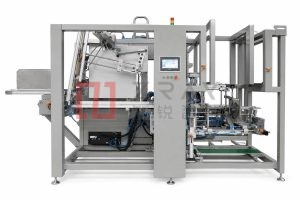
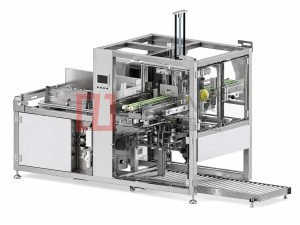
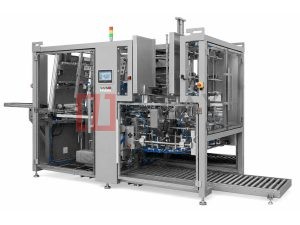
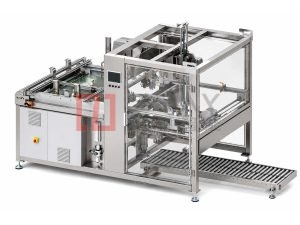
If you are a high-volume operation processing over 500,000 cases per year, explore our Double-Head High-Speed Case Former Series to size the model with two heads. For mid-volume plants the Single-Piece Case Erector is the usual payback winner.
Tracking ROI After Installation
A payback projection is only as good as the follow-up. We recommend the plant controller pulls four numbers from the HMI every week:
- Formed boxes per shift — compare against the model’s assumption. If utilization sits below 60%, the model is wrong, not the machine.
- Jam count — every jam is lost CPM. Five jams a shift costs more than the reject bin shows.
- Alarm code frequency — the PLC logs them; a repeat code points at the maintenance item to schedule before it becomes downtime.
- Glue or tape consumption per 1,000 boxes — drift signals a nozzle or tension problem before it becomes rejects.
With these four, the finance review is a 10-minute dashboard instead of a debate. Every ZRAY HMI exports these logs as CSV, so the controller pulls them without an engineer present.
Common ROI Calculation Mistakes
- Using theoretical CPM. A 25 CPM machine running 7 hours a shift with changeovers and jams produces closer to 12,000–14,000 boxes per shift, not 17,500. Use real utilization.
- Ignoring the reject stream. The reject bin is a cost center, not a byproduct.
- Forgetting compressed air cost. At 120 L/min and 0.07 kWh per m³ of compressed air, a single-head erector can add $300–500/year of air cost that never appears in the brochure.
- Quoting payback on one shift when you run three. If the line runs 24/7, payback accelerates — but so does the machine wear; schedule the semi-annual maintenance.
Verdict
Run the five-input model with real volume, a real burden rate, and a real reject stream. At 500,000+ boxes/year the payback on a single-head erector lands inside 18 months in almost every region. At 2 million boxes it is measured in weeks. The model is the argument — bring it to your finance meeting and let the numbers do the talking.
Want ZRAY to run the full ROI model on your numbers? Send your annual box volume, average box size, board spec, operator burden rate, and reject rate. We reply within 24 working hours with a payback spreadsheet you can take straight to approval.
- Email: [email protected]
- WhatsApp: +86 13681839278
- Inquiry page: Request an ROI Model from ZRAY Engineers
Want To Know More About Our Upgraded Machines?
Send your carton specifications and output demand, our engineer will provide free technical scheme & quotation
Latest Products
Subscribe To Get Latest News & Technical Guides
Leave your business email to receive free industry articles and new product updates