
Robotic Arm vs Mechanical Carton Erecting System: ZRAY Technology Breakdown (40 CPM, ±0.5 mm Accuracy) | ZRAY
Every few months a factory manager asks us whether they should replace their case erector with a robotic arm. The short answer: it depends on what you actually need. The long answer is what follows — a side-by-side breakdown of the two technologies, with real numbers on speed, accuracy, uptime, cost, and energy, so you can decide from data instead of marketing.
We build mechanical case erectors, so you should read the bias here: we think dedicated machinery wins for most corrugated erecting jobs. But we will also tell you the cases where a robot genuinely makes sense, because a correct fit beats a cheap win.
How the Two Systems Actually Work
Mechanical carton erecting system. A dedicated frame with a magazine, a pickup station, flap folders, and a forming mandrel. The motion is generated by servo axes or a cam system; each axis does exactly one job, timed by the PLC. On our machines the feed, pickup rotation, flap folding, and mandrel stroke are servo-driven with vacuum monitoring per zone.
Robotic arm system. A 6-axis industrial robot picks the flat blank with an end-of-arm tool (EOAT), pulls it against a back plate to break scores, rotates it, and presses it onto or over a mandrel — or in some designs folds the box against tooling in space. The same robot also does the flap folding and, sometimes, picks and places other items on the same cell.
The difference is not quality — both can make a good box. The difference is speed, repeatability, cost, and flexibility, and those trade off against each other.
Head-to-Head Comparison Table
| Criterion | Mechanical erector | Robotic arm cell |
|---|---|---|
| Cycle speed | up to 40 CPM (sustained) | 5-15 CPM typical; 20 CPM pushed |
| Box size range | one magazine + guide set per size family; changeover in minutes | flexible by programming; random sizes with vision |
| Repeatability | ±0.5 mm on forming station | ±0.1-0.5 mm at the flange, less at the tool tip |
| Footprint | compact, dedicated | large: robot + safety cage + mandrel tooling |
| Consumables | suction cups, tape/glue | suction cups, tape/glue, EOAT parts |
| Energy | ~250-350 L/min air + 4-9 kW power | robot ~3-6 kW, plus compressed air for EOAT |
| Maintenance | scheduled, predictable | robot gearbox/service intervals, EOAT wear |
| Complexity for operators | one recipe per size, HMI-driven | programming + vision tuning, skilled tech required |
| Capex | lower | 1.5-3× higher for the same duty |
| Best fit | fixed or few box sizes, high volume | random sizes, low volume, mixed cell duties |
The Speed Question Is the Deciding One
Robotic erecting is a pick-place sequence. A 6-axis robot doing pickup → score-break → rotate → mandrel press → retract needs 4-6 seconds per box in practice, with cycle overlap limited because the box is rigidly tied to the robot until folded. That lands most robot cells at 8-15 CPM.
A mechanical erector overlaps every step in the same frame: while the mandrel drives box #1, the pickup is already lifting blank #2. Our double-head design alternates two forming heads so each head gets 2.5-3.0 s while the line sees a box every 1.5 s — a sustained 40 CPM with none of the pick-place dead time.
Put it plainly: if your line needs more than ~15 CPM of erected boxes, a robot cell is not a speed solution, it is a flexibility solution. Most high-volume corrugated lines — beverage, food, e-commerce freight — need 20-40 CPM, and that is dedicated-machinery territory.
When a Robotic Arm Is the Right Call
The robot wins in three situations we see regularly:
- Extreme random-size mixing. If every box is a different size and a vision system must locate and erect each one, a robot with a vacuum EOAT and a single universal mandrel can be simpler than a machine with motorized guide sets. You pay 1.5-3× capex and take 5-15 CPM, but you eliminate changeover entirely.
- Multi-duty cells. One robot that erects, then places the box, then picks a product and packs it — a single cell doing three jobs can beat three single-purpose stations on labor, even at lower speed.
- Very low volume, frequent product change. A prototyping or small-batch line where box sizes change every shift benefits from programming over mechanical changeover.
When the Robot Answer Is Wrong
Equally often, we see robot projects that do not survive contact with a real line:
- Speed expectations mismatch. Spec’d at “as fast as possible,” a robot cell under-delivers against a 30 CPM erector and the line becomes the bottleneck.
- EOAT failure modes. Vacuum cups on a robot EOAT get the same wear as on a mechanical machine, but there is no redundant pickup zone — one glazed cup means every box fails, and a robot fault is a full cell stop, not a controlled line stop.
- Safety integration. A robot needs a fenced cell, area scanners, and coordinated-motion safety — engineering time and floor space a mechanical machine does not consume.
- Operator skill. Recipes on a mechanical machine are HMI-driven; a robot cell needs an operator who can edit programs and tune vision. That person does not exist in every plant.
If your demand is fixed sizes at 20-40 CPM, a robot is engineering theater. The numbers above are why.
Energy and Reliability Numbers
For a planning baseline, measured on 8-hour shifts:
| Metric | Mechanical erector (40 CPM) | Robot cell (10-15 CPM) |
|---|---|---|
| Air consumption | 300–350 L/min | 100-200 L/min (EOAT + grippers) |
| Installed power | 6-9 kW | 3-6 kW robot + peripherals |
| Boxes per kWh | ~250-400 | ~50-80 |
| MTBF (mean time between faults) | hours-to-days of continuous run | robot service schedule driven |
| Major service interval | annual inspection | robot gearbox service every 10,000-20,000 h; EOAT parts as worn |
The mechanical machine’s advantage in boxes-per-kWh is the crux: at equal throughput it simply does more useful work per unit of energy, because every axis is sized for its single job instead of swinging a 6-axis arm.
Maintenance Comparison
Mechanical erector schedule (abbreviated):
| Interval | Task |
|---|---|
| Daily | blow down filters; wipe sensors |
| Weekly | inspect cups; check guide clearance |
| Monthly | clean vacuum filters; lube pivots |
| Quarterly | leak-test pneumatics; verify accuracy |
| Half-year | replace cups; service tape/glue heads |
| Annual | full ZRAY inspection |
Robot cell schedule:
- Robot gearbox oil change per manufacturer interval (typically 10,000-20,000 operating hours)
- EOAT cup and venturi replacement on the same cadence as mechanical cups, but with zero redundancy
- Vision system calibration whenever the robot or light environment changes
- Safety system verification (scanners, fences) per local regulation
Neither is hard to maintain. But the mechanical system has fewer failure-prone subsystems in the box-forming path — a simpler argument for plants with limited maintenance staff.
The ZRAY Position: Dedicated Machines for the Corrugated Core
We are not anti-robot. We integrate robots into end-of-line cells when the job demands it. But for the core task — erecting corrugated cases at 20-40 CPM with ±0.5 mm accuracy and low jamming — a dedicated machine is the engineering-efficient answer, and that is why the ZRAY product line is mechanical.
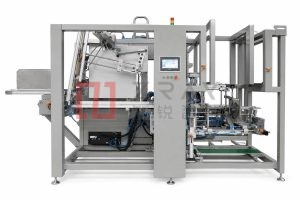
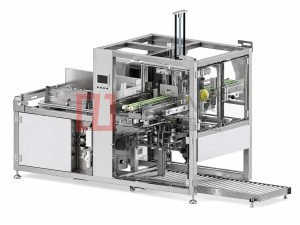
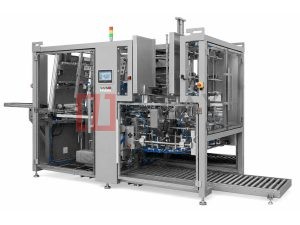
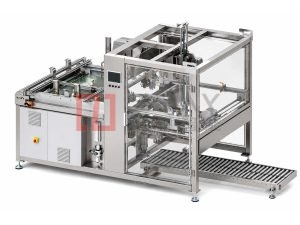
If your need is high volume and fixed sizes, the Double-Head High-Speed Case Former delivers 40 CPM with alternating forming heads and monitored vacuum. For 10-25 CPM in a compact footprint — or as the mechanical core of a cell that also has a robot for other duties — the Single-Piece Case Erector is the platform our integrators pair with robots for pick-and-place after the box is erected.
Five-Year Cost of Ownership
Capex is only the first line. Run a 5-year comparison at 25 CPM for 2 shifts (about 5,000 boxes/day, 1.25M boxes/year):
| Cost line (5 years) | Mechanical erector | Robot cell (same duty) |
|---|---|---|
| Machine capex | 1× | 1.5-3× |
| Line time losses from faults | ~1-2% | ~3-6% (single fault path, cell stop) |
| Maintenance labor | scheduled, low | robot service + vision tuning |
| Energy (boxes/kWh) | best-in-class | 3-5× worse per box |
| Operator skill premium | none special | programming-capable operator |
| Changeover cost | minutes, HMI-driven | zero mechanical, but program+vision time |
At 1.25M boxes/year the energy and downtime gap alone typically repays the mechanical machine’s advantage several times over — before you count the capex difference. If your box mix is truly random-size, the robot’s zero-changeover story can close that gap; if it is not, it cannot.
Make the Call With Numbers
Send us your box size range, target CPM, and number of SKUs, and we will give you an honest comparison for your line: mechanical cost and throughput versus what a robot cell would deliver. If a robot genuinely fits, we will tell you — we integrate them. If not, we will show you the numbers that say so.
Email [email protected] or WhatsApp +86 13681839278. A ZRAY engineer responds within 24 working hours, and the FAT is run on your own blanks before you pay the balance. You can also send your box size range and target CPM via our inquiry page.
Want To Know More About Our Upgraded Machines?
Send your carton specifications and output demand, our engineer will provide free technical scheme & quotation
Latest Products
Subscribe To Get Latest News & Technical Guides
Leave your business email to receive free industry articles and new product updates