
Squareness Issues in Carton Erecting: Top Causes and ZRAY Servo Drive Fixes (90° ± 0.5°) | ZRAY
An out-of-square box is the most expensive defect an erector can produce, because it fails downstream — in the packer, the palletizer, or the customer’s dimensional check — where the cost is five to ten times the box itself. In our field experience the same five causes produce 90% of squareness complaints, and every one of them is a mechanics or control problem that a servo drive either eliminates or exposes. This article ranks those causes, then shows how ZRAY servo-driven erectors hold 90° ± 0.5° on the finished box.
The Five Causes, Ranked by Frequency
1. Fixed-stroke folding on varying board. A pneumatic cylinder or cam folds to a fixed position. Board caliper drifts 0.2–0.4 mm through the day (moisture, roll changes), so a fixed fold lands short or long against the score. Result: corners that open or over-rotate, worse on double wall.
2. Mechanical backlash and wear. Linkage pins, cam followers, and guide shoes accumulate play over millions of cycles. The first 0.5 mm of slack shows up as a corner gap — and it grows.
3. Crease depth mismatch. Fold radius depends on crease depth versus board caliper. Shallow crease on thick board = rounded, open corner. Deep crease on thin board = torn liner, weak corner.
4. Release before the seal sets. If the formed box leaves the mandrel before the glue or tape has taken, the corner springs open. Most visible on double-wall board where glue cure is slower.
5. Inconsistent vacuum on the fold. A blocked or worn cup under one panel pulls unevenly during the fold, skewing the blank by a few tenths of a millimeter.
Why a Servo Drive Fixes All Five
A servo drive is not a stronger cylinder; it is a closed-loop position and torque controller that executes a programmed motion profile every cycle. That changes the failure modes above into adjustable parameters:
- Cause 1 → programmable stroke. Servo fold position is stored per SKU in the recipe. When the afternoon board runs 0.3 mm thicker, the operator recalls the matching recipe and the fold lands exactly on the score. No mechanics to touch.
- Cause 2 → no backlash to wear. A direct-drive servo through a precision coupling has no linkage pins to wear out. Positional repeatability holds at ±0.05 mm over the machine’s life, not until the first wear period.
- Cause 3 → programmable crease pressure. The servo’s torque profile sets crease depth as a function of board caliper. Thick board gets deeper crease, thin board gets lighter pressure, all inside the recipe.
- Cause 4 → programmable dwell. The servo holds the mandrel at the fold position for a set dwell while the seal sets. Release timing is a number in the HMI, not a spring setting.
- Cause 5 → monitored vacuum per station. With servo control, the fold sequence waits for the vacuum confirmation signal from each station. A weak station faults the cycle instead of folding a skewed blank.
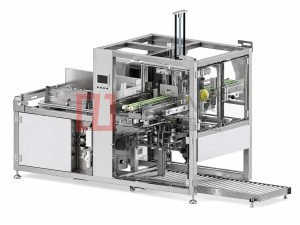
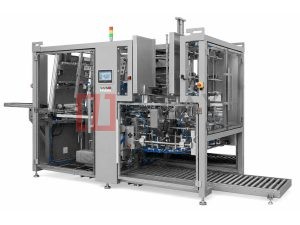
On a ZRAY machine the forming head is a servo-driven assembly, not a cast block with an air cylinder behind it. The Single-Piece Case Erector runs this head as standard, and the same forming technology scales to the Double-Head High-Speed Case Former where both heads hold the same tolerance at up to 40 CPM each.
Technical Reference: Squareness Parameters
| Parameter | Value |
|---|---|
| Corner angle tolerance | 90° ± 0.5° |
| Servo positional repeatability | ±0.05 mm |
| Servo torque resolution | 0.1 N·m steps |
| Crease depth control | Per-recipe, 0.1 mm steps |
| Fold dwell range | 0.1–2.0 s, 0.05 s steps |
| Board thickness range | 1.5–7.0 mm |
| Air pressure | 0.5–0.7 MPa |
| Hot-melt tank temp | 150–170 °C |
| Changeover per recipe | 3–5 min |
Field verification method: form five boxes from one bundle, hold a 500 mm try-square on each corner, measure the gap with a feeler gauge. On a correctly set servo erector the maximum gap on any of the 20 corners is 1.5 mm, which equals roughly 0.4° of angular error. If you see more, work down the cause list — but on a servo machine you will usually find the answer in the recipe, not the mechanics.
How Squareness Fails Downstream
Before tuning anything, know what a skewed box actually costs:
- Case packer infeed: 2 mm of skew on the leading edge rotates the box on the conveyor and jams the packer gate — 5–10 minutes of clearing per jam.
- Flap closing: skewed side walls mean top flaps do not meet; the taper runs over a gap or the glue seam misses the flap edge.
- Palletizing: 2 mm of corner drift per box becomes 15–20 mm of lean at the top of a 10-box stack.
- Customer dimensional checks: an automated checker reads the skewed box as out-of-tolerance — rework or a claim.
PLC Alarms for Squareness Problems
Alarm: Box Not Formed
- Check the active recipe size against the actual blank in the magazine.
- Verify crease depth is set for the current board caliper — measure the bundle with a micrometer first.
- Confirm the vacuum confirmation signal from all fold stations; a weak station trips the cycle.
Alarm: Vacuum Low
- Check the vacuum generator filter — dust plugs it in humid seasons.
- Inspect cup lips; one torn lip drops the pick pattern on that station.
- Verify the vacuum reading at the manifold, not only the gauge.
Alarm: Servo Overload / Servo Error
- Read the servo drive error code on the HMI; log it — this is the diagnostic trail.
- Check for a mechanical bind: jammed blank, seized guide, or debris in the fold path.
- Verify the servo parameter file matches the installed head; a wrong file trips overload on heavy board.
The servo error log is the under-used gold on these machines. Every overload event is stored with a timestamp; a pattern of the same error code at the same cycle position points straight at the mechanism that needs attention.
Servo Tuning in the Field: What a Service Visit Actually Changes
When a ZRAY engineer visits a line with squareness problems, the sequence is always the same, and it rarely involves a wrench:
- Pull the servo error log from the HMI. The timestamped history shows whether the fault is mechanical (same code, same cycle position) or recipe-based (codes moving between cycles).
- Measure the board at the magazine with a micrometer, and compare against the active recipe’s caliper setting. A 0.3 mm drift is the single most common find.
- Adjust the recipe, not the mechanics: crease depth by 0.1–0.3 mm, fold dwell by 0.1 s, release timing by 20–50 ms.
- Run five test boxes and measure with the feeler gauge; log the result in the maintenance file.
A pneumatic machine with the same problem gets a different visit: wedges, shims, and an air-pressure change — each of which masks the next problem. The servo machine’s fix is a data change that the next shift can read off the HMI, repeat, and own. That is why service calls on servo lines end in documentation, not in “we adjusted it and hope it holds.”
Maintenance That Protects Squareness
| Interval | Task |
|---|---|
| Daily | Wipe the mandrel surface; verify no debris on crease bars; check guide gaps |
| Weekly | Measure mandrel land with the calibration gauge; check servo coupling tightness; inspect cup lips |
| Monthly | Verify crease depth against actual board; test safety interlocks; check servo belt tension (if belt-driven) |
| Quarterly | Grease slides; inspect guide wear strips; calibrate glue nozzle position |
| Semi-annual | Full mandrel wear check; electrical cabinet torque check; run a full test box |
Common Mistakes That Make Squareness Worse
- Raising air pressure to push the fold harder. Pressure belongs at 0.5–0.7 MPa for the board, not for the symptom. Higher pressure on a pneumatic assist makes the fold faster, not straighter — on double wall it can crack the liner.
- Shimming one corner to fix skew. Masking wear on one side builds the skew into every subsequent box. Fix the guide clearance and the servo position, then re-measure.
- Editing crease depth without measuring board. Crease depth means nothing without the actual caliper of the bundle. Measure first, then adjust, then re-test.
Verdict
Squareness failures come from five known causes, and a servo-driven forming head converts each one into a programmable parameter instead of a mechanical fight. The result is a box that is the same box all day: 90° ± 0.5° on every corner, whether the board reads 2.7 mm or 3.1 mm.
Chasing open corners right now? Send a photo of the affected box, your board spec, and the active recipe settings. ZRAY engineers reply within 24 working hours and can run a remote diagnostic to walk your team through the cause list.
- Email: [email protected]
- WhatsApp: +86 13681839278
- Inquiry page: Contact ZRAY about Squareness and Servo Control
Want To Know More About Our Upgraded Machines?
Send your carton specifications and output demand, our engineer will provide free technical scheme & quotation
Latest Products


Subscribe To Get Latest News & Technical Guides
Leave your business email to receive free industry articles and new product updates