
Automated Case Formers Cut End-of-Line Labor Costs: 1 Operator Replaces 3 at 40 CPM | ZRAY
Walk to the end of most packaging lines and count the people. In a mid-size plant you will find one operator forming cases by hand, one sealing them, and one feeding the palletizer — three people doing a job a single machine does at 35–40 CPM. The labor line item on the P&L hides this, because it is spread across shifts, overtime, and turnover. But the number is real, and it is one of the largest controllable costs in end-of-line packaging.
A manual case-forming station processes roughly 8 to 15 cases per minute with an experienced operator, and that rate drops as the shift wears on, as board quality varies, and as the operator rotates. An automated case former holds 40 CPM for the entire shift on the same board. The math is not close. This article breaks down the labor cost model, the manning comparison, and the machine specs that make the headcount reduction stick without creating a new bottleneck downstream.
The True Cost of Manual Case Forming
Start with the hourly rate — not the gross wage, but the fully loaded cost. In the EU and North America, a loaded packaging operator runs USD 18–28 per hour including taxes, benefits, and shift premiums. In CIS markets the range is lower, but overtime and night-shift multipliers close part of the gap. Use your own loaded rate; the structure below stays valid.
The real cost is not the wage. It is the people-to-output ratio:
| Scenario | Operators at the end of line | Cases per hour | Cases per operator-hour |
|---|---|---|---|
| Manual forming + manual sealing | 3 | 480–900 | 160–300 |
| Manual forming, semi-auto sealer | 2 | 900–1,200 | 450–600 |
| ZRAY automated former + sealer | 1 (supervising 2 lines) | 2,400 (one line) | 2,400 |
| Double-head automated, 2 lines | 1 (monitoring) | 4,800 | 4,800 |
At a loaded rate of USD 22/hour, a three-person end-of-line crew costs USD 528 per 8-hour shift, USD 158,400 per year at two shifts. Replacing two of those positions with one automated former and one supervisor drops the annual labor cost to about USD 52,800 — a saving of USD 105,600 per year per line, before overtime and turnover costs.
Here is the shift math at 40 CPM for a plant running 16 hours a day:
| Variable | Manual (3 people) | Automated (1 supervisor) |
|---|---|---|
| Loaded labor per hour | USD 66 | USD 22 |
| Cases formed per shift | 6,400–9,600 | 19,200 |
| Labor cost per 1,000 cases | USD 6.90–10.30 | USD 1.15 |
| Annual labor per line (300 d × 16 h) | USD 316,800 | USD 105,600 |
| Overtime incidents | Weekly | Rare |
The labor cost per 1,000 cases drops by 6–9×. That is the number to take to the capex committee, and it ignores the output gain, which is arguably the bigger win.
Why Automation Does Not Just Replace Hands
An automated case former does more than replace muscle. It removes the variance that manual forming injects into the line. A tired operator forms cases slightly out of square; the flap catches the sealer; a half-sealed case reaches the palletizer; the layer pattern shifts; the pallet leans. Each of those events costs labor time to fix somewhere downstream.
A ZRAY case former holds geometry to the board spec:
- Forming accuracy: crease set depth controlled to ±0.3 mm
- Squareness: box diagonal within ±2 mm on every cycle
- Rate: 35–40 CPM continuous on RSC board, single head
- Changeover: under 15 minutes, tool-free rail adjustment
Because the machine forms every case the same way, the sealer and palletizer stop eating labor. The supervisor’s job becomes monitoring, not fixing. That is the difference between a labor reduction of 2 people and a labor reduction of 2 people plus a downstream repair backlog that does not exist anymore.
Machine Specifications That Matter for Manning
When you size the machine, the specs that decide whether one person can supervise two lines are the ones below. Compare any quote against these values.
| Parameter | ZRAY single-head | Notes |
|---|---|---|
| Speed | 35–40 CPM | RSC, B/C flute, 300–400 gsm board |
| Box size range (L × W × H) | 200–600 × 150–500 × 120–600 mm | Tool-free rails |
| Air pressure | 0.5–0.7 MPa | Dedicated receiver recommended |
| Air consumption | 200–300 L/min | Shared rings need a buffer tank |
| Hot-melt tank temp | 150–170°C | If taping, no glue station |
| Changeover time | < 15 min | No tools for rails and guides |
| Control | Siemens PLC | Schneider safety, SMC pneumatics |
The box size range matters for manning because it defines how often the supervisor must physically touch the machine. If your product mix spans the full range, choose a former with quick rail locking so changeover stays under 15 minutes. That keeps one supervisor feasible even with three SKUs per shift.
Board Grades That Keep the Line Running Hands-Off
The machine holds its rate only if the board holds its spec. Use these grades as the baseline for your RFQ and reject any blank supplier who cannot hold crease tolerance:
| Board | Thickness | Basis weight | Typical use |
|---|---|---|---|
| Single-wall B flute | 2.5–3.0 mm | 200–320 gsm | Light e-commerce and beverage |
| Single-wall C flute | 3.5–4.0 mm | 280–400 gsm | Standard shipping RSC |
| Double-wall BC | 6–7 mm | 500–700 gsm | Heavy appliances, bulk liquid |
| Double-wall EB | 4.5–5.5 mm | 400–550 gsm | Produce, food service |
Specify burst strength and crease depth tolerance in the purchase order, not just thickness. We recommend a crease depth deviation of ±0.3 mm and a diagonal check of ±2 mm per blank. When board meets spec, the operator does not intervene, and the labor saving is real.
Alarm Handling Without a Dedicated Operator
The concern every plant manager raises is: “if there is only one supervisor and the former jams, who fixes it?” The answer is a machine that tells the supervisor what to do, and an alarm list short enough to learn in one shift. These are the alarms ZRAY logs most on automated lines, all operator-resolvable:
| Code | Alarm | Probable cause | Exclusion steps |
|---|---|---|---|
| AL-102 | Air Pressure Low | Regulator below 0.5 MPa; clogged SMC filter | Check main filter; drain water; replace O-rings on cylinder couplings |
| AL-204 | Vacuum Low | Blocked generator; worn suction cup | Blow out generator; replace cup; verify pick-up timing |
| AL-311 | Box Not Formed | Flap on forming horn; crease drift | Clear blank; measure blank ±1.5 mm; square magazine rails |
| AL-403 | Glue Temp Low | Heater below 150°C; contactor tripped | Wait for ramp to 150–170°C; reset contactor; check level |
With remote diagnostics, the supervisor gets the ZRAY engineer on a video call when a code repeats. In our experience, more than 80% of repeats on automated lines are resolved remotely within the hour, without a site visit.
Maintenance Schedule for a One-Supervisor Line
The fewer people on the line, the more the machine must look after itself. This is the schedule we hand over with every automated former, tuned for two-shift operation:
| Interval | Task | Detail |
|---|---|---|
| Daily | Clean vacuum cups, drain air filter | 5 minutes; prevents AL-204 and AL-102 |
| Daily | Verify sensor faces clean | Photo-eyes at magazine exit and discharge |
| Weekly | Grease erecting arm pivots | 3–4 shots lithium grease per pivot |
| Weekly | Check belt tension | 3 mm deflection at mid-span |
| Monthly | Inspect hot-melt nozzles | Bead width vs. start-up standard; clean if needed |
| Monthly | Check splice plate / tape path (taping) | Remove dust and residue |
| Quarterly | Calibrate forming depth | Step 0.2 mm adjustments to board grade |
| Half-year | Replace feed belts and cups | Regardless of visible wear |
| Half-year | Full pneumatic audit | Cylinder seals, solenoid valves |
The daily tasks are 10 minutes total and fit inside the supervisor’s routine between monitoring rounds. Keep a spare kit with two cups, one belt set, solenoid coils, and nozzle seals — it covers 90% of the repairs that would otherwise call the supervisor away from the second line.
Where the Double-Head Machine Earns Its Keep
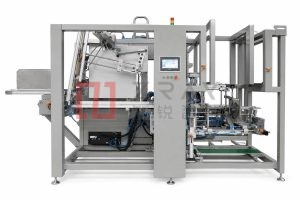
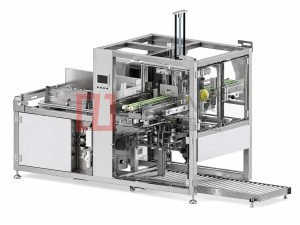
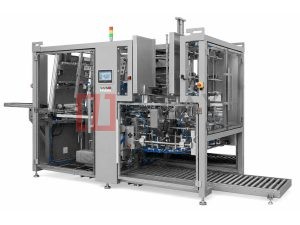
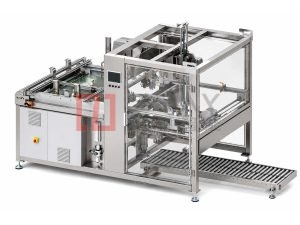
When two filling lines share one end-of-line area, the manning case for automation gets even stronger. One Double-Head High-Speed Case Former running two heads at 35–40 CPM each replaces the case-forming labor for both lines with a single machine and a single supervisor. You keep one operator on the floor watching two streams instead of three operators on one.
For a plant that does not yet have the volume for a double head, the Single-Piece Case Erector is the standard first step: one machine, 40 CPM, the same alarm and maintenance regime, and a footprint that fits a retrofit into an existing line without moving the palletizer.
If you process over 500,000 cases per year across two shifts, explore our Automatic High-Speed Case Former Series — the manning math is where this series pays for itself fastest.
The Payback Sheet
Use this simple payback model when you present the capex. It is deliberately conservative — it ignores overtime, turnover, training, and downstream repair savings.
| Line item | Value |
|---|---|
| Loaded rate per operator (assumed) | USD 22/h |
| Operators removed per line | 2 |
| Annual labor saved (2 shifts, 300 days) | USD 105,600 |
| Additional output at 40 CPM (optional) | Up to 9,600 cases/shift vs. manual |
| Est. payback on a single-head former | 12–24 months |
| Est. payback on a double-head (2 lines) | 9–18 months |
Payback inside 2 years is the rule, not the exception, when labor cost per 1,000 cases is the metric. And unlike a headcount cut that creates overtime elsewhere, this saving compounds: fewer people, higher output, and a supervisor who has time to catch quality problems instead of creating them.
Bottom Line
End-of-line labor is one of the last places where packaging lines still pay three people to do one machine’s job. An automated case former at 40 CPM replaces two manual positions, cuts labor cost per 1,000 cases by 6–9×, and removes the forming variance that generates downstream repair labor. The machine specs are not exotic: 35–40 CPM, 0.5–0.7 MPa air, 150–170°C glue, under 15-minute changeover, and a short, operator-readable alarm list.
Every ZRAY case former ships with CE and EAC certification, a 12-month warranty, and remote diagnostics. We will run a remote video FAT so you can verify the 40 CPM rate on your own board before the machine is paid in full.
Want us to run the labor model on your actual line? Email [email protected] or message us on WhatsApp at +86 13681839278. Send us your shift count, loaded labor rate, and case dimensions, and our sales engineers will return a manning and payback sheet within 24 working hours.
Request a quotation — include your current end-of-line headcount and we will show you the labor cost per 1,000 cases before and after.
Want To Know More About Our Upgraded Machines?
Send your carton specifications and output demand, our engineer will provide free technical scheme & quotation
Latest Products
Subscribe To Get Latest News & Technical Guides
Leave your business email to receive free industry articles and new product updates