
Why Your Case Former Leaves Tape Gaps and How ZRAY Auto-Tension Heads Fix It (Gap ≤ 0.5 mm, Up to 40 CPM) | ZRAY
You run a case erector at line speed, then the packing station starts rejecting boxes because the bottom tape is lifting. Not a jamming problem, not a glue problem. A tape gap problem. And it is almost never the tape. It is the tension.
Tape gaps are the most reported “quality” fault on automatic case formers, and the least understood. Most lines chase them with tape brand changes and pressure roller tweaks, then call maintenance in. This article walks through the real failure chain, the physics of the pull, and the mechanical fix we ship on every ZRAY machine since 2019: the auto-tension tape head. If you see gaps wider than 0.5 mm at the bottom flap joint, read on before you touch the machine.
What a tape gap actually is
A tape gap is a segment where the adhesive tape does not fully cover the flap seam. It shows up in three places:
- Center gap – the tape bridges the seam but wrinkles or lifts at the center fold line.
- Edge lift – the tape covers the flap but peels at either edge within hours.
- Full separation – the tape never bonds; the box opens on the conveyor.
All three cost you the same thing: rejected boxes, re-taping labor, and downtime. On a 25 CPM line that is roughly 1,500 boxes per hour, even a 1% gap rate puts 15 boxes an hour back on the bench.
Root causes, ranked by how often we actually see them in the field
We log every service ticket ZRAY engineers run remotely or at the customer site. Here is the real ranking, not the theory:
- Uneven tape tension across the roll – most common. Brake pads or friction clutches grab harder at the end of a roll than at the start. The tape stretches, relaxes, and pulls away from the box within 30-60 minutes.
- Brake pad contamination – dust and cardboard fibers get into a friction brake, the pull becomes jerky, and the tape feed length varies from box to box.
- Dull or chipped cutter blade – the blade tears instead of cuts, leaving a ragged tape end that does not seat into the brush/wipe-down section.
- Worn pressure rollers or brushes – after 6-12 months the roller surface hardens and the brush bristles collapse, so the tape is laid but never pressed into the corrugation valleys.
- Tape core slipping on the mandrel – when tension spikes, the inner wrap spins on the core instead of the roll unwinding cleanly.
- Board moisture swings – high-humidity board (above 60% RH storage) traps moisture in the flute, and solvent or water-based tape adhesive does not wet out on the surface.
You will notice tape brand is not on the list. Tape quality matters, but a machine that cannot hold constant tension will produce gaps on premium tape too. We have proven this in our own test bay.
How ZRAY auto-tension heads fix the root cause
The auto-tension head replaces the passive friction brake with a spring-loaded dancer arm plus a damped tension roller. Instead of a fixed clamp force, the dancer arm reads the actual tape web tension 20 times per second and modulates the brake through an air regulator. The result is a constant pull across the full roll diameter, from a full 1,000 m roll down to the last 30 m.
What changes on your line:
- Gap width held under 0.5 mm across the entire roll life – measured at the bottom flap joint on a C-flute 3.5-4.0 mm board at 25 CPM.
- No re-tensioning at roll change – the head self-compensates, so your operator does not have to guess the brake setting.
- Cutter blade life improves because the web is not snapping loose at the cut point.
On our high-speed frame, the same head runs at up to 40 CPM without the “tape whip” you get from a mechanical brake at speed.
Reference data: ZRAY auto-tension tape head
| Parameter | Value | Notes |
|---|---|---|
| Tape width supported | 38-75 mm | BOPP and kraft paper tape |
| Roll diameter | up to 1,000 m / 400 mm OD | core 76 mm standard |
| Gap tolerance at 25 CPM | ≤ 0.5 mm | C-flute board, 3.5-4.0 mm |
| Gap tolerance at 40 CPM | ≤ 1.0 mm | high-speed frame, short flap |
| Tension control loop | dancer arm + air brake, 20 Hz | no manual brake adjustment |
| Cutter blade | tungsten-coated, 500,000+ cycles | replace as a set |
| Compressed air | 0.5-0.7 MPa | same supply as machine |
The PLC alarms you will hit before the fix, and how to clear them
If your machine still uses a passive brake, these alarm codes are the ones you will see in the control panel log. Clear steps are what we give every ZRAY service engineer.
| Alarm code | Meaning | Fix steps |
|---|---|---|
| TP-101 TAPE TENSION LOW | dancer arm reads low web pull, brake not gripping | 1. Check air pressure to brake regulator (0.5-0.7 MPa). 2. Inspect brake pad for fiber contamination; clean with dry air. 3. Verify tape core is seated, not slipping. 4. Recycle power after confirming no mechanical jam. |
| TP-102 TAPE CUT FAIL | cutter sensor did not see the web break | 1. Inspect blade for chips; replace if edge is nicked. 2. Check blade dwell time in HMI (default 120 ms). 3. Clear tape scraps under the cutting shoe. 4. Run a single-cycle test before resuming auto mode. |
| TP-103 TAPE SPLICE ERROR | splice sensor triggered during run | 1. Pause line, remove spliced segment. 2. Verify splice is straight and flap-free. 3. Reset sensor count in PLC. 4. Never run unspliced overlaps through the head. |
| GL-201 GLUE TEMP LOW | on tape-plus-glue machines, hot melt below setpoint | 1. Check heater and thermocouple. 2. Set target 150-170 deg C, wait 15 min for soak. 3. Purge nozzle before restart. |
Rule of thumb from the field: if TP-101 appears more than twice a week on a passive-brake machine, the brake is not the problem – the whole head assembly is. It is cheaper to retrofit the auto-tension head than to keep paying overtime for re-taping.
The gap-check routine for quality engineers
Set this up as a 15-minute check at the start of each shift:
- Pull five consecutive boxes off the outfeed.
- Inspect both bottom flap seams and both top seams for gaps over 0.5 mm.
- Run a fingernail test along the seam edge – the tape must not lift.
- Check the box top flap for tape overhang past the edge (over 3 mm means the cut timing is drifting).
- Record results in the shift log; if two of five fail, stop the line and check the tension head.
This catches the problem inside 30 minutes of its start, not after the customer’s QC does.
Maintenance schedule that keeps the head consistent
| Interval | Action |
|---|---|
| Daily | Wipe dancer arm pivots; check tape path for fiber build-up; log gap check results |
| Weekly | Blow out brake area with dry air; inspect blade edge under a light; verify air pressure at brake regulator |
| Monthly | Check dancer arm spring free-play (target < 1 mm); inspect pressure rollers for hardening; replace brushes if bristles collapse |
| Quarterly | Clean and re-grease head pivots; measure gap distribution over a 100-box run and compare to baseline |
| Semi-annual | Replace cutter blade set; inspect brake diaphragm; recalibrate dancer arm sensor position |
Put this schedule next to the machine, not in a drawer. The 20 minutes a week it costs is less than one rejected pallet.
What to check before you blame the machine
If you are not ready to change the head yet, run this 10-minute sequence first:
- Measure the board: C-flute should be 3.5-4.0 mm, B-flute 2.5-3.0 mm, single wall. Board thicker than spec compresses in the forming section and the tape seam shifts.
- Check roll storage: tape stored above 30 deg C or in direct sun develops curl; a curled roll cannot lay flat regardless of tension.
- Verify flap pressure: the flap closer must hold the flap for 300-400 ms before the tape head fires. Too short and the seam opens under the tape.
- Watch a slow-motion cycle: most root causes are visible in one slow cycle – watch the web as it leaves the roll and enters the head.
If all four pass and you still see gaps, the head design is the constraint. That is the point where a retrofit makes sense, and it is the point where we see the strongest ROI numbers.
When the fix pays for itself
A beverage line we serviced ran 2,400 boxes per hour with a 1.2% gap rate. Each gap cost them roughly $0.18 in labor and re-taping material, plus rejected-box write-offs. At 19,200 boxes per shift that is 230 gaps and about $40 in direct cost per shift, before lost throughput. The auto-tension head eliminated the pattern within two days and the machine paid back in a quarter.
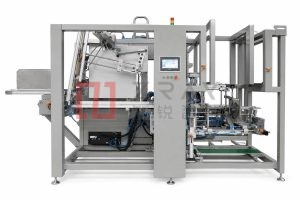
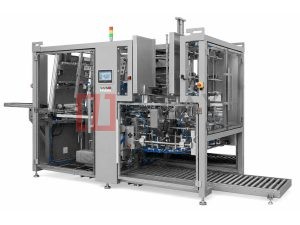
For plants processing over 500,000 cases per year, the same tape head logic is the difference between a “good enough” sealer and a stable line. If your volumes are there, look at the Automatic High-Speed Case Former Series and its built-in auto-tension sealing station.
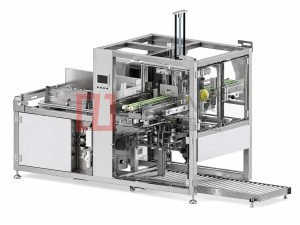
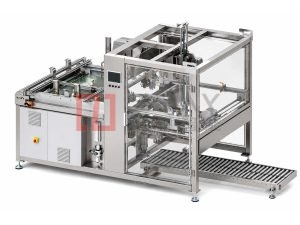
For smaller plants running one shift on a compact frame, the auto-tension head is available as a standard option on the Single-Piece Case Erector, so you do not need a high-speed frame to get the fix.
Final numbers to take to your maintenance meeting
- Target gap tolerance: ≤ 0.5 mm at 25 CPM, ≤ 1.0 mm at 40 CPM.
- Check interval: 15 minutes per shift, 5 boxes.
- Maintenance cost: about 20 minutes per week for the whole head.
- Payback: typically one quarter on lines with a gap rate above 1%.
Tape gaps are a tension problem, not a tape problem. Fix the tension and the gaps disappear. ZRAY builds the auto-tension head into every case erector we ship, and we can retrofit it onto third-party frames that share the standard mounting pattern. If you want the retrofit drawing pack or a remote diagnosis of your current head, send us your machine data and your top three alarm codes from the shift log.
Get a quote or a retrofit assessment within 24 working hours. Email us at [email protected] or message us on WhatsApp +86 13681839278. Include your machine model, line speed in CPM, and current tape gap photos. Our sales engineers will walk the failure data with you and, if needed, join a remote diagnostic session with the PLC log open. You can also submit your details through our contact page – every inquiry gets an answer from an engineer, not a sales bot.
Want To Know More About Our Upgraded Machines?
Send your carton specifications and output demand, our engineer will provide free technical scheme & quotation
Latest Products
Subscribe To Get Latest News & Technical Guides
Leave your business email to receive free industry articles and new product updates